
NEW YORK, August 6, 2026, 06:04 EDT
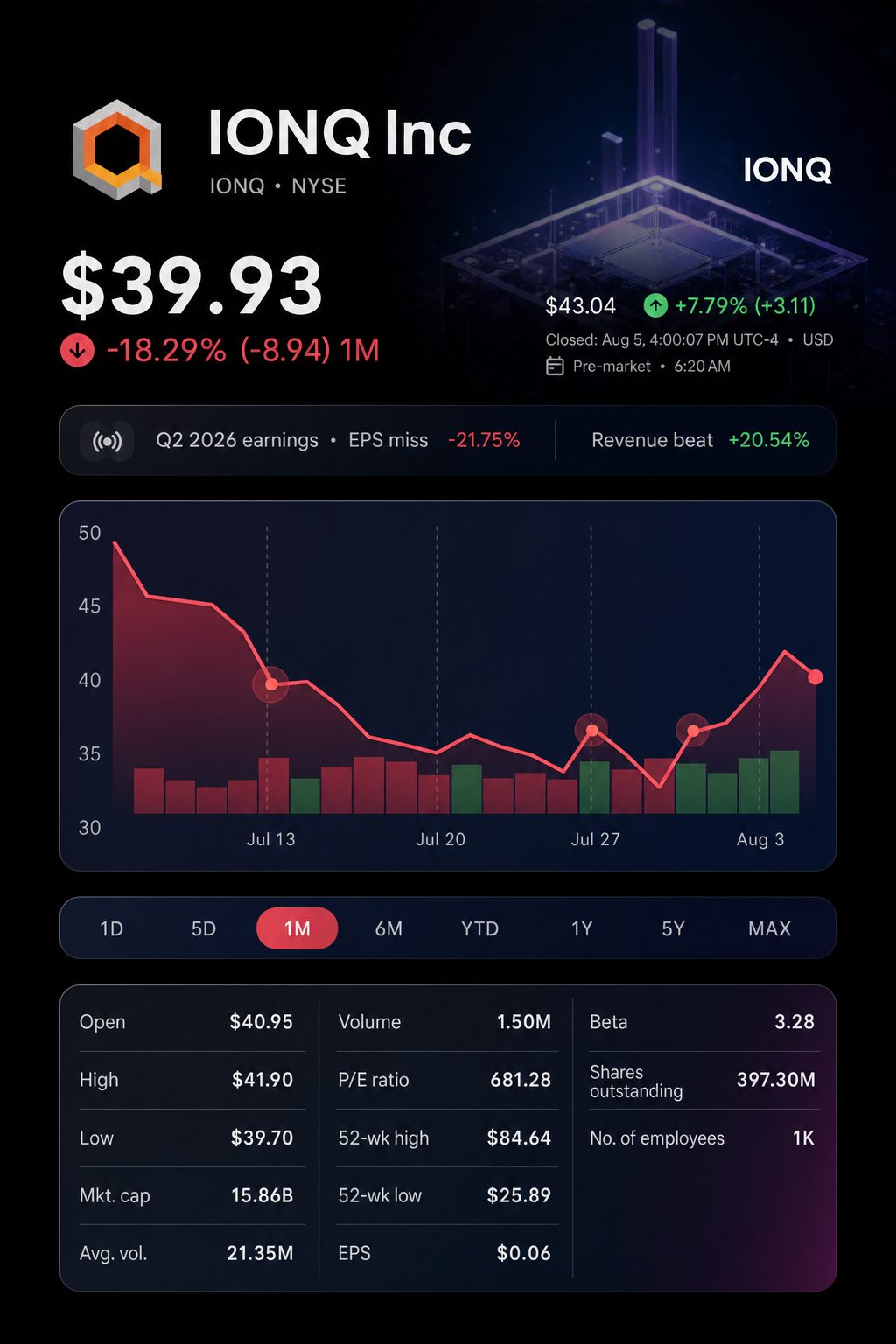
- IonQ traded at $43.49, up 8.9% in Thursday’s premarket session.
- The guidance midpoint requires $140.3 million of second-half revenue, below the first-half result.
- Jefferies kept its Buy rating but cut its target to $75.
IonQ Inc. NYSE:IONQ shares rose 8.9% to $43.49 before Thursday’s open. The move followed record second-quarter revenue and another forecast increase. Shares had closed Wednesday down 4.3% at $39.93.
The new outlook carries a modest second-half revenue hurdle. At the $285 million midpoint, IonQ needs $140.3 million from July through December. That is 3.1% below its $144.7 million first-half revenue, based on company data and reporter calculations.
That changes the near-term investment debate. The sales target no longer requires second-half acceleration. Margins, cash use and acquisition integration now carry more weight.
Revenue reached $80.1 million, rising 287% from one year earlier. It beat Wall Street’s $66.5 million estimate by about 20%. Chief Executive Niccolo de Masi called it the “strongest quarter” in IonQ’s history. IonQ
Second-quarter scorecard
| Metric | Q2 reported | Comparator | Difference |
|---|---|---|---|
| Revenue | $80.1 mln | Street: $66.5 mln | +$13.6 mln |
| Adjusted EPS | -$0.33 | Street: -$0.56 | $0.23 better |
| Adjusted EBITDA | -$120.3 mln | Q2 2025: -$36.5 mln | Loss widened $83.8 mln |
| GAAP net loss | -$1.868 bln | Q2 2025: -$177.5 mln | Loss widened $1.691 bln |
| Cash and investments | $3.0 bln | Post-SkyWater pro forma: $2.0 bln | $1.0 bln lower |
Company figures are unaudited. Street estimates came from Barron’s.
The GAAP loss included a $1.65 billion warrant-liability fair-value charge. Adjusted EBITDA included $24.7 million of SkyWater-related research spending. Excluding that spending, the adjusted EBITDA loss was $95.6 million.
IonQ said international customers generated about half of quarterly revenue. Commercial customers represented 60%, while multi-product sales contributed 25%. Those categories overlap and should not be added together. Chief Financial Officer Inder Singh said the “revenue base is broadening.” IonQ
Revenue growth versus cost pressure
| Metric | Q2 2026 | Q2 2025 | Change |
|---|---|---|---|
| Revenue | $80.05 mln | $20.69 mln | +287% |
| Cost of revenue, excluding D&A | $60.11 mln | $8.33 mln | +622% |
| Gross-margin proxy, excluding D&A | 24.9% | 59.8% | -34.9 points |
| Research and development | $160.63 mln | $103.36 mln | +55% |
| General and administrative | $117.57 mln | $48.11 mln | +144% |
| H1 operating cash use | $254.78 mln | $85.60 mln | +198% |
Percentage changes and the gross-margin proxy are reporter calculations. The proxy subtracts reported cost of revenue, which excludes depreciation and amortization.
Cost of revenue therefore grew more than twice as fast as sales. The calculated margin proxy is not a company-reported non-GAAP measure. It still highlights the main issue beneath the revenue beat.
IonQ lifted its annual revenue range to $280 million-$290 million. The previous range was $260 million-$270 million. February’s initial outlook was $225 million-$245 million. The latest forecast excludes any contribution from the completed SkyWater acquisition.
2026 revenue bridge
| Stage | Revenue amount | Comparison |
|---|---|---|
| Initial guidance midpoint, February | $235.0 mln | — |
| Post-Q1 midpoint, May | $265.0 mln | +$30.0 mln |
| Post-Q2 midpoint, August | $285.0 mln | +$20.0 mln |
| First-half actual revenue | $144.7 mln | 50.8% of latest midpoint |
| Second-half revenue needed | $140.3 mln | 3.1% below first half |
| Average needed per H2 quarter | $70.1 mln | 12.4% below Q2 |
Revenue bridge uses the current guidance midpoint. Calculations are based on IonQ’s reported results.
Even the range’s high end needs only $145.3 million in second-half revenue. That is 0.4% above the first half. The low end requires $135.3 million, or 6.5% less.
IonQ also announced two U.S. government awards Thursday. DARPA extended an atomic-clock contract by $28 million for 125 units. IonQ will invest $15 million in production capacity. Its Capella division separately won an NRO radar-data contract, whose value was not disclosed.
The $1.8 billion SkyWater transaction closed on July 31. IonQ estimated post-deal cash and investments at about $2 billion. Excluding SkyWater from guidance preserves a clean standalone target, but delays a full view of combined margins.
Jefferies Financial Group NYSE:JEF lowered its IonQ target to $75 from $85. It retained a Buy recommendation. The firm described the report as strong and identified September’s analyst day as the next catalyst.
Selected analyst recommendations
| Date | Firm and analyst | Rating | Target | Action |
|---|---|---|---|---|
| Aug. 6 | Jefferies Financial Group NYSE:JEF | Buy | $75 | Cut from $85 |
| Aug. 3 | Wedbush — Matt Bryson | Outperform | $75 | Initiated |
| July 27 | Benchmark | Buy | $60 | Initiated |
| June 22 | Northland — Nehal Chokshi | Outperform | $70 | Raised from $55 |
| June 11 | Rosenblatt — John McPeake | Buy | $100 | Reiterated |
| May 7 | JPMorgan Chase NYSE:JPM — Peter Peng | Neutral | $50 | Raised from $42 |
The table shows selected published actions, not the full analyst universe.
A 14-analyst tracker showed nine Buy, four Hold and one Sell recommendation. Its average target was $70.71, with a $35-$100 range. Most listed targets predated the latest results.
Rigetti Computing Inc. NASDAQ:RGTI reports second-quarter results after Thursday’s close. Its figures will provide the next public comparison for quantum-sector demand and spending.
Risks: The margin proxy compressed sharply, while adjusted losses and operating cash use increased. IonQ’s remaining performance obligations also include unfunded contract portions. SkyWater reduces near-term liquidity and adds integration risk.
The premarket reaction rewards IonQ’s demand momentum. Further gains may require evidence that the lower second-half sales hurdle produces better margins, not merely another revenue beat.
Related articles: NYSE:IONQ