
SEOUL, August 8, 2026, 00:13 KST
- The Korea Exchange will remain shut on Saturday. Normal trading will restart at 09:00 KST on Monday, August 10.
- SK hynix Inc. KRX:000660 ended trading on Friday at 1,422,000 won, a decrease of 4.88%.
- Shares of its U.S. ADRs NASDAQ:SKHY fell 6.1% to $134.81 in late-morning trading in New York. Of analysts tracked, nine recommend Buy.
SK hynix’s market capitalization dropped by about 53.3 trillion won in Friday trading in Seoul, closely aligning with the 54.3 trillion won ($38.3 billion) fab initiative cleared on that day. The stock closed at 1,422,000 won.
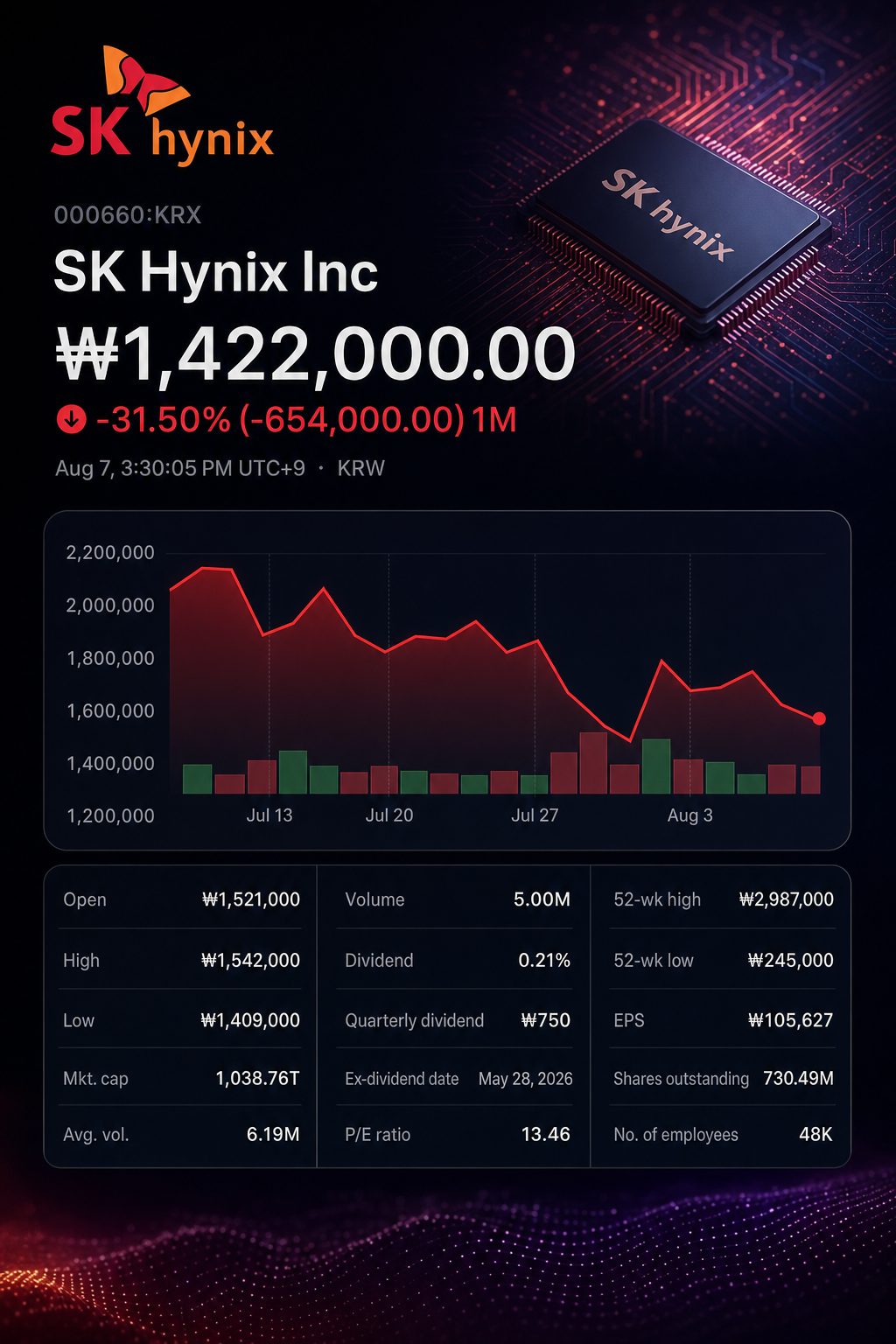
The comparison tracks scale, not the expenditures that led to Friday’s drop. Korean equities had already been weighed down by uncertainty around AI, selling by overseas investors, and stress from leveraged trading. Nevertheless, these figures highlight capital allocation as a key issue in the ongoing valuation discussion.
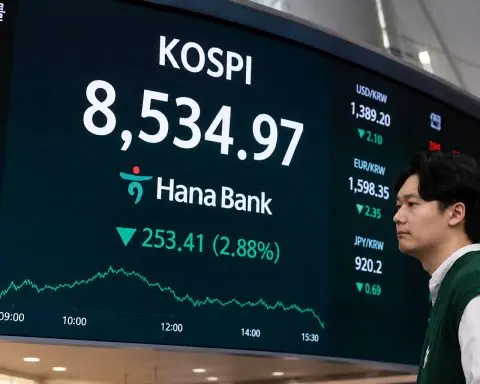
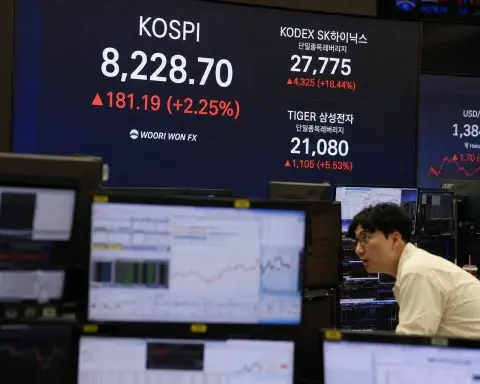
Between the close on July 31 and August 7, SK hynix dropped 17.2%, while shares in Samsung Electronics Co. KRX:005930 slipped 12.0%. The KOSPI shed 5.1%, logging a seventh consecutive weekly decline.
| Security or index | July 31 close | August 7 close | Friday move | Friday-to-Friday |
|---|---|---|---|---|
| SK hynix | ₩1,718,000 | ₩1,422,000 | -4.88% | -17.2% |
| Samsung Electronics | ₩262,500 | ₩231,000 | +0.22% | -12.0% |
| KOSPI | 6,595.45 | 6,258.77 | -0.60% | -5.1% |
Initial estimates below are based on 730.49 million shares in circulation. The 73,000-won drop on Friday resulted in an approximate loss of 53.3 trillion won. For the entire week, losses totaled around 216.2 trillion won, roughly quadruple the amount of new investment.
| Measure | Preliminary value | Comparison with fab budget |
|---|---|---|
| Market value drop on Friday | ₩53.3 trillion | 98% |
| Loss from July 31 to August 7 | ₩216.2 trillion | 3.98 times |
| Fab investment approved | ₩54.3 trillion | 100% |
| Market value at Friday close | ₩1,038.8 trillion | Capex accounts for 5.2% |
The board allocated the investment across two locations. Yongin Y2 is set to manufacture high-bandwidth memory as well as additional DRAM products. Cheongju M17 will increase NAND production capacity.
| Project | Main products | Investment | Construction start | First cleanroom |
|---|---|---|---|---|
| Yongin Y2 | HBM plus other DRAM | ₩35.2 trillion | July 2027 | June 2029 |
| Cheongju M17 | NAND flash | ₩19.1 trillion | February 2027 | December 2028 |
The specified dates cap the short-term impact on supply. SK hynix is also aligning cleanroom expansions and equipment setups with customer requirements. Omdia forecasts annual growth of 19% for both DRAM and NAND demand from 2025 to 2030. President Song Hyun-jong stated last week that “major customers are still requesting more memory supply.” SK hynix Newsroom
The immediate focus is on cash distribution. On Friday, SK hynix announced that it is actively considering further returns to shareholders. The company plans to provide more information in the third quarter and has announced a dividend of 375 won per share.
SK hynix and Samsung both have goals to provide shareholders with returns amounting to 50% of their free cash flow. In June, Micron Technology Inc. NASDAQ:MU committed to distribute 100%. Samsung has stated that additional information about its policy will be shared “very soon.” Reuters
| Company | Free-cash-flow return yardstick | Latest signal |
|---|---|---|
| SK hynix | 50% | Further actions are being considered; Q3 announcement pending |
| Samsung Electronics | 50% | Policy revision anticipated shortly |
| Micron Technology | 100% | Pledge made public in June |
Richard Clode, a portfolio manager with a fund that holds SK hynix shares, stated that a policy near 50% could result in what he described as an “incredibly inefficient balance sheet.” He advocated for a minimum return of 80%. Equities executive Aadil Ebrahim commented that investment and shareholder returns were “not a binary choice.” Reuters
Broker sentiment is significantly more bullish than current market valuation. According to Google Finance, all nine analysts tracked have Buy recommendations, with no Holds or Sells reported. The consensus average target price for the ADR stands at $245.50, with projections spanning from $200 to $320.
| Analyst | Recommendation | Price target | Report date |
|---|---|---|---|
| Kevin Cassidy | Buy | $320 | August 4 |
| C.J. Muse | Buy | $300 | August 4 |
| Simon Coles | Buy | $300 | July 30 |
| Brian Chin | Buy | $240 | August 4 |
| Nicolas Gaudois | Buy | $204 | July 30 |
| Quinn Bolton | Buy | $200 | August 4 |
| Chris Caso | Buy | $200 | August 4 |
| Srini Pajjuri | Buy | $200 | August 4 |
| Sebastien Naji | Buy | — | August 4 |
Based on late-morning Friday ADR levels, the average price target indicates a potential upside of roughly 82%. This divergence is notable. Analysts are forecasting prolonged HBM dominance, while investors seek more immediate evidence on margins and cash flow.
Skepticism existed before Friday’s investment announcement. SK hynix posted all-time high operating profit for the second quarter last week, though results were below expectations. DRAM price growth was constrained by delayed shipments of certain advanced products, prompting the local shares to decline 9.6% following the report.
The drop in U.S. ADRs signals a weak start for Seoul trading on Monday. Actual cleanroom capacity from these projects will not come online for over two years. As a result, attention this week is likely to center on payout forecasts, market leverage, and how management times spending according to demand.
Risks exist on both sides. AI infrastructure investment may weaken. SK hynix might experience HBM market share losses, construction overrun risks, or another slump in NAND. Conversely, higher memory prices and increased payouts have the potential to prompt a significant rebound.
The facilities reflect SK hynix’s strategic outlook. The upcoming shift in valuation could depend on a more immediate issue: the amount of cash returned to shareholders before the cleanrooms become operational.
Related articles: KRX:000660