
SEOUL, July 29, 2026, 17:25 KST — Regular trading concluded; after-hours markets stayed active.
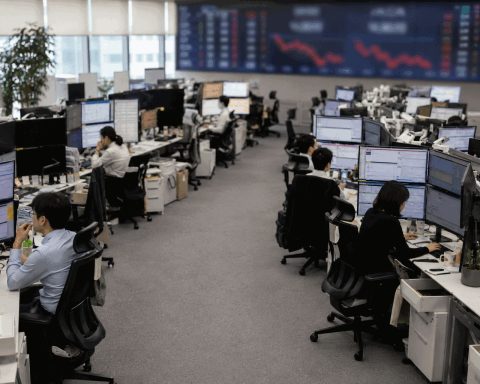
- The KOSPI ended down 6%, following an almost 11% drop on Tuesday. Over two sessions, the index lost about 16%.
- SK Hynix reported preliminary revenue and operating profit that were around 5.6% and 5.4% below estimates. Its stock slipped 9.6%.
- Shares of Samsung Electronics KRX:005930 dropped 5.2%. Taiwan Semiconductor Manufacturing TPE:2330 was down 3.5%, reflecting intensified pressure in Korea.
South Korea’s AI-driven stock rally faced a sharp pullback on Wednesday, as the KOSPI tumbled up to 12.6%, prompting a 20-minute pause in trading. The index ultimately ended the session down 6%.
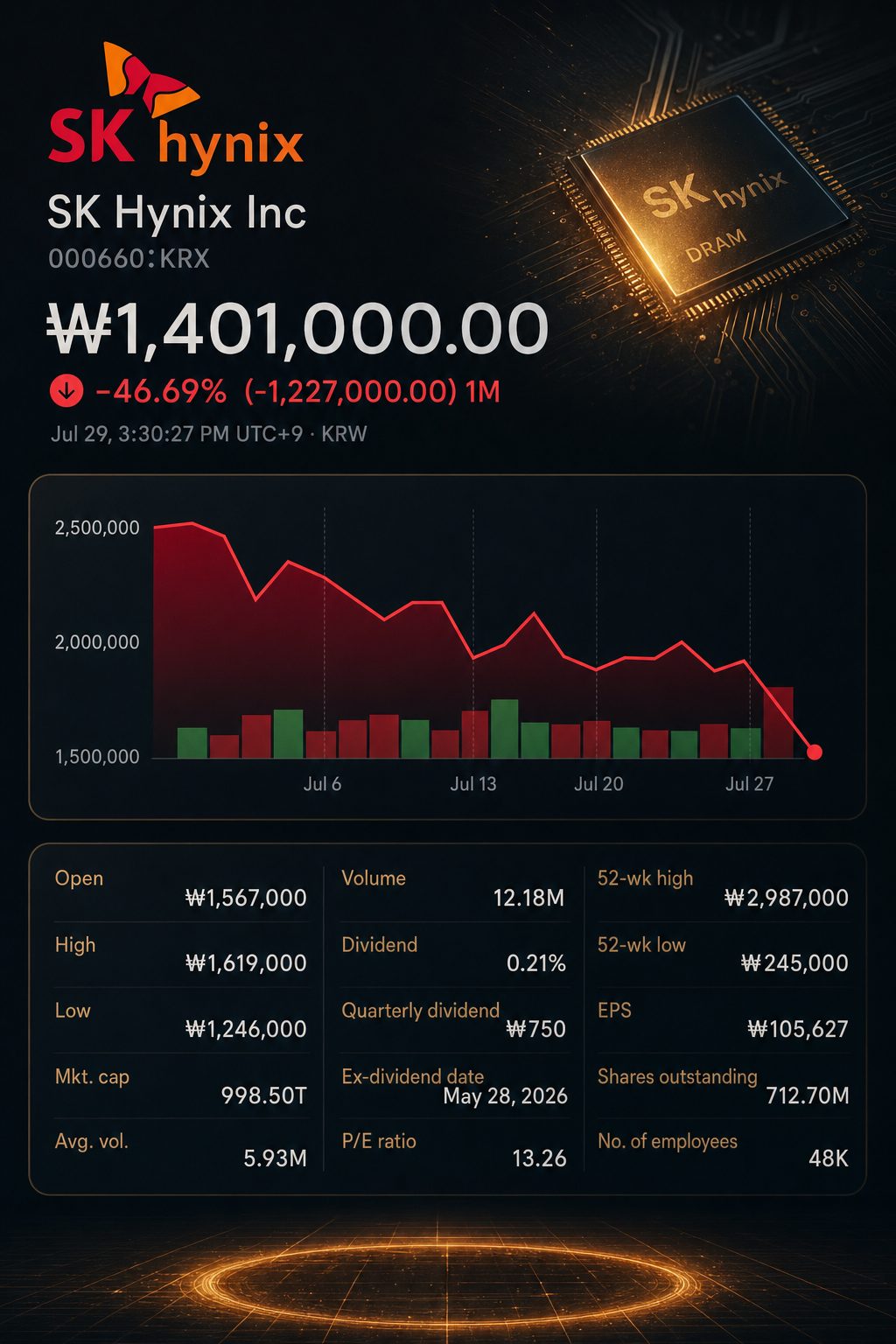
Shares of SK Hynix plunged 9.6% even after it reported record quarterly profits. Samsung declined 5.2%. Over two days, as much as $2.18 trillion in market value was wiped from Seoul’s stock market.
The investor response goes further than a single earnings miss. The magnitude of the market decline far surpassed the miss in SK Hynix’s results.
Second-quarter preliminary revenue came in at 79.3 trillion won, falling 5.6% short of the consensus estimate of 84 trillion won. Operating profit stood at 60.5 trillion won, 5.4% below expectations.
| Measure | Latest result or move | Comparison | Difference |
|---|---|---|---|
| SK Hynix Q2 revenue | ₩79.3 trillion | ₩84.0 trillion forecast | −5.6% |
| SK Hynix operating profit | ₩60.5 trillion | ₩64.0 trillion forecast | −5.4% |
| SK Hynix shares | −9.6% | Wednesday close | — |
| KOSPI | Dropped 6.0% Wednesday | Down nearly 11% on Tuesday | Roughly −16% in total |
| Samsung / TSMC | Fell 5.2% / 3.5% | Same session | Underperformance in Korea |
The company’s results are provisional and await completion of its audit process. LSEG SmartEstimate provided the consensus forecasts.
Operating results remained strong, with revenue climbing 257% year-on-year. Operating profit jumped 557%, and the margin expanded to 76%, compared to 72% in the prior quarter.
Headline net income warrants closer scrutiny. SK Hynix reported earnings of 93.9 trillion won, with 63.3 trillion won attributed to investment returns. This amount accounted for roughly 67% of disclosed net profit.
As a result, investors overlooked the thirteen-fold rise in net income. Attention shifted to how recurring cash would be distributed to shareholders.
At the end of the quarter, cash and equivalents totaled 88 trillion won, with debt amounting to 18.6 trillion won, resulting in net cash of 69.4 trillion won. Still, SK Hynix did not disclose specifics regarding the amount, structure, or timing of its upcoming shareholder-return programme.
“Strong is no longer enough,” said Gary Tan, who manages portfolios at Allspring Global Investments. Investors had been looking for more obvious triggers related to contracts and capital returns. Reuters
SK Hynix President Song Hyun-jong stated that underlying demand was solid, noting, “Major customers are still requesting more memory supply.” The firm has finalized long-term supply deals with approximately 10 clients. Reuters
SK Hynix initiated large-scale deliveries of HBM4 in the quarter. Output is anticipated to climb in the latter half. Nonetheless, revenue recognition was postponed for certain shipments due to slower-than-anticipated delivery rates.
Long-term agreements help minimise vulnerability to memory market fluctuations, but may restrict profits if spot prices surge rapidly. Capital expenditure is expected in the upper 40 trillion-won range, up from 30.2 trillion won the previous year.
The actions among peers suggest a liquidity-based interpretation. TSMC dropped 3.5%, a smaller decrease than those seen by South Korean chip manufacturers. Peter Kim of KB Securities described the sell-off as “a liquidity and sentiment-driven event.” Reuters
The opening session on Tuesday highlighted anxieties over AI funding and advances in China’s chip manufacturing. By the next day, a combination of mandatory sell-offs and limited market liquidity heightened these foundational fears.
The KOSPI is up 41.5% this year when measured in dollar terms. Despite this, it is still down nearly 40% from its latest high. This mix means the correction is steep, though it doesn’t necessarily mean the index is undervalued.
Samsung is due to report results on Thursday, marking the next key earnings event. Investors are also awaiting Seoul’s evaluation of market-stabilisation efforts and an update from SK Hynix regarding its shareholder-return commitments.
Risks: Additional margin calls might deepen the sell-off. A slowdown in AI infrastructure investment, postponement of HBM4, or accelerated competition from China would raise doubts about the notion that this is primarily a leverage-driven event.
Currently, demand remains steady, but positioning has shifted. Investors are requiring higher cash returns before acknowledging another quarter of record results.
Related articles: KRX:000660