
NEW YORK, August 7, 2026, 14:06 EDT — U.S. markets have opened.
- TeraWulf shares were at $16.82, falling 4.5%. The stock was trading 10.9% lower than its closing price before its earnings release.
- HPC lease revenue increased by 52% over the prior quarter, accounting for 71% of overall revenue.
- Just 12.2% of 839 contracted critical IT megawatts are online, with the rest awaiting buildout and deployment.
TeraWulf Inc. NASDAQ:WULF shares dropped 4.5% to $16.82 on Friday afternoon. The price was 10.9% lower than its close on August 4, prior to the results.
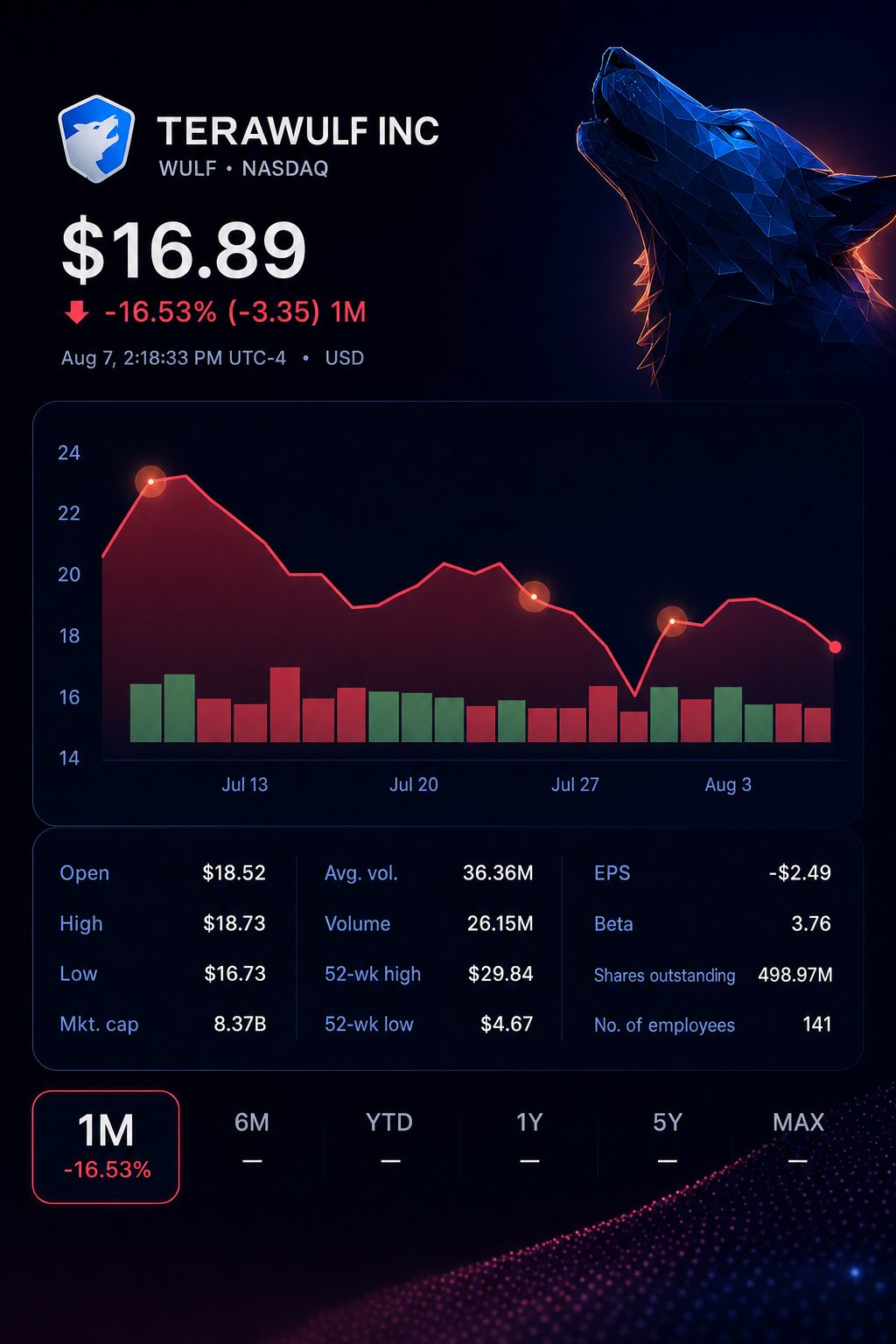
The drop occurred even as reported revenue showed a notable change. HPC lease sales increased by 52% quarter-on-quarter and accounted for 71% of revenue in the second quarter.
According to company data, new HPC revenue offset 91.8% of digital-asset revenue losses compared with the previous year. Overall, total revenue declined by 6%.
TeraWulf’s stated revenue and data from its quarterly earnings call form the basis for the comparison.
| Revenue metric | Q2 2025 | Q1 2026 | Q2 2026 | Q2 year-on-year change |
|---|---|---|---|---|
| Digital-asset revenue | $47.6 mln | $13.0 mln | $12.8 mln | -73.1% |
| HPC lease revenue | — | $21.0 mln | $31.9 mln | New revenue stream |
| Total revenue | $47.6 mln | $34.0 mln | $44.8 mln | -6.0% |
| HPC share of revenue | 0% | 62% | 71% | +71 percentage points |
| HPC replacement of lost mining revenue | — | — | 91.8% | Calculated |
This is the challenge for investors. The transition is underway, though it has not delivered year-on-year growth so far.
Second-quarter revenue came in below the consensus estimate of about $46 million. The company posted a loss per share of $1.94, compared with an anticipated loss of $0.24. The bulk of the $939.9 million net loss was due to a warrant fair-value charge totaling $755.7 million.
Operating performance showed mixed results. The HPC division reported a margin of 28%. According to management, the adjusted margin came to 80% once fit-out, pre-revenue and development costs were removed. The company’s long-term goal remains near 85%.
Company statements reveal the division between operating and development. The percentages listed are based on disclosed megawatt figures.
| Contracted capacity stage | Critical IT load | Share of 839 MW | Expected timing |
|---|---|---|---|
| Operations at Lake Mariner | 102 MW | 12.2% | Earning revenue |
| Lake Mariner in construction | 336 MW | 40.0% | Staggered delivery in H2 2026 and start of 2027 |
| Anthropic campus lease secured | 401 MW | 47.8% | First delivery in H2 2027; complete by early 2028 |
| Total | 839 MW | 100% | — |
Just 12.2% of that capacity is currently in use. This generates significant revenue leverage, but focuses value on upcoming delivery timetables.
Lake Mariner’s cost per megawatt climbed to $9.1 million, up from the $8.6 million initially financed, marking a 5.8% rise. The figure still aligns with TeraWulf’s guidance range of $8 million to $10 million. CB4’s first hall is anticipated to commence rent payments in late September, while CB5 is scheduled to start energizing in early January.
Chief financial officer Patrick Fleury stated the profile was “increasingly driven by long-term, contracted HPC revenue.” TeraWulf finished June holding around $3 billion in cash and restricted cash. The company also anticipates approximately $530 million from the divestment of its Abernathy joint-venture stake. Investing.com
On Friday, the peer group showed mixed performance. TeraWulf trailed behind IREN and Core Scientific, aligning more with mining-focused firms. The most recent quotes were recorded at approximately 13:51 EDT.
| Company | Share price | Friday change | Market value |
|---|---|---|---|
| TeraWulf Inc. NASDAQ:WULF | $16.81 | -4.60% | $8.17 bln |
| IREN Ltd. NASDAQ:IREN | $39.34 | +3.72% | $13.14 bln |
| Core Scientific Inc. NASDAQ:CORZ | $21.15 | +0.45% | $6.88 bln |
| CleanSpark Inc. NASDAQ:CLSK | $12.32 | -3.37% | $2.81 bln |
| MARA Holdings Inc. NASDAQ:MARA | $10.10 | -5.21% | $3.86 bln |
| Riot Platforms Inc. NASDAQ:RIOT | $20.67 | -2.55% | $7.19 bln |
Investor sentiment on Wall Street stayed positive following the report. The recommendations listed suggest significant potential gains, but all hinge strongly on upcoming delivery performance.
| Analyst recommendations | Date | Rating | Price target | Implied upside from $16.82 |
|---|---|---|---|---|
| Bernstein | August 6 | Outperform | $36 | 114% |
| Needham | August 6 | Buy | $33 | 96% |
| Rosenblatt Securities | August 6 | Buy | $30 | 78% |
| WSJ consensus | August 7 | Buy | $36 median | 114% |
According to the WSJ consensus, there were 19 Buy ratings and one Overweight, with no Hold or Sell recommendations given. The mean price target stood at $37.63.
Bernstein analysts, led by Gautam Chhugani, project that 102 operational megawatts generate roughly $180 million in annual recurring revenue. The team anticipates all 839 contracted MW to be online by the first half of 2028. Bernstein, however, lifted its estimated development costs to $10 million-$12 million per MW and identified customer concentration as the principal downside risk.
The next test of operations is scheduled for next week. Management anticipates commissioning CB4 at Level 3 around mid-August, with rental commencement slated for late September.
Risks: In the second quarter, HPC revenue was generated from just two clients. The 401 MW Anthropic lease was not yet active. Important risks continue to include construction setbacks, increased expenses, and possible dilution from 73.6 million warrants granted to Google, part of Alphabet Inc. NASDAQ:GOOGL. These warrants represent roughly 14.7% of shares outstanding as of June.
Revenue now reflects the shift. The 11% share drop after results indicates investors are looking for realised operating profit, not just contracted megawatts.
Related articles: NASDAQ:WULF