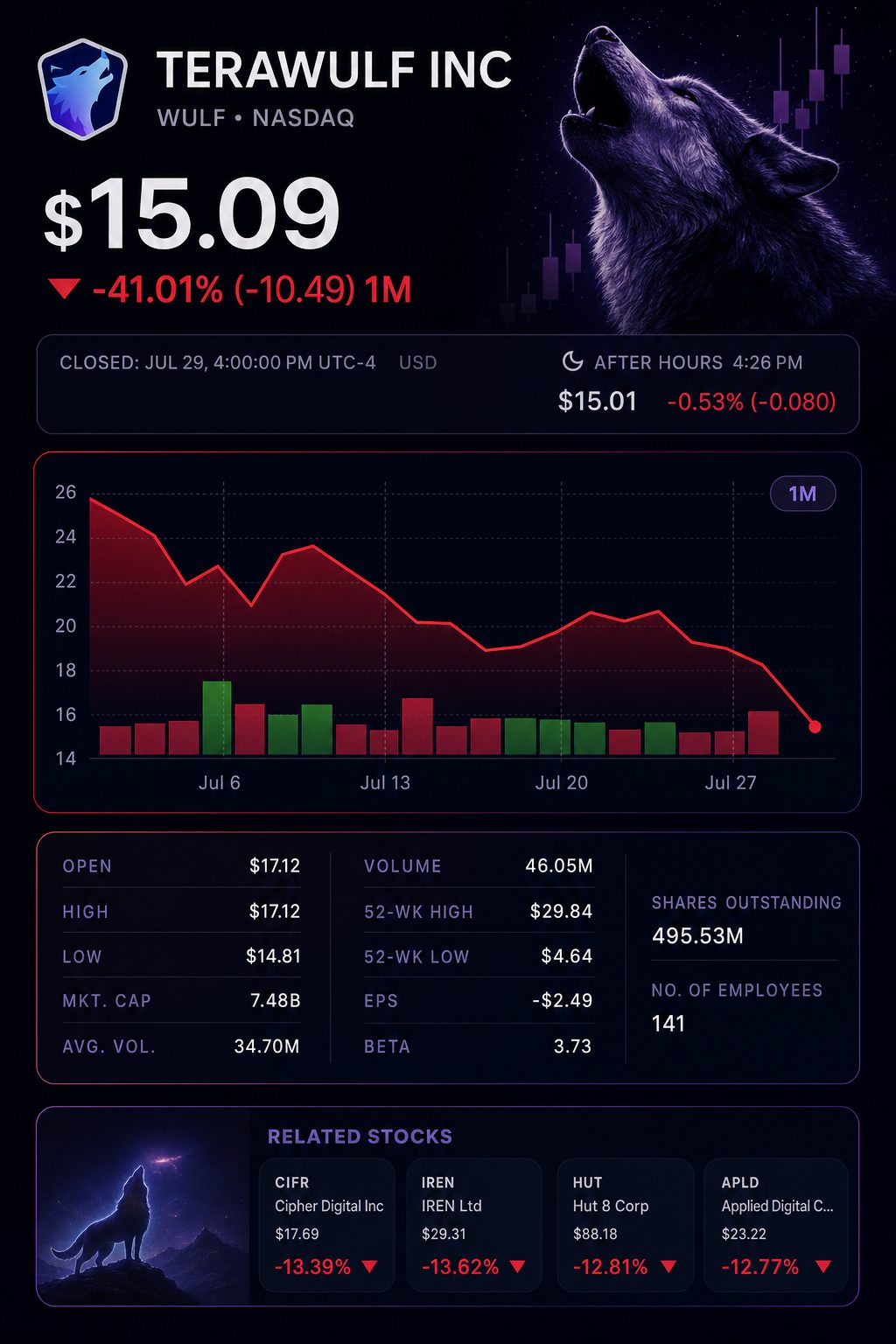
TeraWulf dropped 11.9% to $15.05 in late trading, approaching its session low.
Shares in four listed miner-to-AI peers declined by an average of 13.2%. Bitcoin edged down 0.4%.
The current preliminary Zacks consensus projects a quarterly per-share loss of $0.20.
TeraWulf Inc. NASDAQ:WULF fell 11.9% to $15.05 in late trade on Wednesday. The stock hovered close to its session low ahead of the market close.
Bitcoin slipped just 0.4% over the same period. The divergence indicates that investors are primarily viewing TeraWulf as an AI-infrastructure project developer.
The stock traded in line with firms repurposing power sites as data centres.
The four ex-miner counterparts posted an average decline of 13.2%. TeraWulf outpaced them by roughly 1.3 percentage points, yet lagged CoreWeave by 3.4 points.
TeraWulf’s shift places it in that intermediate spot. The company is no longer solely focused on bitcoin, though its main AI initiatives will take years to build.
Technology shares faced a broad downturn. The PHLX semiconductor index fell 2.2% as concerns rose about the pace of AI-related spending. The Federal Reserve kept interest rates steady between 3.50% and 3.75%, while three policymakers backed a rate hike.
The investor-relations website for TeraWulf displayed no recent operational updates on Wednesday. The most current item was still the July 22 alert regarding its August 5 earnings call. This suggests the drop is linked to sector trends instead of new company-specific developments.
An investor’s key consideration is whether contract rates adequately offset construction delays. The Anthropic deal announced by TeraWulf features higher reported revenue per megawatt compared to its prior Fluidstack arrangement.
Contract and customer
Critical IT load
Initial term
Contracted revenue
Revenue per MW-year
Planned delivery
Hawesville — Anthropic
401 MW
20 years
About $19 billion
About $2.37 million
From late 2027 until early 2028
Lake Mariner — Fluidstack
More than 360 MW
10 years
About $6.7 billion
No more than $1.86 million
Staggered through 2026
The method uses reported revenue, dividing it by megawatts and the length of the initial contracts. With this approach, Anthropic’s payment per MW-year is at least 27% higher.
This is not a comparison of profits. The contracts vary in terms of capital costs, annual escalations, services, and power agreements.
Chief Executive Paul Prager stated the Anthropic deal “validates our strategy.” But rental payments will start solely once TeraWulf provides the capacity. The initial phase is set for the latter half of 2027. SEC
The postponement is significant. Increased contract prices support the backlog, yet they do not generate immediate cash flow. Revenue scheduled far in the future is also worth less when expected investment returns increase.
The following operational test is scheduled for August 5. Early Zacks consensus forecasts predict second-quarter revenue of $44.71 million, representing a 6.2% decline compared to the previous year. Analyst projections indicate a loss of $0.20 per share.
Revenue for the first quarter reached $34.0 million. High-performance computing leases generated $21.0 million, making up roughly 62% of the total figure. TeraWulf disclosed $3.1 billion in cash and restricted cash.
Investors are set to monitor Lake Mariner delivery timelines and the start of leases. These numbers will indicate if present revenue aligns with the contracted backlog.
Risks: New York’s July 14 directive may halt unfinished state permit requests for data centres drawing 50 megawatts or more. The specific project impact has not been determined. Other ongoing risks include costs for construction, access to funding, power supply, and possible delivery setbacks.
Currently, TeraWulf is seen more as a leveraged AI play than a proxy for bitcoin. The August 5 update needs to demonstrate a shift from committed megawatts to operational, revenue-generating capacity.
What caused WULF to drop significantly during the most recent trading session?
WULF was last seen at around $15.03 late on July 29, representing a fall of about 12.1%. Bitcoin stayed close to $63,500 with little movement, so broader crypto declines were not a clear factor. TeraWulf’s investor-relations website did not display updates following July 22. New York’s July 14 permit freeze remains a possible reason for pressure on valuation. The precise cause for the decline remains unclear; investors may be cutting risk ahead of earnings.
What is the value of the Anthropic lease, and when does it begin generating revenue?
Anthropic has agreed to a 20-year lease for approximately 401 megawatts in Kentucky. TeraWulf anticipates about $19 billion in contracted revenue over the initial term, averaging $950 million each year, or around $2.37 million per megawatt-year. TeraWulf Inc. Rent is scheduled to start as capacity becomes available, from late 2027 through early 2028. This represents a significant backlog rather than revenue for 2026. Credit support is anticipated, but the final arrangement has not yet been disclosed publicly.
What can investors anticipate from the earnings report on August 5?
TeraWulf is scheduled to report ahead of its August 5 call at 8:00 a.m. Eastern. TeraWulf Inc. The latest analyst consensus forecasts $46.0 million in revenue and a loss of $0.24 per share. These figures do not represent company guidance and may be updated prior to results. MarketBeat First-quarter revenue reached $34.0 million, of which $21.0 million came from HPC leases. GAAP net loss totaled $427.7 million, with $216.3 million attributed to warrant revaluation. Stock-based compensation accounted for an additional $101.4 million. Key metrics remain delivered megawatts, timing of rent commencements, cash usage, and project timelines.
Is Lake Mariner's timeline for its AI expansion unchanged?
Recent filings indicate Lake Mariner has 438 megawatts in contracted HPC load. Core42 received its full 60-megawatt allotment by March 31, while Fluidstack secured 378 megawatts, with deliveries anticipated in 2026. SEC Management aimed to bring CB-3 online in May; CB-4 and CB-5 are slated for completion in 2026. Independent verification of all project milestones has not occurred after March. Updated details on energized capacity and the start of rent payments are expected in the August 5 update.
Could the suspension of data-center permits in New York impact TeraWulf’s developments?
New York has halted processing of certain state permit applications for data centers requiring at least 50 megawatts, unless those applications were marked complete before July 14. Governor Kathy Hochul Lake Mariner’s Fluidstack-Google expansion remains fully permitted, according to management, who maintain this assessment. Lake Hawkeye is seen as having higher timing risks, given its status as a multi-year project. Expected future changes to state standards or grid fees could raise overall project expenses.
Is TeraWulf able to fund expansion plans without seeking significant additional capital?
As of March 31, TeraWulf reported holding $2.63 billion in cash alongside $463 million in restricted cash. Principal debt stood at $5.73 billion, which included $3.2 billion in 7.75% secured notes. SEC The company’s equity offering in April brought in approximately $1.04 billion in gross proceeds before fees. TeraWulf Inc. The Abernathy deal is expected to deliver $530 million in three payments. SEC TeraWulf also obtained a $250 million revolving credit line. First quarter investment cash outflows totaled $712.8 million, mostly linked to construction and acquisitions. Liquidity appears sufficient for now, but a further capital raise could be needed if spending increases.
What is the extent of dilution risk facing current shareholders?
Dilution has become significant. In April, TeraWulf issued 54.51 million shares at $19, raising its basic share total before the deal by about 12.5%. TeraWulf Inc. Shares of WULF are now trading roughly 21% below that offering price. Google owns 73.58 million warrants priced at one cent, equating to nearly 15% of shares directly after the deal. March filings also listed 47.3 million unvested employee and director equity awards. Although not all securities will be exercised or vested, downward pressure on each share is still considerable.
Did the sale of the Abernathy stake benefit shareholders?
TeraWulf has agreed to divest its full 50.1% interest in Abernathy for approximately $530 million. The deal involves an initial $250 million payment, a further $150 million by December 31, and a final installment of about $130 million. The last payment is slated for April 30, 2027, and its value may be adjusted. SEC Based on a previously disclosed $450 million investment, the headline premium is roughly 18%, not counting taxes, transaction expenses, or money's time value. The transaction will boost liquidity but means TeraWulf gives up any future financial upside from Abernathy.
To what extent is TeraWulf still impacted by Bitcoin price movements?
Bitcoin remains relevant, yet it is no longer the main driver of quarterly revenue. In Q1, digital-asset revenue was $13.0 million, while revenue from HPC leases reached $21.0 million. This means mining accounted for approximately 38% of total sales in the quarter. TeraWulf Inc. The company reported an operational hash rate of 7.9 EH/s, or nearly 0.9% of the worldwide network. TeraWulf estimated daily production at about one bitcoin. SEC With Bitcoin trading close to $63,500, mining activity remains cyclical, but now holds a secondary role.
What is a realistic outlook for WULF's share price over the next 12 months?
My 12-month base scenario is $20–$26, with a midpoint around $23, suggesting roughly 33%–73% upside from the latest $15.03 share price. The downside scenario is $9–$12, should deliveries lag or dilution restart. If Fluidstack commissioning remains on track, the optimistic scenario is $30–$37. This top end matches the most recent $30 and $37 analyst projections, though these are not assured. Barron's Anthropic rental payments begin after this period, making performance a prerequisite for steady cash flow. The base case factors in Q2 sales near consensus and assumes no major schedule delays.
Jerzy Lewandowski is a senior markets editor at TS2.tech. His coverage ranges from stocks and semiconductors to AI and the broader global markets. He studied economics at the University of Warsaw and worked in investment analysis before becoming a financial journalist. Follow Jerzy Lewandowski on Google News.
Surprising starts and permits data can impact homebuilders, mortgage-sensitive stocks, Treasury yields, and the dollar if results deviate significantly from consensus estimates.
#02
Home Depot Q2
The results and outlook provide key insights into housing turnover, renovation demand, professional customer activity, and U.S. discretionary spending.
#03
09:15 ET industrial production
A robust or disappointing factory or utilities report can shift expectations for economic growth, cyclical stocks, bond yields, and the Federal Reserve’s policy direction.