NEW YORK, August 7, 2026, 19:13 EDT — The main U.S. session ended, while after-hours trade continued to see activity.
- Images from Danuri have verified a new lunar crater following the impact of a Falcon 9 upper-stage on Wednesday.
- SpaceX finished Friday up 15.8%. Four other chosen space sector peers each advanced a minimum of 9.5%.
- Artificial intelligence accounted for 86.2% of capital expenditure in the second quarter, while the space sector generated 12.3% of total revenue.
SpaceX stock climbed 15.8% to $133.11 on Friday after satellite imagery verified the lunar impact. The move indicates that investors viewed lunar debris as a lesser risk to valuation.
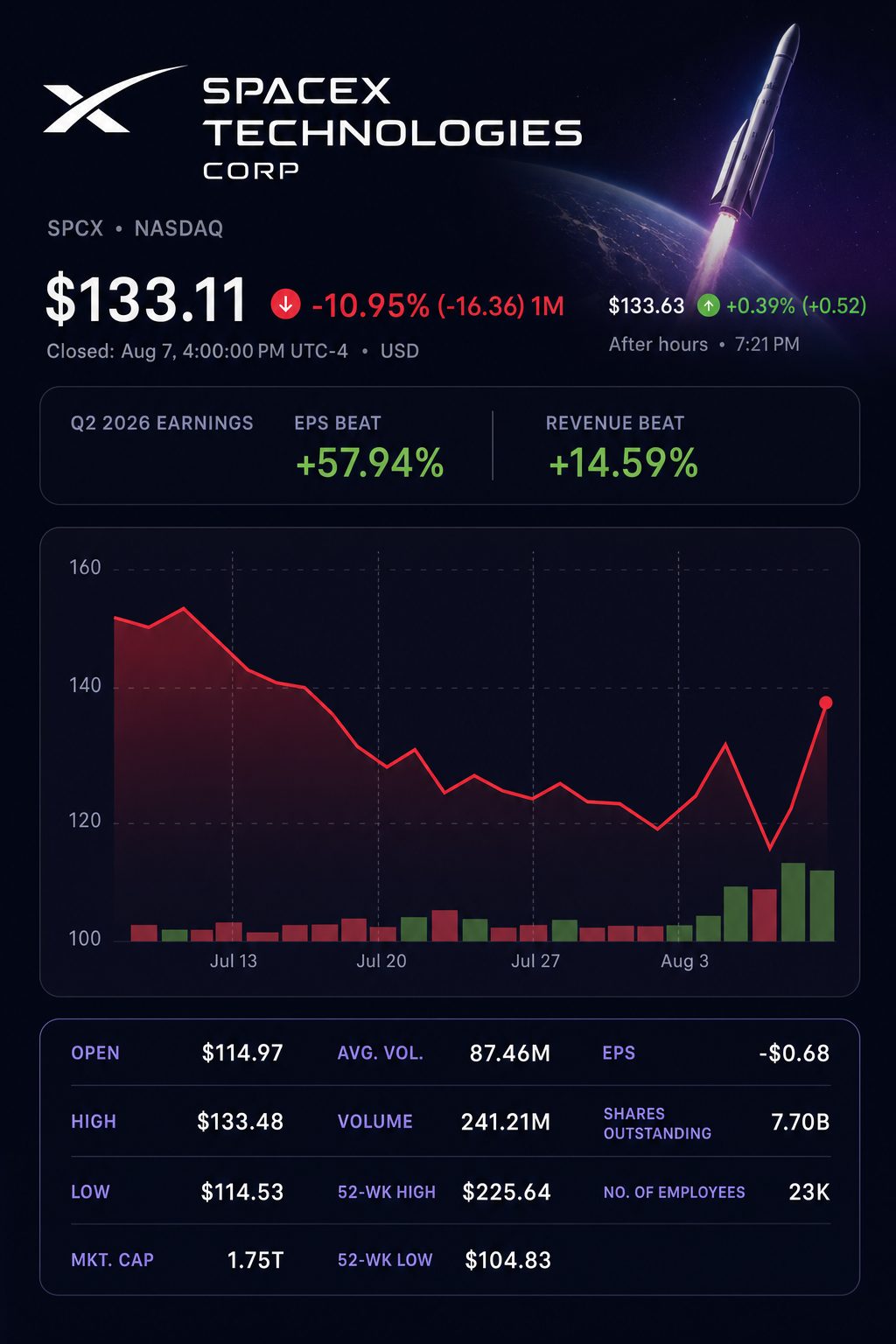
The breakdown of finances sheds light on that reaction. Space accounted for $962 million, representing 12.3% of revenue in the second quarter. AI accounted for $15.83 billion, or 86.2%, of total capital expenditures.
The discussion following earnings focused on AI-related spending and the availability of insider shares. Friday’s recovery indicates these concerns continue to influence valuation more than the recent drop.
The approximately four-ton stage impacted at around 5,400 mph on August 5. Danuri captured images showing darker surface areas, ejecta, and the newly formed crater. According to PBS, initial spectrometry detected sodium and lithium traces.
The stage finished its main objective, delivering Firefly Aerospace NASDAQ:FLY’s Blue Ghost 1 in January 2025. Increased solar activity and gravitational forces subsequently caused the unexpected return to the lunar surface.
NASA stated the collision does not threaten Earth. The agency also recognizes controlled impacts on the Moon as a standard disposal practice in specific situations. However, this particular impact was uncontrolled.
Evidence of impact and outstanding projections
| Measure | Latest finding | Status |
|---|---|---|
| Impact date | August 5, 2026 | Validated by Danuri imagery |
| Impact speed | About 5,400 mph | Released following impact |
| Stage mass | About 4 metric tons | Estimated |
| Crater | New crater and visible ejecta | Verified |
| Crater dimensions | Roughly 60 feet across and 12 feet deep | Initial NASA pre-impact projection |
| Natural comparison | This energy level matches an impact roughly every six days | NASA estimate |
| Next observation | LRO to fly over target next week | Planned |
Crater size measurements are yet to be reported.
Shares of listed space companies did not reflect a broad sector decline; each chosen peer gained on Friday and since Monday’s close. However, given the presence of upgrades and mission updates, this is not a pure event study.
Public-space stock performance
| Company | Friday close | Friday change | Aug. 3–7 change |
|---|---|---|---|
| SpaceX | $133.11 | up 15.8% | up 16.2% |
| Firefly Aerospace | $26.71 | rose 11.0% | gained 22.0% |
| Intuitive Machines NASDAQ:LUNR | $16.40 | up 9.8% | jumped 25.2% |
| Rocket Lab USA NASDAQ:RKLB | $82.83 | rose 9.5% | increased 17.6% |
| Redwire NYSE:RDW | $13.59 | climbed 14.9% | soared 41.0% |
Calculations reflect differences from closing prices reported on August 3 and August 7.
Rocket Lab’s 92nd Electron launch contributed to its advance on Friday. SpaceX was given an Argus upgrade as well. As a result, the broad market rally highlights resilience rather than direct causation.
SpaceX’s risk order was determined by segment data. Only the Connectivity segment generated an operating profit. Investment in AI capital expenditures outpaced Space capex by over 13 times.
SpaceX Q2 segment financials
| Segment | Revenue | Revenue share | Operating income/(loss) | Capex | Capex share |
|---|---|---|---|---|---|
| Space | $0.962 bln | 12.3% | $(0.542) bln | $1.174 bln | 6.4% |
| Connectivity | $4.291 bln | 54.9% | $1.656 bln | $1.367 bln | 7.4% |
| AI | $2.561 bln | 32.8% | $(1.257) bln | $15.828 bln | 86.2% |
| Total | $7.814 bln | 100% | $(0.143) bln | $18.369 bln | 100% |
Share numbers are based on overall company figures. Operating losses are shown in parentheses.
Chief Financial Officer Bret Johnsen stated that AI initiatives were producing “less than a one-year payback.” Argus analyst Steven Silver raised his rating on SpaceX to Buy, setting a $160 target. Silver noted the company was “encouraged” by swift payback and expanding compute. Investor’s Business Daily
The broader analyst group holds a positive view as well. However, there is still considerable dispersion. Bullish totals include both Buy and Overweight ratings, whereas bearish totals combine Underweight and Sell ratings.
Analyst ratings
| Company | Consensus | Bullish / Hold / Bearish | Median target | Implied upside |
|---|---|---|---|---|
| SpaceX | Overweight | 30 / 6 / 3 | $217 | 63.0% |
| Firefly Aerospace | Overweight | 6 / 3 / 1 | $40 | 49.8% |
| Intuitive Machines | Buy | 9 / 2 / 0 | $43 | 162.2% |
| Rocket Lab USA | Overweight | 18 / 4 / 0 | $120 | 44.9% |
| Redwire | Overweight | 6 / 2 / 0 | $15 | 10.4% |
Implied upside is based on a comparison of median targets against Friday’s closing prices. These targets should not be considered predictions or assurances.
SpaceX price targets vary between $75 and $800. The median target, $217, is 63% higher than the closing price on Friday. The wide range highlights a sharp divide over the company’s approach spanning AI, broadband, and space launches.
Stronger challenges are ahead next week. Rocket Lab will post results following Monday’s market close. Intuitive Machines will release its report ahead of Thursday’s opening. NASA’s LRO may further update the crater measurement.
Risks: A bigger detected crater may trigger fresh demands for stricter disposal regulations. Multiple unsuccessful trajectories would increase the financial impact of the event. Substantial AI investment and additional insider share sales continue to be immediate risks for the stock.
Related articles: NASDAQ:FLY