NEW YORK, August 10, 2026, 08:05 EDT — Pre-market trading; the NYSE core session opens at 09:30 EDT.
- Oklo gained 14.8% on Friday and 24.7% last week. It remains down 32.5% in 2026.
- Q2 revenue reached $1.2 million, mainly from acquired businesses. Interest income was 19 times larger.
- A preliminary calculation leaves about $6.0 billion assigned to operations and future projects after subtracting liquidity.
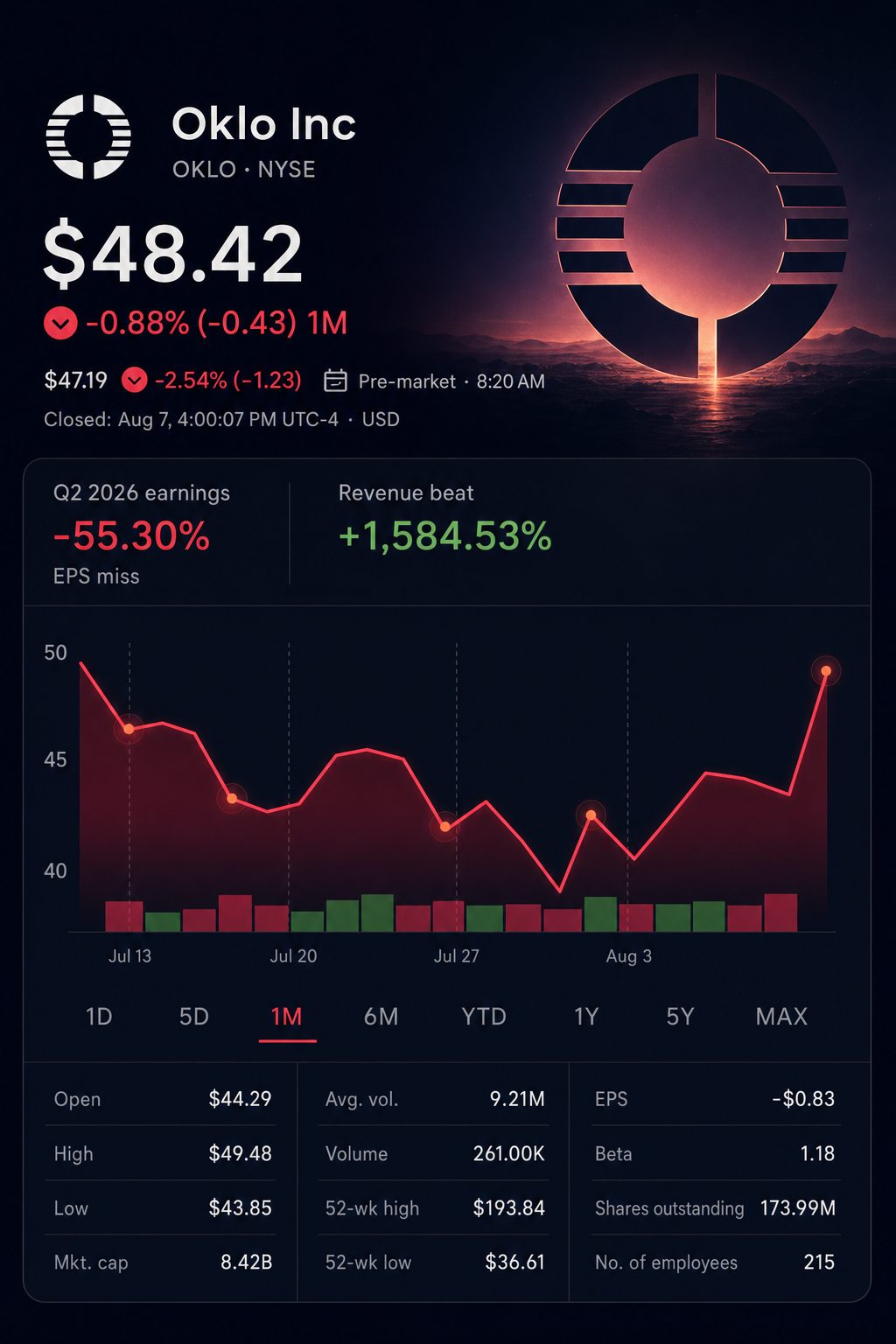
Oklo Inc. NYSE:OKLO ended Friday with an implied equity value near $9.0 billion. After subtracting $3.0 billion of cash and securities, investors still assigned roughly $6.0 billion to operations and future projects. That is the key number after the rally.
The quarter did not show a reactor-revenue inflection. Revenue was $1.2 million and came mainly from acquired businesses. Net interest and dividend income reached $23.2 million, or 19 times sales. It offset almost 32% of the operating loss.
Shares closed at $48.42, with 22.1 million changing hands. Friday volume was 2.7 times the prior four-day average. The stock gained 24.7% last week, but remains down 32.5% this year.
| Oklo market measure | Latest reading | Investor context |
|---|---|---|
| Friday close | $48.42 | Up 14.8% |
| Week ended August 7 | +24.7% | Most gains came Friday |
| 2026 year to date | -32.5% | December 31 close was $71.76 |
| Below 52-week high | -75.0% | High was $193.84 |
| Friday volume | 22.1 million | 2.7 times prior four-day average |
Returns are calculated from reported closing prices.
The pre-earnings debate centered on burn, timelines, approvals and customer commitments. The results kept that framework intact. Revenue comprised $800,000 from engineering and consulting, $168,000 from fabrication and $242,000 from other work. It was not commercial reactor-power revenue.
| Q2 financial measure | 2026 | 2025 | Change |
|---|---|---|---|
| Revenue | $1.2 million | Nil | Not meaningful |
| Research and development | $39.5 million | $11.5 million | +244% |
| General and administrative | $34.2 million | $16.5 million | +107% |
| Operating loss | $73.2 million | $28.0 million | +161% |
| Interest and dividend income | $23.2 million | $3.8 million | +517% |
| Net loss | $48.5 million | $24.7 million | +97% |
| Loss per share | $0.28 | $0.18 | Wider by $0.10 |
Figures are unaudited.
Costs rose far faster than sales. Research spending more than tripled, while administration costs more than doubled. Net loss nearly doubled despite the income generated by Oklo’s large investment portfolio.
Groves provided the real catalyst. The low-power isotope reactor reached first criticality less than one year after groundbreaking. Oklo said substantial construction took 229 days. “Reaching criticality in less than a year is an incredible milestone for our team,” CEO Jacob DeWitte said. Oklo
Groves is still not Aurora. Management expects roughly another year of commissioning at the Texas site. It said initial isotope revenue is more likely from its Idaho laboratory in early 2027. Aurora-INL remains targeted for 2028, with total project cost still undisclosed.
The balance sheet buys time. It also carries a dilution bill. Oklo raised $1.85 billion through stock sales during the first half. Shares outstanding increased 15.3% by June 30, then reached 186.0 million on August 4.
| Capital and valuation bridge | Amount |
|---|---|
| Filed shares outstanding, August 4 | 186.0 million |
| Friday closing price | $48.42 |
| Preliminary implied equity value | $9.01 billion |
| Cash and marketable securities | $3.01 billion |
| Preliminary cash-adjusted project value | $6.00 billion |
| Liquidity as share of equity value | 33.4% |
| 2026 guided operating cash use | $120 million–$150 million |
| 2026 guided capital spending | $400 million–$500 million |
| Liquidity divided by one-year guided spending | 4.6–5.8 times |
Preliminary estimates use the August 4 share count and Friday’s close. The cash-adjusted figure subtracts liquidity only, before debt and other adjustments. The final ratio is not a runway forecast.
Management raised operating cash-use guidance from $80–$100 million. Planned capital spending also increased. The acceleration covers procurement, construction, fuel and other project work intended to protect deployment schedules.
First-of-a-kind costs can climb as procurement and construction accelerate. Oklo also expects continued spending on fuel, recycling, powerhouses and isotopes. Its cash advantage is substantial. It does not yet establish project returns.
NuScale Power NYSE:SMR is the closest listed reactor-development peer. Centrus Energy (NYSEAMERICAN:LEU) is more relevant as a fuel supplier. Oklo’s letter of intent with Centrus could cover up to five Aurora units, with potential deliveries beginning in 2029. A definitive agreement is still required.
Wall Street remains constructive, though its assumptions extend well beyond 2028. H.C. Wainwright analyst Sameer Joshi reiterated Buy and a $90 target on Monday. Barclays PLC NYSE:BCS values Oklo at $76 under a model assuming twelve 75-megawatt plants annually by 2035. That production rate then continues through 2050.
| Firm or consensus | Analyst | Recommendation | Target | Implied upside |
|---|---|---|---|---|
| H.C. Wainwright | Sameer Joshi | Buy | $90.00 | 85.9% |
| Barclays PLC NYSE:BCS | Christine Cho | Overweight | $76.00 | 57.0% |
| Truist Financial NYSE:TFC | Christopher Souther | Hold | $55.00 | 13.6% |
| Current consensus | — | Overweight | $81.50 median | 68.3% |
Upside is calculated from Friday’s $48.42 close. The consensus includes 10 Buy, two Overweight, nine Hold and one Sell recommendation. Consensus data were supplied by FactSet Research Systems NYSE:FDS.
A move to $100 would require more than another milestone. At the August 4 share count, it would imply $18.6 billion of equity value. Subtracting current liquidity leaves about $15.6 billion for operations and projects. That is 2.6 times Friday’s cash-adjusted figure.
Oklo’s investor page showed no upcoming corporate event on Monday morning. Investors will instead watch post-results analyst changes and Friday’s price support. July consumer inflation arrives Wednesday, followed by producer prices Thursday. Rates matter twice here: through valuation and returns on $2.95 billion of interest-sensitive assets.
Risks: Aurora licensing or construction delays, higher first-of-a-kind costs, fuel constraints, nonbinding commitments and further dilution could overwhelm the Groves signal. Faster approvals, firm customer contracts or clearer project economics could move the valuation the other way.
Related articles: NYSE:OKLO