
South San Francisco, August 12, 2026, 04:19 EDT — Shares of Septerna (SEPN) climbed 23% after the company released a promising update on SEP-479, propelling the stock past consensus expectations.
- Shares of Septerna finished up 22.9% at $47.76 on Tuesday.
- The observed half-life of SEP-479, ranging from three to four days, supports administering the drug once per day.
- The closing price was above the average analyst price target of $46.78.
Shares of Septerna, Inc. NASDAQ:SEPN rose 22.9% on Tuesday after the company announced promising initial pharmacokinetics data for SEP-479. The oral therapy for hypoparathyroidism demonstrated an observed elimination half-life between three and four days. According to management, this supports a once-daily dosing regimen.
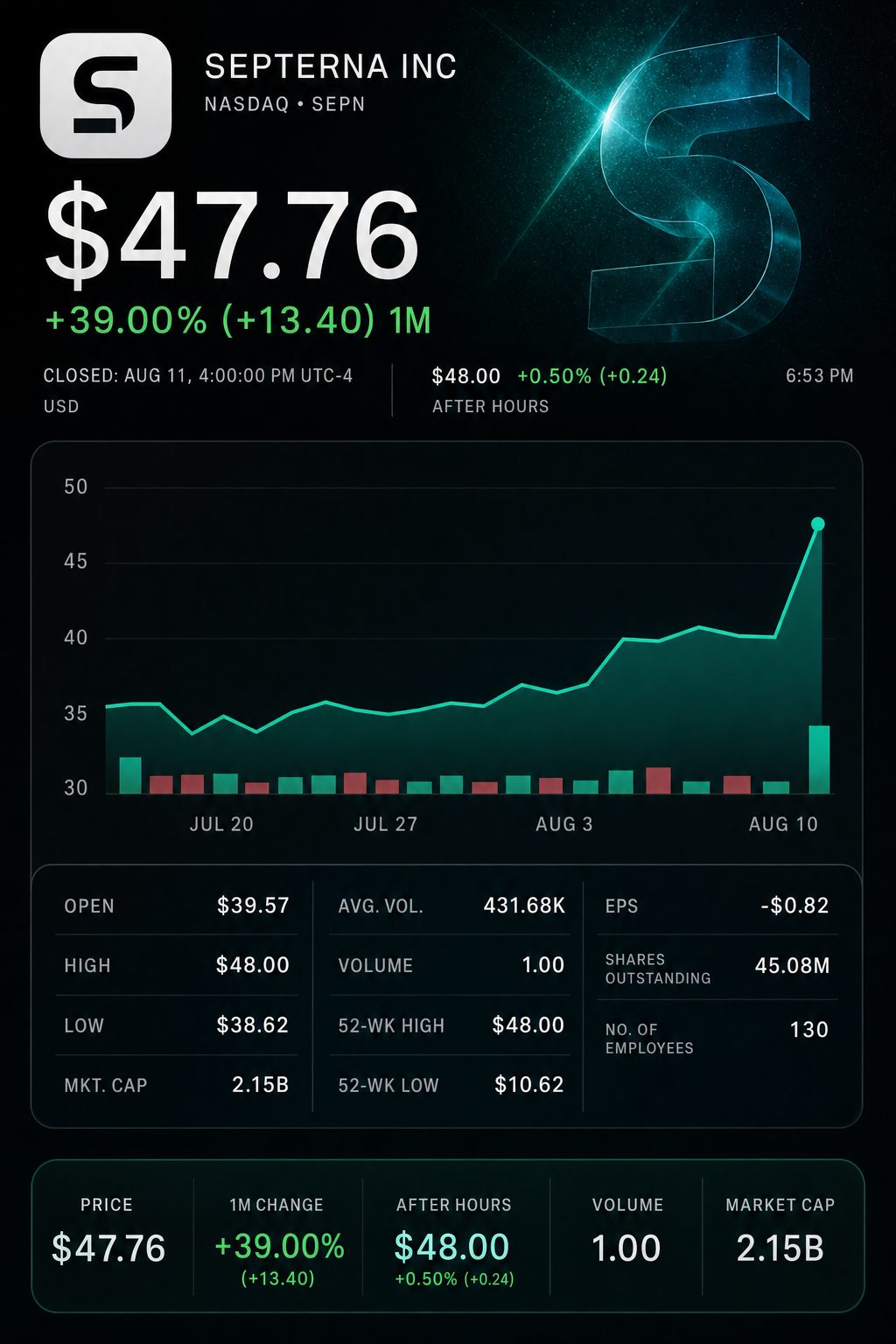
The change impacted the valuation assessment. Septerna closed at $47.76, surpassing the average analyst price target of $46.78. However, its quarterly revenue of $26.7 million was solely generated through a research collaboration rather than from product sales.
U.S. markets are not open for regular trading. The stock rose 22.5% in the past week from its August 4 close. On Tuesday, trading volume was 2.8 times higher than its daily average over the past three months.
Chief Executive and co-founder Jeffrey Finer said, “We are very pleased with the observed clinical half-life, which is at the longer end of our preclinical estimates.” He noted that this outcome further supports confidence in the possibility of once-daily treatment. Company release
| Market measure | Value | Investor reading |
|---|---|---|
| August 11 close | $47.76 | Closed at session peak |
| Daily move | +22.93% | Top Yahoo gainer not featured recently |
| One-week move | +22.52% | Up from $38.98 on August 4 |
| Volume | 1.15 million | 2.78 times three-month average |
| Versus $18 IPO price | +165.3% | Rated higher over the longer term |
S&P Global market data and Yahoo’s average trading volume are used for these figures. Septerna launched its IPO in October 2024 at a price of $18.
The company’s balance sheet provides it with a buffer. As of June 30, cash, equivalents and marketable securities amounted to $516.5 million, representing nearly 12 quarters of operating expenses at the most recent rate, not accounting for any potential changes in future revenue or costs.
| Q2 measure | 2026 | 2025 | Change |
|---|---|---|---|
| Revenue | $26.7 million | $0.1 million | Increase of $26.6 million |
| R&D expense | $35.1 million | $22.2 million | Up 58.3% |
| G&A expense | $8.5 million | $6.9 million | Higher by 22.3% |
| Operating loss | $16.8 million | $29.0 million | Reduced by 41.9% |
| Net loss | $13.0 million | $24.8 million | Down 47.5% |
Increased collaboration revenue helped reduce the loss, even though research expenses accelerated. Septerna maintains its projection that current cash will support operations into at least 2029. The numbers are based on unaudited quarterly data.
| Q2 2026 collaboration revenue | Amount | Share of total |
|---|---|---|
| Amortization of upfront fee | $14.6 million | 54.6% |
| Milestone revenue from research | $0.9 million | 3.4% |
| Revenue from research services | $11.2 million | 41.9% |
| Total | $26.7 million | 100.0% |
Septerna’s entire revenue stream was provided by its partnership with Novo Nordisk A/S NYSE:NVO. The initial deal featured a $195 million upfront payment with additional possible milestones totaling around $2.2 billion. While these terms support development costs, they do not represent confirmation of a drug on the market.
| Program | Current position | Next disclosed step |
|---|---|---|
| SEP-479 | Phase 1; half-life observed at three to four days | SAD/MAD results expected in Q1 2027 |
| SEP-631 | Phase 1 proof-of-mechanism positive | Focus on cost-effective, signal-detection studies |
| TSHR program | Lead optimization ongoing | Choose candidate for development |
| Novo collaboration | Four oral GPCR initiatives | Research milestone achievements and candidate development |
SEP-479’s steady-state characteristics will be clarified through an extended 14-day multiple-dose study. As a result, the update covering both single- and multiple-dose regimens has been moved to the first quarter of 2027. This schedule is reiterated in the company’s August presentation.
Another strategic shift is underway. Septerna is weighing the option of conducting smaller signal-finding trials for SEP-631 targeting mast-cell diseases, instead of its earlier plan for a Phase 2b study in chronic spontaneous urticaria.
| Analyst | Firm | Rating | Target | Upside/downside |
|---|---|---|---|---|
| Martin Auster | Raymond James | Buy | $49 | +2.6% |
| Joshua Schimmer | Cantor Fitzgerald | Buy | $60 | +25.6% |
| Seamus Fernandez | Guggenheim | Buy | $51 | +6.8% |
| Ram Selvaraju | H.C. Wainwright | Buy | $40 | -16.2% |
| Srikripa Devarakonda | Truist | Buy | $43 | -10.0% |
The sell side keeps a bullish stance, with nine Strong Buy recommendations and one Buy. Raymond James and Guggenheim boosted their price targets following the update. However, the average target of $46.78 is now 2.1% under Tuesday’s closing price.
Risks: SEP-479 is still in Phase 1 without patient efficacy results. Extended dosing may uncover safety or exposure concerns. For SEP-631, the updated approach means the details of its forthcoming trial remain undecided.
The main trigger is now evident. First-quarter 2027 results need to support a stock price that is already ahead of consensus, while maintaining the case for once-daily dosing that fueled Tuesday’s surge.
Related articles: Biotechnology