
NEW YORK, Aug. 10, 2026, 4:06 p.m. EDT — Silence Therapeutics plc NASDAQ:SLN jumped over 25% in late trading on Monday as the company reported its investigational RNA-interference drug divesiran reached all primary and secondary endpoints in a randomized Phase 2 polycythemia vera trial. While overall efficacy was notable, investors appeared to focus on a less obvious outcome: the therapy showed sustained activity with dosing every 12 weeks.
The latest results establish quarterly dosing as a defining aspect of the program, moving beyond an initial hypothesis. In a chronic blood cancer where many patients rely on repeated blood draws to manage hematocrit, fewer required injections could set divesiran apart commercially, even if a competing treatment launches earlier. The main reference for trial data is the full SANRECO Phase 2 release.
- Divesiran achieved an overall response rate of 88%, compared to 19% for the placebo group, with p<0.0001.
- The 12-weekly dosing group saw an 81.3% response rate, backing the decision to select the quarterly schedule for Phase 3.
- Silence intends to commence a placebo-controlled Phase 3 trial in the first half of 2027, as a rival therapy is currently undergoing FDA Priority Review.
A limited study shows strong efficacy
SANRECO included 48 participants whose hematocrit levels were not controlled and who required ongoing phlebotomy, despite receiving standard therapies such as hydroxyurea, interferon or ruxolitinib. Subjects received subcutaneous divesiran at doses of 6 mg/kg every six weeks, every 12 weeks, or received placebo. The main goal was for patients to remain ineligible for phlebotomy during weeks 18 to 36 and maintain hematocrit under 45%.
| Phase 2 SANRECO group | Dosing | Primary response |
|---|---|---|
| All patients receiving divesiran | Q6W or Q12W | 88% |
| Divesiran Q6W | One dose every 6 weeks | 93.8% |
| Divesiran Q12W | One dose every 12 weeks | 81.3% |
| Placebo | Matched dosing schedule | 19% |
Both dosing regimens surpassed the placebo benchmark by a substantial amount. “The SANRECO Phase 2 trial delivered our best-case outcome,” said Silence chief medical officer Curtis Rambaran. While that assessment is promotional, the quarterly dosing schedule is the main factor that could shift the program’s worth: it maintained much of the efficacy seen in the six-week dosing with only half the number of injections.
The secondary endpoint supported the overall findings, with divesiran recipients having a mean of 0.2 phlebotomies up to week 36, versus 2.1 in the placebo group, and a p-value of <0.0001. Silence said there were no new safety signals; injection-site reactions occurred rarely and resolved on their own, while two patients experienced grade 1 anemia adverse events. Comprehensive results, including data to assess durability and subgroup consistency, will be presented at an upcoming medical congress.
Divesiran employs small interfering RNA technology to lower levels of TMPRSS6, which is a liver-derived regulator of hepcidin. Increasing hepcidin is expected to limit iron necessary for red blood cell formation. This approach targets the underlying erythrocytosis characteristic of polycythemia vera, rather than just extracting surplus blood after its production. Silence points out that there are currently no approved treatments that focus directly on red cells and hematocrit.
Quarterly convenience faces a rival already ahead
Investors frequently compare rusfertide, a hepcidin mimetic administered once weekly, developed by Protagonist Therapeutics, Inc. NASDAQ:PTGX in partnership with Takeda Pharmaceutical Company Limited NYSE:TAK. In the Phase 3 VERIFY study involving 293 participants, rusfertide achieved a 76.9% clinical response rate compared with 32.9% for placebo. The FDA granted Priority Review to its application, with a target decision expected in the third quarter of 2026. The VERIFY trial data and the regulatory update were provided by Takeda.
| Candidate | Mechanism | Randomized study | Active vs placebo response | Dosing tested | Next regulatory step |
|---|---|---|---|---|---|
| Divesiran | siRNA targeting TMPRSS6 | Phase 2, n=48 | 88% versus 19% | Administered every 6 or 12 weeks | Phase 3 scheduled for H1 2027 |
| Rusfertide | Peptide that mimics hepcidin | Phase 3, n=293 | 76.9% compared with 32.9% | Weekly administration | FDA Priority Review; target action date Q3 2026 |
The percentages cited do not represent a direct head-to-head comparison. SANRECO is considerably smaller, its response period opened two weeks ahead, and unique trials can vary in terms of patient populations and background therapies. The more supportable conclusion is limited: divesiran showed a promising signal with a notably lower dosing frequency. Demonstrating superiority would necessitate a direct comparison, which has not yet been conducted.
Rusfertide holds a significant advantage. If cleared as planned, it could allow doctors to become accustomed to the therapy and secure reimbursement ahead of pivotal divesiran studies. In contrast, Silence offers convenience and a potentially long-lasting gene silencing effect; however, the firm needs to replicate Monday’s finding in a broader trial. Management intends to advance the 12-week regimen into a placebo-controlled Phase 3 trial starting in the first half of 2027.
Shares adjust ahead of the arrival of the development bill
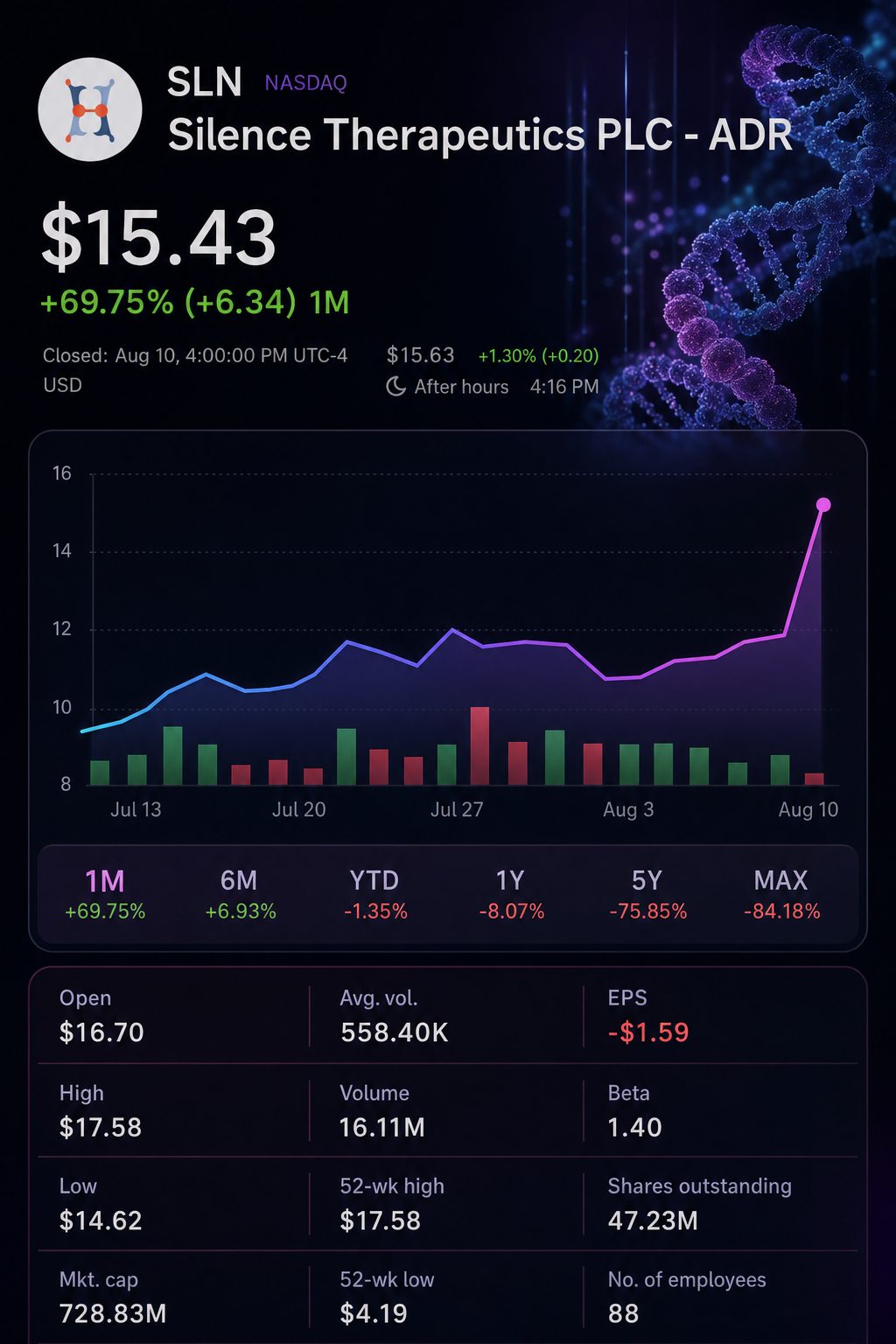
SLN was quoted above $15 in late trading on Monday, marking a gain of over 25% from Friday’s close at $11.95, with volume exceeding 15 million American depositary shares. This represented about 35 times the recent daily average and brought the stock near a new 52-week peak. The market snapshot was captured prior to the market close, so the percentages reflect late-session activity, not final closing figures.
The second component of the thesis is now the balance sheet. At the end of June, Silence held $72.1 million in cash and cash equivalents. Research and development expenditure in the second quarter dropped significantly from the previous year, and the net loss reduced to $12.3 million. These results support the company’s short-term liquidity, though launching a global Phase 3 trial, set to surpass the scale of SANRECO, may drive spending higher again. The data is based on the company’s second-quarter results.
| USD millions | Q2 2026 | Q2 2025 | Change |
|---|---|---|---|
| Research and development expense | $9.1 | $17.6 | Decreased 48% |
| General and administrative expense | $4.7 | $5.1 | Reduced 8% |
| Net loss | $12.3 | $27.4 | Improved by 55% |
| Cash and cash equivalents at period end | $72.1 | Not shown here | Reported for this period only |
This results in a typical biotech dilemma. Favorable Phase 2 results can reduce clinical uncertainty and boost the stock price, which may help a company secure better terms when raising funds. However, expenses for the pivotal trial, manufacturing, and commercial planning remain. Investors should anticipate that funding strategy will take on greater significance long before Phase 3 outcomes are available.
Analysts held differing opinions ahead of the readout
Analyst recommendations ahead of Monday exhibited unusual divergence, with price targets ranging from a bearish $4 to a bullish $75. This wide range highlights that analysts are assigning varied probabilities to clinical success, possible dilution, and commercial uptake. The actions listed below were collected from TipRanks’ SLN forecast page; Silence also provides a list of its covering analysts on its analyst coverage page.
| Firm | Analyst | Published view | Price target | Latest listed action |
|---|---|---|---|---|
| Goldman Sachs NYSE:GS | Richard Law | Sell | $4 | Reiterated July 27, 2026 |
| Cantor Fitzgerald | Prakhar Agrawal | Overweight | Not listed | Initiated June 24, 2026 |
| H.C. Wainwright | Patrick Trucchio | Buy | $75 | Reiterated June 17, 2026 |
| Morgan Stanley NYSE:MS | Michael Ulz | Buy | $25 | Reiterated June 11, 2026 |
| William Blair | Myles Minter | Buy | Not listed | Reaffirmed June 11, 2026 |
| Chardan | Keay Nakae | Buy | $27 | Reaffirmed May 7, 2026 |
Risks: SANRECO’s randomization included just 48 patients and Monday’s release was topline, lacking the detailed data found in peer-reviewed publication. Phase 3 is not expected to begin before 2027, and regulatory demands could shift. Rusfertide maintains a significant lead, while Silence still lacks product revenue needed to offset the expenses of a pivotal stage. Key uncertainties persist regarding safety, durability, patient recruitment, and potential dilution.
The market’s initial reaction is clear: quarterly divesiran performed strongly in Phase 2, supporting its case as potentially best-in-class. The more complex task ahead is valuation. Silence now faces the challenge of turning an impressive signal seen in 48 patients into a Phase 3 program that can attract funding, as a leading competitor moves closer to a potential approval. Monday’s rally reflects a premium on flexibility and opportunity, but the progress that follows will demand further resources, time and investment.
Related articles: Biotechnology