
NEW YORK, August 12, 2026, 08:21 EDT
- U.S. credit-card debt increased by $21 billion to reach $1.263 trillion in the second quarter.
- The rate of serious card delinquency was 6.97%, nearly unchanged compared with 6.93% in the previous year.
- Capital One reported year-on-year declines in both domestic-card delinquency and charge-off rates.
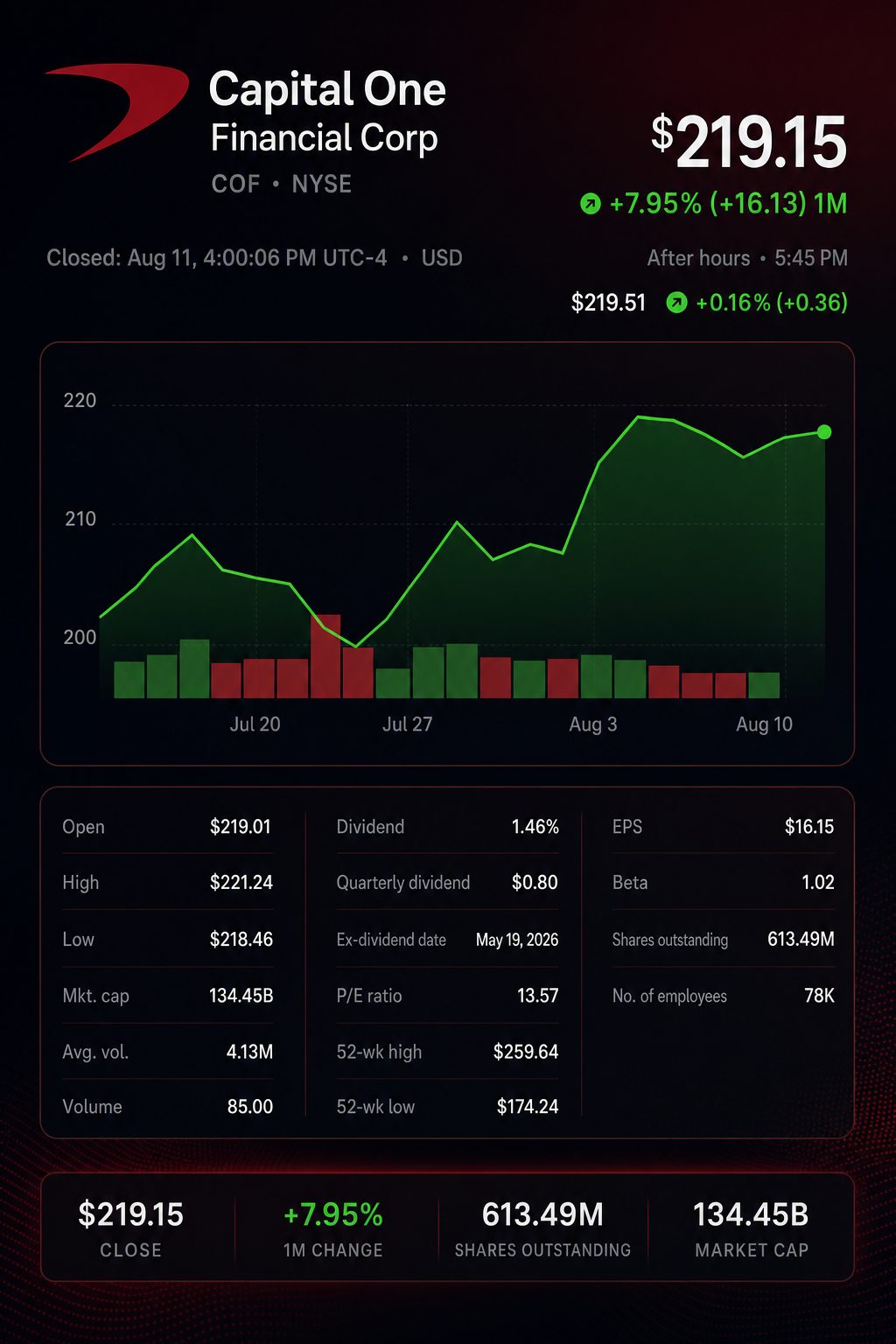
Shares of Capital One Financial Corporation NYSE:COF declined 0.9% to $217.12 at 07:09 EDT in premarket trading on Wednesday. The drop came after new data showed U.S. credit card balances hit $1.263 trillion, with the rate of new serious delinquencies staying largely unchanged.
Capital One is more influenced by national statistics than many other major banks. Its domestic card portfolio totals $259 billion, accounting for about a fifth of the New York Fed’s overall balance calculation. This comparison highlights size rather than market share, as each dataset relies on distinct definitions.
Household debt decreased by $13 billion to $18.771 trillion in the second quarter. Credit card debt increased $21 billion. Auto loan balances climbed $28 billion. Mortgage balances dropped due to a reporting change, which the New York Fed anticipates reversing.
| Debt category | Q2 2026 change | Q2 2026 balance |
|---|---|---|
| Mortgage | Down $74 billion | $13.117 trillion |
| Credit card | Up $21 billion | $1.263 trillion |
| Auto loan | Higher by $28 billion | $1.713 trillion |
| Student loan | Reduced by $7 billion | $1.651 trillion |
| HELOC | Increase of $13 billion | $459 billion |
Total delinquency edged down to 4.7%. Credit card strain remained elevated, though it did not intensify. Joelle Scally, economic policy adviser at the New York Fed, noted that new auto and card delinquencies “remain at elevated levels.” New York Fed statement
The serious-delinquency flow for credit cards reached 6.97%, compared with 6.93% in the prior year. Auto loan delinquencies increased slightly. Mortgage figures also climbed, yet both remained far beneath the transition rate for student loans.
| Loan type | Q2 2025 flow into serious delinquency | Q2 2026 flow | Change |
|---|---|---|---|
| Credit card | 6.93% | 6.97% | +0.04 points |
| Auto loan | 2.93% | 3.00% | +0.07 points |
| Mortgage | 1.29% | 1.52% | +0.23 points |
| Student loan | 12.88% | 7.83% | -5.05 points |
Capital One reported similar trends in its second-quarter results. Domestic card loans increased by 2% since March, reaching $259.0 billion. Purchase volume climbed 26% year-on-year to $253.75 billion.
Credit quality showed gains as well. The 30-day delinquency rate for domestic cards dropped by 21 basis points from a year ago to 3.39%. The charge-off rate decreased by 54 basis points to 4.71%.
| Capital One measure | Q2 2026 | Comparison |
|---|---|---|
| Domestic-card loans | $259.0 billion | 2% higher than Q1 |
| Domestic-card purchase volume | $253.75 billion | 26% increase year over year |
| 30+ day performing delinquency | 3.39% | down 21 basis points from a year ago |
| Net charge-off rate | 4.71% | down 54 basis points year over year |
| Companywide credit-loss provision | $2.99 billion | decreased 74% year over year |
The bank posted net income of $3.0 billion, or $4.73 per diluted share, for the quarter. Revenue increased by 4% since March to reach $15.9 billion. Chief Executive Richard Fairbank stated the results demonstrated “solid top line growth and strong credit performance.” Capital One
The data points to a cautious interpretation of the debt figures. Balances are on the rise, but both the national flow statistics and Capital One’s portfolio reflect no new disruption in credit trends. The bank additionally freed up $662 million in reserves, primarily linked to its U.S. card portfolio.
Wall Street’s stance is positive. According to Investing.com’s latest poll, there are 20 buy recommendations, four holds, and zero sell ratings. The average price target stands at $256.50, suggesting a potential 17% gain from Tuesday’s close of $219.15, although these targets represent views rather than predictions.
| Analyst or consensus | Recommendation | Price target | Date |
|---|---|---|---|
| Consensus, 24 analysts | Buy | $256.50 average | Current survey |
| UBS | Buy | $280 | Aug. 3, 2026 |
| Bank of America | Buy | $229 | July 22, 2026 |
| JPMorgan | Buy | $246 | July 22, 2026 |
| Barclays | Buy | $240 | July 22, 2026 |
Shares were down 15.6% from the 52-week high of $259.63 prior to the opening bell. The premarket value stood at $217.12, still higher than analysts’ minimum estimate of $214. Trading starts at 09:30 EDT.
Risks: National card delinquency levels are still high. Capital One faces the task of merging with Discover, while contending with a slowdown in consumer growth. Releases of reserves could be reversed if joblessness increases or if payment performance declines.
The upcoming evaluation is credit conversion. Investors are watching for Capital One’s card charge-off rate to remain at or under 4.71% as the nationwide card balance exceeds $1.26 trillion.
Related articles: NYSE:COF