
NEW YORK, August 13, 2026, 18:18 EDT — The U.S. stock market session had ended.
- Hertz dropped almost 12% to $2.47 following Pershing Square’s exit.
- The closing price was 8.5% lower than June’s $2.70 per share offering for borrowed stock.
- The company reported $984 million in liquidity, but both secured debt and fleet obligations take priority over equity.
Hertz Global Holdings NASDAQ:HTZ dropped almost 12% on Thursday following the exit of Pershing Square. Shares ended the session at $2.47, reducing the car rental firm’s market capitalization to under $1 billion.
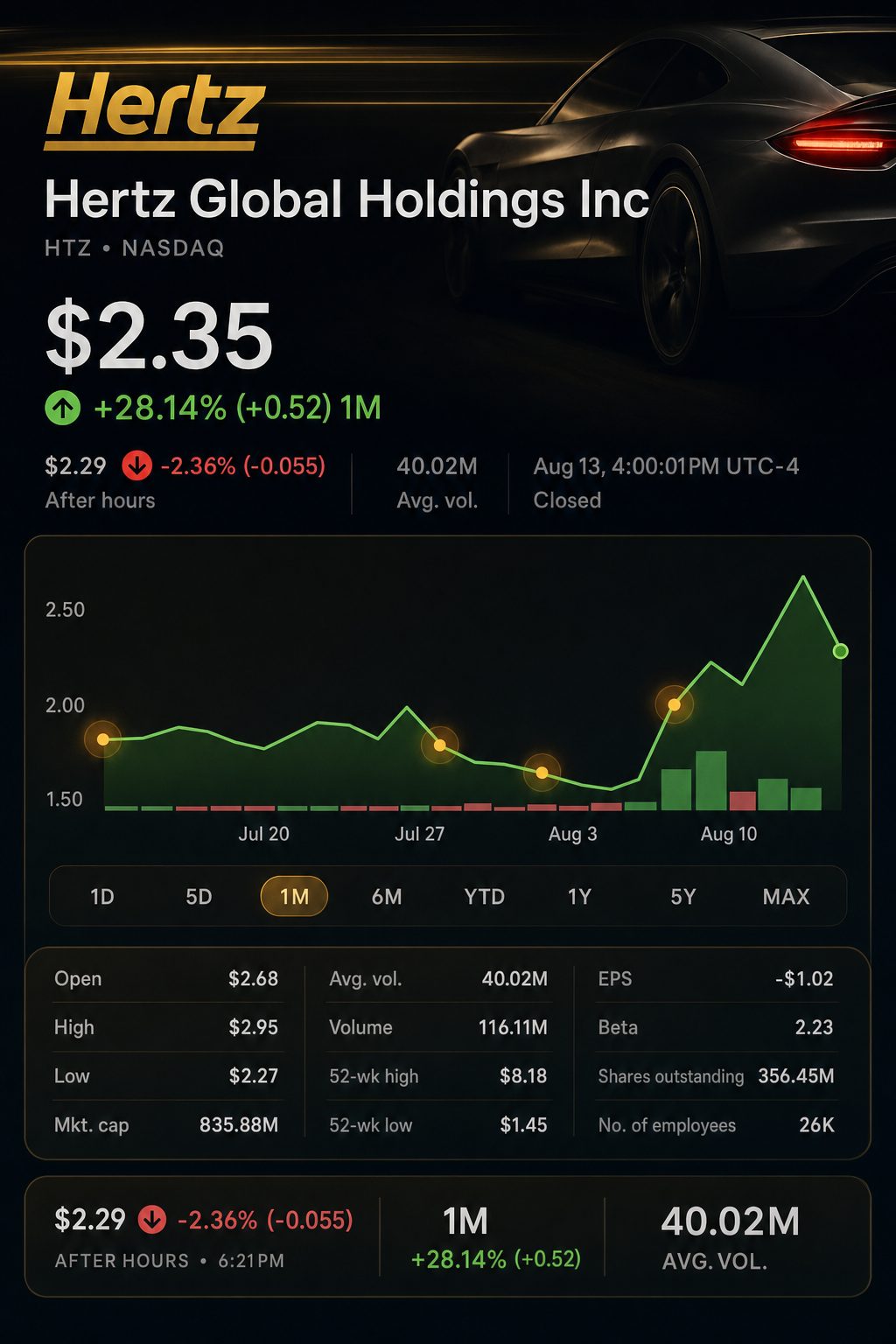
The drop casts greater scrutiny on Hertz’s $984 million in liquidity. That amount is nearly the same as its equity value, though it does not represent available cash for shareholders.
Fleet financing, revolving credit and holders of secured notes all vie for that capital. As a result, the shares continue to represent a leveraged wager on a recovery, rather than a value supported by cash.
| Market or financing signal | Level | Gap from Thursday close |
|---|---|---|
| HTZ closing price | $2.47 | — |
| Price for June borrowed-share deal | $2.70 | +9.3% |
| Conversion rate for exchangeable notes | $3.58 | +44.9% |
| Pershing’s highest economic stake in 2025 | 19.8% | Now sold |
| Short position | Over 34% of float | High volatility |
Pershing Chief Investment Officer Ryan Israel described June’s share deal as “bungled.” He added that the hedge fund considered the move unnecessary. Barron’s
The arrangement was atypical. Hertz provided 37.04 million shares to be sold at $2.70 apiece. The company did not obtain direct proceeds from the sale of stock, aside from a small lending fee.
Hertz’s operating arm opted to generate $350 million via secured exchangeable notes. The 6.75% notes are set to mature in 2030. The company intends to use the net proceeds to pay down its revolver and for general corporate purposes.
| June financing component | Amount | Economic effect |
|---|---|---|
| Secured PIK notes | $350 million | Increased liquidity; senior lien |
| Estimated net note proceeds | $339.5 million | Revolver payoff and general use |
| Borrowed shares | 37,037,037 | Enabled hedging by note investors |
| Gross stock-sale value | $100 million | Hertz received no direct proceeds |
| Initial exchange premium | 32.5% | $3.58 for exchange |
The departure came after real progress in operations. Hertz reported an adjusted loss of 11 cents per share for the second quarter, while analysts had forecast a loss of 24 cents per share.
Revenue totaled $2.4 billion, surpassing the consensus estimate of approximately $2.3 billion. Adjusted corporate EBITDA came in at $81 million, exceeding management’s guidance high by $1 million.
| Second-quarter measure | Reported | Benchmark | Difference |
|---|---|---|---|
| Adjusted EPS | -$0.11 | -$0.24 consensus | $0.13 stronger |
| Revenue | $2.40 billion | About $2.30 billion consensus | Roughly 4% above |
| Adjusted corporate EBITDA | $81 million | $50-$80 million guide | $1 million over upper end |
| Revenue per rental unit | +8% year on year | Prior-year base | Higher |
Chief Executive Gil West stated the quarter showed “disciplined execution of our strategy.” The earnings outperformance triggered a 29.5% surge on August 6. Some of those gains were lost on Thursday.
Wall Street is staying cautious. The latest targets range from $1 to $6, an atypically broad spread for a $2.47 stock. This variance highlights how much traditional earnings forecasts are influenced by financing assumptions.
| Firm | Date | Recommendation | Price target |
|---|---|---|---|
| Barclays | July 28 | Underweight | $1.00 |
| Jefferies | July 28 | Hold | $2.00 |
| Goldman Sachs | July 24 | Sell | $2.00 |
| Morgan Stanley | June 29 | Equal-weight | $3.50 |
| Susquehanna | May 8 | Neutral | $6.00 |
Short sellers remain at risk. Over 34% of Hertz shares available for trading are sold short. A new positive EBITDA shock could trigger a further squeeze, similar to last week’s.
But Thursday’s announcement marked a shift. A major sponsor exited as the stock price neared the funding benchmark. Investors are now seeking sustained cash flow rather than fresh backing.
Risks: Depreciation could rise and proceeds from vehicle sales may fall if used-car prices increase. Elevated debt, PIK interest, fleet financing requirements and short interest could magnify both potential gains and losses.