AUSTIN, Texas, August 14, 2026, 18:35 CDT — U.S. cash markets closed for the weekend.
- Oracle fell 3.8% Friday, sharply underperforming other large cloud providers.
- Fiscal 2026 cloud infrastructure revenue jumped 77%, but free cash flow was negative $23.7 billion.
- Oracle expects roughly $40 billion of new debt and equity funding in fiscal 2027.
Oracle Corporation NYSE:ORCL fell 3.8% to $150.52 on Friday. The retreat left its $638 billion contracted backlog competing with a more immediate investor concern: funding the infrastructure needed to deliver it.
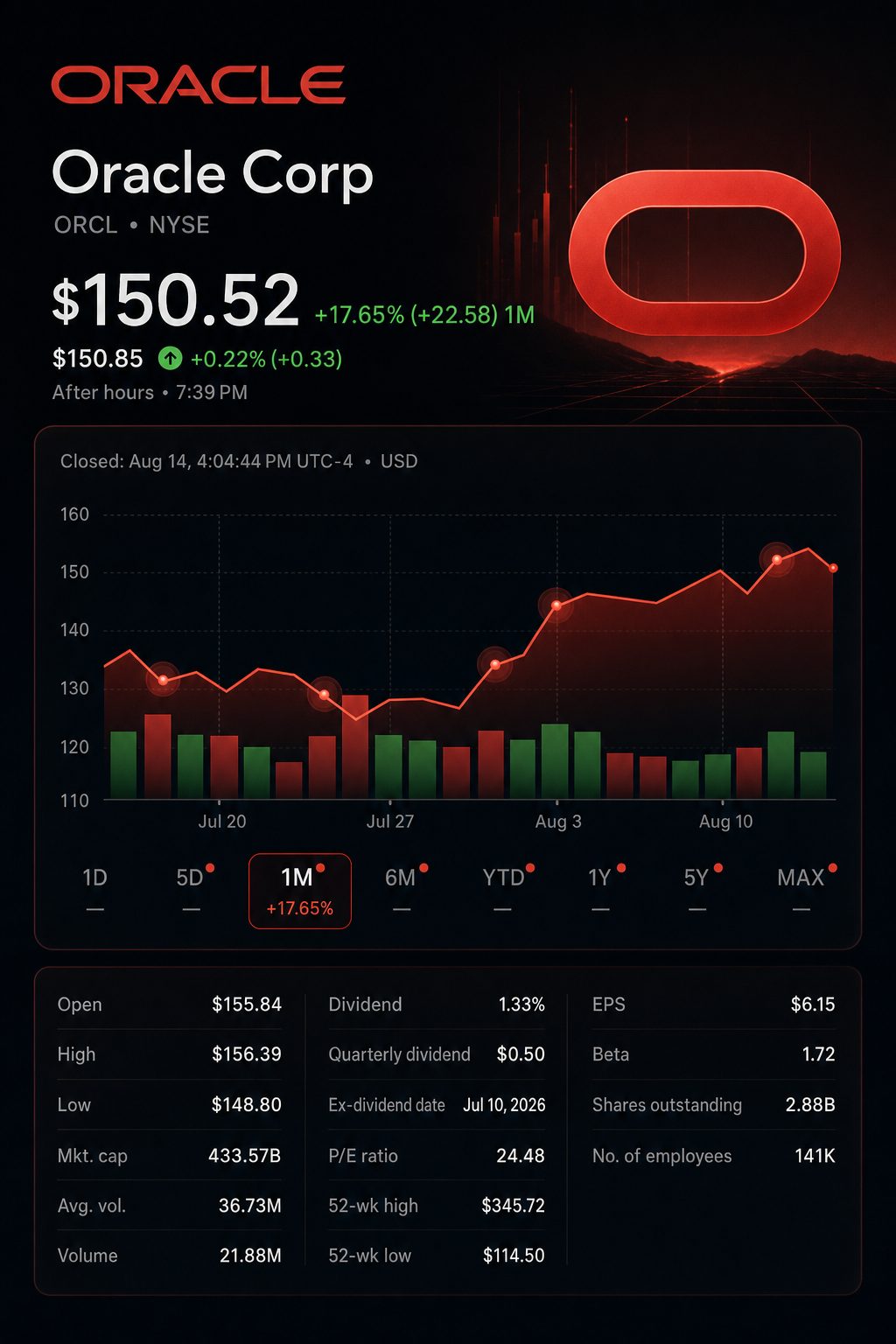
The company plans to raise about $40 billion through debt and equity this fiscal year. That includes a previously announced $20 billion at-the-market share program. Oracle also expects capital spending of up to $95 billion, partly offset by as much as $25 billion of customer repayments.
| Company | Friday close | Daily move | Market value | P/E |
|---|---|---|---|---|
| Oracle NYSE:ORCL | $150.52 | -3.76% | $438.3 billion | 27.0 |
| NVIDIA NASDAQ:NVDA | $225.16 | -0.04% | $5.49 trillion | 34.3 |
| Microsoft NASDAQ:MSFT | $495.40 | -0.34% | $3.69 trillion | 29.5 |
| Amazon NASDAQ:AMZN | $262.65 | -0.94% | $2.86 trillion | 21.1 |
| Alphabet NASDAQ:GOOGL | $345.90 | -0.15% | $4.23 trillion | 17.4 |
Oracle’s growth case remains unusually strong. Fiscal 2026 revenue rose 17% to $67.4 billion, while cloud infrastructure sales grew 77% to $18.1 billion. Yet $55.7 billion of capital investment overwhelmed $32.0 billion of operating cash flow.
| Fiscal 2026 measure | Result | Year-on-year change |
|---|---|---|
| Total revenue | $67.4 billion | +17% |
| Cloud revenue | $34.0 billion | +39% |
| Cloud infrastructure revenue | $18.1 billion | +77% |
| Operating cash flow | $32.0 billion | +54% |
| Free cash flow | -$23.7 billion | Not meaningful |
| Remaining performance obligations | $638 billion | +363% |
That cash gap changes the valuation question. Oracle is no longer financed like a conventional high-margin software vendor. It increasingly resembles a leveraged infrastructure operator with long-lived obligations.
S&P Global Ratings cut Oracle to BBB- in July, one step above speculative grade. Reported debt stood at $129.5 billion, or roughly 4.3 times EBITDA. Alphabet, Amazon, Microsoft and Meta Platforms NASDAQ:META were below one turn of leverage.
| Funding or credit measure | Oracle position | Investor test |
|---|---|---|
| Reported debt | $129.5 billion | 4.3 times EBITDA |
| Data-center leases | About $260 billion | Some begin next year |
| Fiscal 2027 capital spending | Up to $95 billion | Up to $25 billion reimbursed |
| Planned fiscal 2027 funding | About $40 billion | Debt plus equity |
| S&P issuer rating | BBB- | One notch above junk |
S&P analyst Andrew Chang put the threshold plainly: “We could downgrade Oracle if Oracle sustains leverage exceeding 4.5 times.” Moody’s has separately said leverage could temporarily approach five times. Those levels make execution speed central to the stock.
Backlog quality provides a counterweight. Oracle said $75 billion of large AI contracts includes GPUs prepaid or supplied by customers. That reduces its own capital requirement, though Reuters reported that almost half of RPO is tied to OpenAI.
Management is also tightening payroll. Oracle’s workforce fell by 21,000, or 13%, during fiscal 2026. Business Insider reported possible additional reductions before September 1, including double-digit cuts in some teams; Oracle declined to comment.
| Analyst or consensus | Recommendation | Target | Implied move from $150.52 |
|---|---|---|---|
| MarketBeat consensus | Moderate Buy | $263.97 | +75% |
| Piper Sandler | Overweight | $225 | +49% |
| Guggenheim | Buy | $400 | +166% |
| Rothschild & Co Redburn | Sell | Not stated | Not stated |
The target spread captures the debate. Bulls value the 77% infrastructure growth and $638 billion backlog. Bears focus on dilution, execution risk and financing costs before that revenue becomes cash.
Risks: Delayed data centers, weaker AI demand or customer concentration could slow backlog conversion. Faster prepayments, lower capital costs or stronger cloud margins could improve cash flow sooner than expected.
Related articles: NYSE:ORCL