
SANTA CLARA, California, August 15, 2026, 13:12 PDT — NVIDIA Corporation NASDAQ:NVDA on Friday reported holding $63.44 billion in U.S.-listed equities. Intel and SpaceX represented 80.3% of the portfolio’s value.
The concentration introduces another earnings factor ahead of Nvidia’s August 26 report. This has a greater impact on profit swings between quarters than on the stock’s overall valuation.
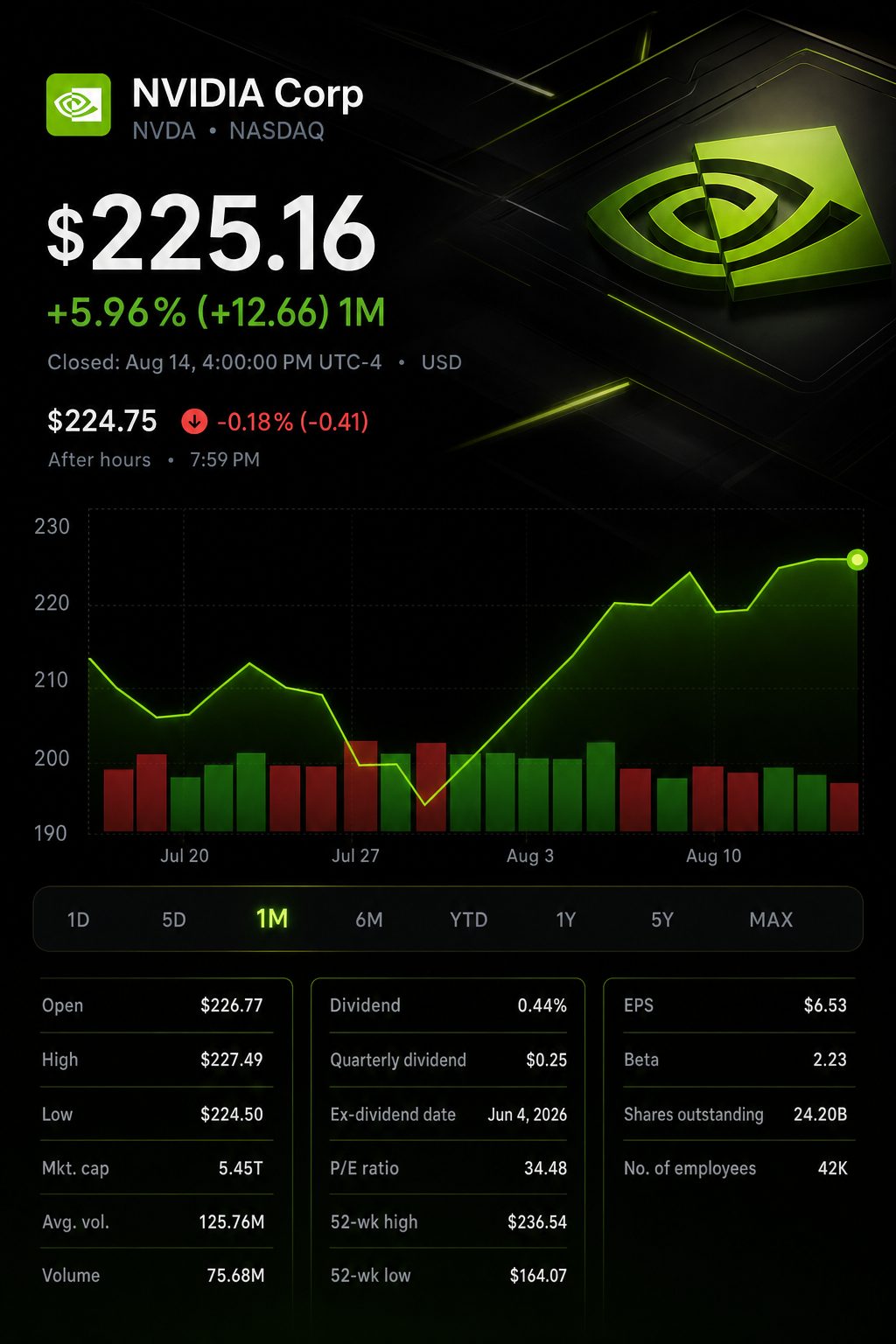
Nvidia ended Friday’s session at $225.16, a drop of 0.06%. The stock is still trading 4.8% under its 52-week peak of $236.54. U.S. markets will not reopen until after the weekend.
The report disclosed holdings as of June 30. Nvidia listed 122.8 million shares in Space Exploration Technologies Corp. NASDAQ:SPCX, with a value of $20.98 billion at that time. Intel Corporation NASDAQ:INTC was higher, totaling $29.99 billion.
| Holding | Shares at June 30 | Filed value | Portfolio weight |
|---|---|---|---|
| Intel NASDAQ:INTC | 214.8 million | $29.99 billion | 47.3% |
| SpaceX NASDAQ:SPCX | 122.8 million | $20.98 billion | 33.1% |
| CoreWeave NASDAQ:CRWV | 47.2 million | $4.70 billion | 7.4% |
| Coherent NYSE:COHR | 7.8 million | $3.07 billion | 4.8% |
| Nokia NYSE:NOK | 166.4 million ADRs | $2.21 billion | 3.5% |
| Synopsys NASDAQ:SNPS | 4.8 million | $2.15 billion | 3.4% |
| Nebius NASDAQ:NBIS and Generate Biomedicines NASDAQ:GENB | 2.0 million total | $342.8 million | 0.5% |
The filing shows unchanged share numbers for seven previous holdings compared to the March report. The total value increased to $42.46 billion from $18.37 billion. SpaceX was included following its listing in June. As a result, the expansion of Nvidia’s portfolio is due to market appreciation and the addition of the newly disclosed stake, rather than significant purchases over the quarter.
The difference matters. The $63.44 billion portfolio accounts for roughly 1.16% of Nvidia’s $5.45 trillion market capitalization. SpaceX on its own made up 0.38%.
| Equity-investment measure | Amount | Investor reading |
|---|---|---|
| Listed portfolio as of June 30 | $63.44 billion | Represents 1.16% of Nvidia’s market capitalisation |
| Combined holdings: Intel and SpaceX | $50.96 billion | Equals 80.3% of total listed assets |
| Equity-security gains for Q1 FY2027 | $15.94 billion | Added to GAAP earnings |
| GAAP net profit for Q1 | $58.32 billion | $12.77 billion higher than non-GAAP figure |
| Q1 net income, non-GAAP | $45.55 billion | Did not reflect changes in equity values |
The effect on earnings may remain significant. Nvidia recorded net equity-security gains of $15.94 billion in the April quarter. GAAP diluted earnings reached $2.39, compared to $1.87 on the company’s non-GAAP basis.
SpaceX demonstrates the potential downside. According to the Financial Times, Nvidia’s stake was valued at about $17 billion after the initial surge following the IPO subsided. This marks a decrease of around $4 billion compared to the valuation from the June filing, depending on quarter-end pricing and how it is recorded in the accounts.
The core business continues to be the primary contributor. Nvidia posted first-quarter revenue of $81.62 billion, an 85% increase year-on-year. Revenue from Data Center operations climbed 92% to $75.2 billion. Chief Executive Jensen Huang stated the AI-factory expansion was “accelerating at extraordinary speed.”
Nvidia projected its second-quarter revenue at $91 billion, with a potential fluctuation of 2% either way. The company did not include any Data Center compute revenue from China in its estimates. Nvidia plans to publish its results on August 26 at around 13:20 PDT, with a conference call set for 14:00.
| Analyst or consensus | Rating | Target | Upside from $225.16 |
|---|---|---|---|
| KeyBanc, July 14 | Overweight | $330 | 46.6% |
| Morgan Stanley, July 10 | Buy | $288 | 27.9% |
| TD Cowen, July 9 | Buy | $275 | 22.1% |
| S&P Global analyst consensus | Strong Buy | $302.83 average | 34.5% |
While analysts retain an overall bullish stance, there is significant divergence in their price targets, which range from $180 to $500. Given this wide spread, the most valuable insights come from monitoring earnings trends, margin forecasts and the company’s exposure to China, rather than relying solely on the consensus target.
No Nvidia results are on the calendar for the upcoming week. Investors will focus on whether the stock can remain close to its all-time high, assessing operational progress apart from portfolio valuations. The filing increases the difficulty of overlooking this distinction.
Risks: Significant GAAP earnings volatility could arise from potential reversals at SpaceX or Intel. Tighter export regulations, supply limitations, and reduced cloud investment continue to pose major threats to Nvidia’s key valuation.
Related articles: NASDAQ:NVDA