
NEW YORK, August 20, 2026, 12:26 EDT
- The Nasdaq Composite dropped 0.8% at midday, while the 10-year Treasury yield climbed to 4.70%.
- Walmart Inc. NASDAQ:WMT fell by 9.4%, but due to its weight in the QQQ, it contributed just approximately 0.23 percentage points to the index’s decline.
- Many analysts maintain an upbeat view on key Nasdaq-100 stocks, making interest rates the central test for broader valuations.
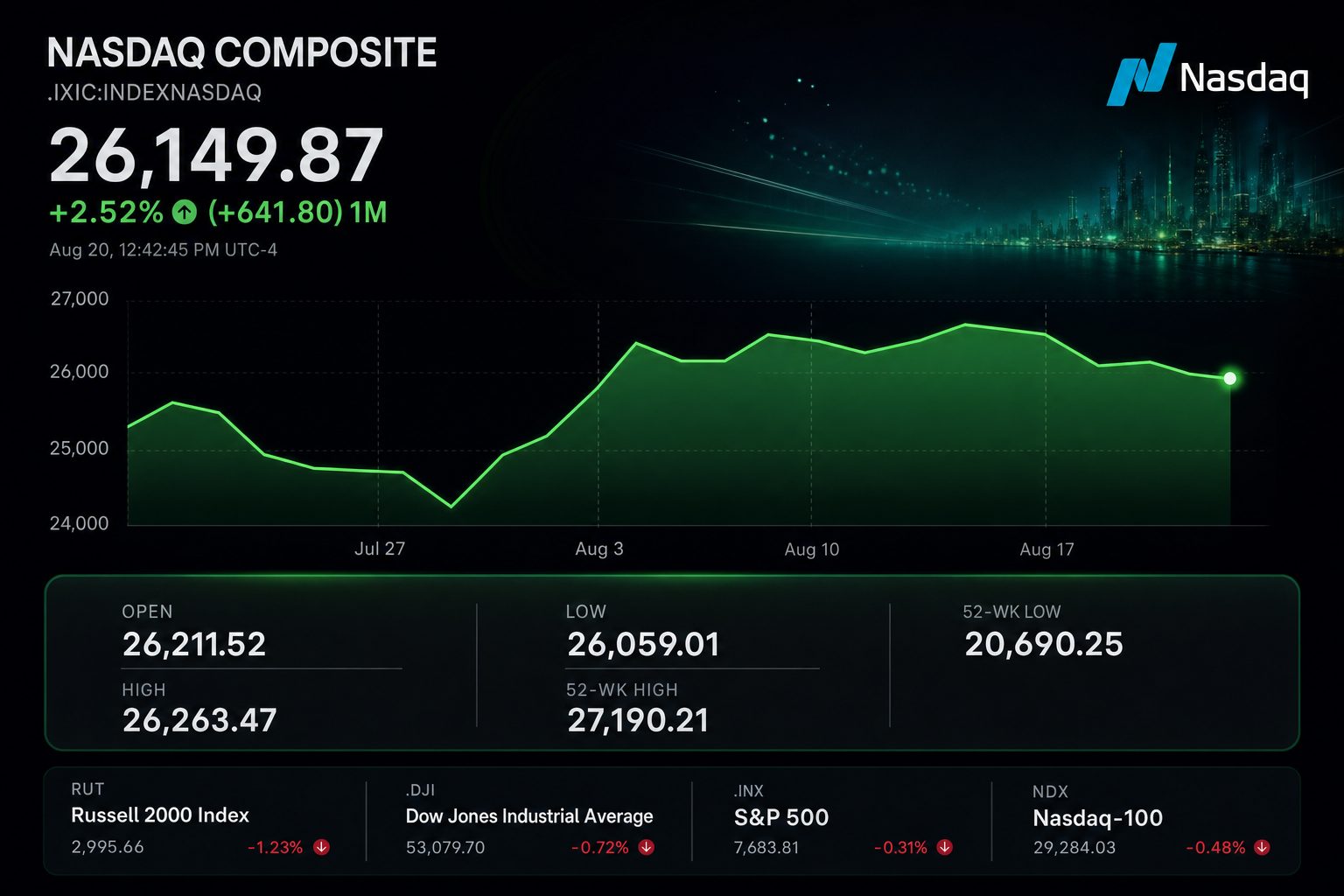
The Nasdaq Composite (INDEXNASDAQ:.IXIC) dropped 0.8% by midday on Thursday. Walmart Inc. NASDAQ:WMT slumped 9.4% as the 10-year Treasury yield climbed to 4.70%. The combination suggested the decline was driven by retail, but index data does not support that view.
Walmart holds a 2.41% weighting in the Invesco QQQ Trust NASDAQ:QQQ. Factoring in Thursday’s share decline at that level suggests an estimated impact of 0.23 percentage points. This is significant, yet there remains an overarching issue with rates and growth stocks.
| Midday market measure | August 20 reading | Investor signal |
|---|---|---|
| Nasdaq Composite | -0.8% | Growth sector underperformed |
| S&P 500 | -0.3% | Declines extended beyond technology |
| Dow industrials | -344 points | Walmart’s drop contributed to losses |
| 10-year Treasury yield | 4.70% | Discount rate moved higher |
| Walmart | -9.4% | Profit concerns drove the fall |
The early data remained consistent. At 09:44 EDT, the Nasdaq fell 0.29% to 26,254.38. The yield on the 10-year was 4.698%, and the yield on the 30-year rose to 5.239%. On the Nasdaq, decliners outnumbered advancers by a 1.68-to-one ratio.
“As the yields start to continue to move up, equity investors will continue to have a problem with it,” said Joe Saluzzi, co-manager of trading at Themis Trading. His comment matches breadth readings. Higher yields decrease the present value of future profits. Reuters
| Pressure channel | Observed move | Likely transmission |
|---|---|---|
| Walmart earnings | WMT -9.4% | Simple weighting suggests roughly -0.23 point drag on QQQ |
| Long-term rates | 10-year at 4.70% | Raises the valuation bar for growth shares |
| Oil | Nearly +2% | New upward pressure on inflation and consumer costs |
| Market breadth | 1.68 Nasdaq decliners per advancer at 09:44 EDT | Declines spread beyond a single name |
The difference is significant since QQQ follows the Nasdaq-100 and not the full Composite. Nevertheless, it remains a relevant concentration check. Walmart falls below the tech sector’s biggest names in the index. Nvidia Corporation NASDAQ:NVDA, Apple Inc. NASDAQ:AAPL, and Microsoft Corporation NASDAQ:MSFT collectively account for over 21% of the fund.
| QQQ constituent | Fund weight | Weight versus Walmart |
|---|---|---|
| Nvidia | 8.52% | 3.5 times |
| Apple | 7.02% | 2.9 times |
| Microsoft | 5.58% | 2.3 times |
| Amazon.com Inc. NASDAQ:AMZN | 4.40% | 1.8 times |
| Tesla Inc. NASDAQ:TSLA | 2.65% | 1.1 times |
| Walmart | 2.41% | Reference |
Walmart’s results delivered a strong signal about consumer behavior. Comparable sales in the U.S. increased by 2.6%, marking the slowest growth rate in six years. The company posted quarterly revenue of $187.94 billion, and adjusted earnings came in at 81 cents per share. Walmart maintained its full-year adjusted earnings outlook at $2.80 to $2.87, which is short of the $2.90 analysts were expecting.
Amazon and Tesla were also down in early trading, according to Reuters. Nvidia and Apple posted gains, restricting the overall drop. This divergence aligns with a repricing driven by higher rates, rather than a broad judgment on demand for artificial intelligence.
Wall Street analysts’ recommendations highlight the division. The consensus is firmest for Nvidia, Microsoft and Amazon. Apple’s rating is less decisive. Walmart’s Buy call is now challenged by a slowdown in store sales.
| Company | Consensus | Analysts | Average target |
|---|---|---|---|
| Nvidia | Strong Buy | 61 | $304.64 |
| Microsoft | Strong Buy | 56 | $569.56 |
| Amazon | Strong Buy | 60 | $326.84 |
| Apple | Buy | 45 | $326.34 |
| Walmart | Buy | 41 | $137.65 |
Bonds continue to act as the primary clear-cut factor in the market. The U.S. Treasury intends to increase long-term debt buybacks from $2 billion to at least $4 billion starting September 9. Thursday’s pullback suggested ongoing uncertainty about debt supply remains unresolved.
Investors are watching to see if the 10-year yield remains close to 4.70%. A pullback could relieve pressure on valuations, while a continued increase would challenge even firms with robust earnings outlooks.
Risks: The QQQ contribution figure is a fixed estimate. Realized attribution may shift due to intraday weight changes, futures, options, or index rebalancing. Rapid moves in oil driven by geopolitical events and new policy headlines could swiftly impact both yields and equities.
Related articles: NASDAQ:WMT






Walmart hurt. Rates widened the wound.
A clean read on the Nasdaq Composite, long yields and QQQ concentration.
One stock cannot explain the whole tape
Read-through: Walmart supplied a visible hit. Weak breadth and higher yields show a wider repricing.
QQQ weight map
Analyst recommendation check
| Constituent | QQQ weight | Consensus | Analysts | Average target |
|---|---|---|---|---|
| Nvidia | 8.52% | Strong Buy | 61 | $304.64 |
| Microsoft | 5.58% | Strong Buy | 56 | $569.56 |
| Amazon | 4.40% | Strong Buy | 60 | $326.84 |
| Apple | 7.02% | Buy | 45 | $326.34 |
| Walmart | 2.41% | Buy | 41 | $137.65 |
Analyst snapshot collected 20 Aug 2026 at 12:29 EDT. Targets are company-specific; they are not a Nasdaq forecast.
Investor watch
The 10-year retreats below 4.70%, easing the growth-stock discount rate.
Walmart stays isolated while AI leaders absorb the rate pressure.
Long yields hold near highs and earnings sensitivity spreads.