
SEATTLE, August 21, 2026, 19:05 PDT
- Engineers at Boeing turned down the proposal with 64% voting against; 72% of technical staff also voted to reject it.
- Members have given approval for a strike, though the soonest a walkout could occur is October 7.
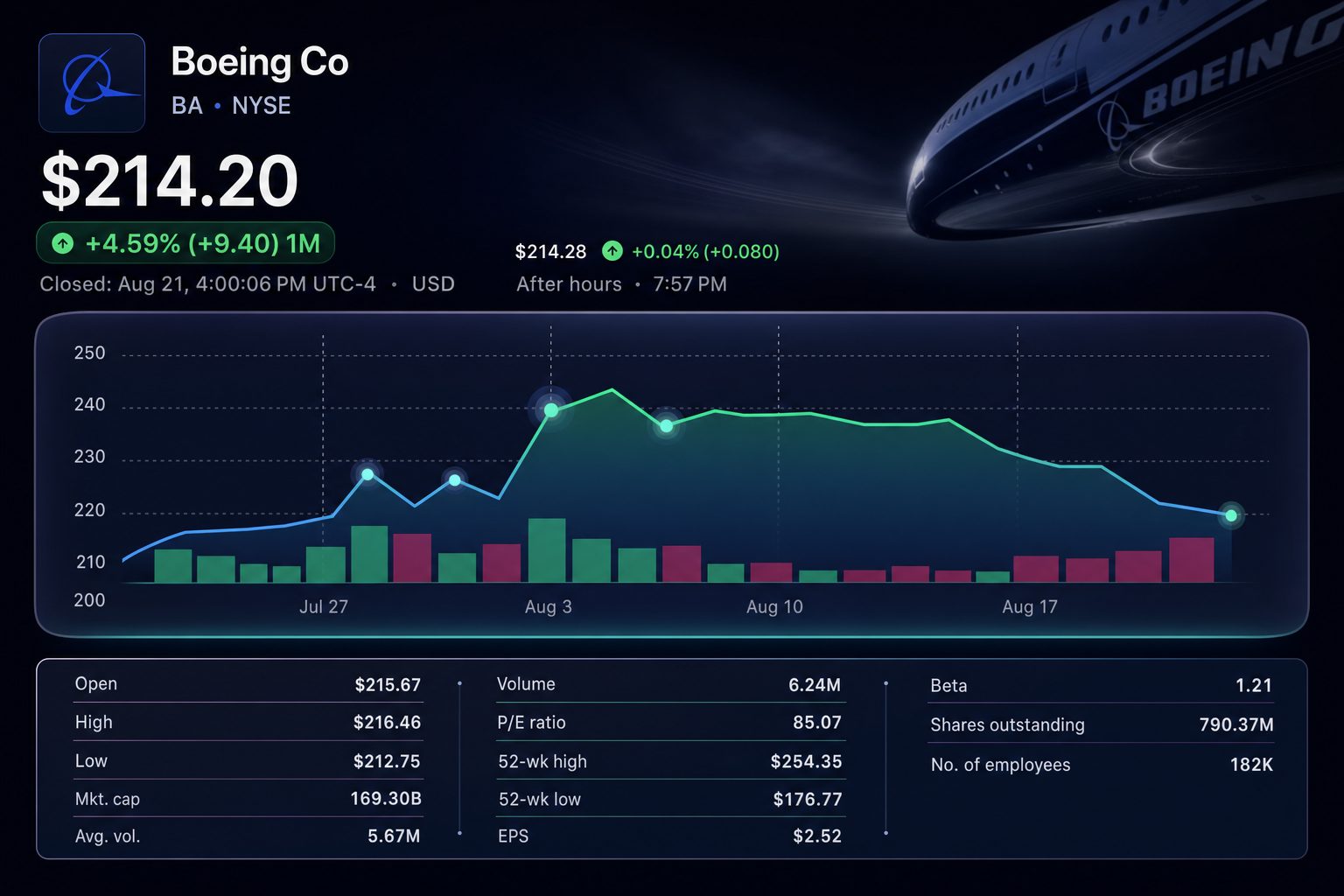
- Boeing stock ended Friday’s session at $214.20, marking a 7.5% decline for the week.
Boeing NYSE:BA faced a fresh labor deadline after about 17,000 engineers and technical staff turned down a proposed four-year contract and voted to strike. Shares finished Friday at $214.20, marking a 7.5% drop from the previous week’s close.
The vote does not immediately halt production. Existing contracts remain in effect until October 7. However, the workers impacted are directly involved in certification and engineering tasks for the 737 MAX 7, MAX 10 and 777X.
This primarily presents a schedule risk. Any certification work slowdown could further postpone cash inflows linked to deliveries that have already been delayed. Boeing stated it is maintaining its initial proposal and has initiated contingency measures.
| Labor marker | Verified figure | Investor reading |
|---|---|---|
| Unionized employees | About 17,000 | Engineering and technical resources |
| Engineers voting no | 64% | Clear majority rejected proposal |
| Technical staff voting no | 72% | Greater level of resistance |
| Total wage gains proposed | About 32% | Deal covers four years |
| Soonest strike could begin | October 7 | 47 days post-vote |
The decline in shares reflects some concerns over execution. Based on 789.8 million shares outstanding in the second quarter, the decrease over the week wiped out approximately $13.8 billion in market value. This figure is an initial calculation using closing prices.
| Market measure | Value | Change |
|---|---|---|
| August 14 close | $231.67 | Baseline |
| August 17 close | $225.95 | -2.5% that day |
| August 21 close | $214.20 | -0.4% Friday |
| Weekly move | -$17.47 | -7.5% |
| Estimated equity value lost | $13.8 billion | Calculation uses 789.8 million shares |
Boeing’s balance sheet provides flexibility in talks, but that flexibility has limits. Operating cash flow in the second quarter totaled $1.36 billion. Free cash flow stood at $631 million, with debt unchanged at $45.9 billion.
| Q2 recovery marker | Q2 2026 | Year-on-year |
|---|---|---|
| Revenue | $24.56 billion | Up 8% |
| Commercial deliveries | 171 | Increase of 14% |
| Operating cash flow | $1.36 billion | Growth of $1.14 billion |
| Free cash flow | $631 million | Rising from -$200 million |
| Total backlog | $715 billion | All-time high |
Chief Executive Kelly Ortberg stated in July that operations were “more stable” and certification programs stayed on track. That assertion is now under scrutiny with the labor vote. Boeing is moving 737 production toward 47 jets each month and anticipates initial deliveries of the MAX 7, MAX 10, and 777X in 2027. Boeing second-quarter results
The backlog ensures demand coverage. At $715 billion, it represents roughly 7.3 years’ worth of annualized revenue based on the second quarter. The risk of slippage also increases, as clients have already queued for limited delivery slots.
The parallel with 2024 is not exact. At that time, a seven-week work stoppage saw around 33,000 machinists walk out, disrupting assembly in the Seattle region. SPEEA employs about half as many people, yet its influence lies mainly in areas like design, testing and certification.
| Analyst action | Rating | Target | Upside vs. $214.20 |
|---|---|---|---|
| Argus, August 11 | Raised to Buy | $265 | 23.7% |
| Tigress, August 6 | Buy | $305 | 42.4% |
| BNP Paribas Exane, August 3 | Upgraded to Outperform | $300 | 40.1% |
| 28-analyst consensus | Buy | $274.85 average | 28.3% |
Analysts maintain a positive outlook on the extended rebound. The consensus price target is 28.3% higher than Friday’s closing level. This gap is notably large for a major industrial company, highlighting the level of execution still required.
Other aerospace stocks saw marginal declines Friday. RTX Corporation NYSE:RTX slipped 1.1% to $209.91, and Boeing shed 0.4%. The S&P 500, meanwhile, gained 0.4%, suggesting the drop in aerospace shares was isolated to the sector.
Risks: Members might approve a modified agreement ahead of October 7, eliminating the strike premium. On the other hand, extended negotiations may divert engineering teams’ attention prior to any official strike. Risks around certification schedules, production standards and client concessions persist independently.
Markets will open again on Monday, August 24. Investors are advised to monitor planned bargaining sessions, results from a member survey, and any updates to Boeing’s contingency strategy. A critical indicator will be if both parties significantly close differences ahead of October.
Related articles: NYSE:BA