
NEW YORK, August 24, 2026, 07:10 EDT
- PDD Holdings Inc. NASDAQ:PDD posted second-quarter revenue of RMB112.36 billion, falling approximately 3.4% short of the LSEG consensus estimate.
- Operating profit increased by 8% and operating cash flow climbed 19%, while net income declined 12% following an other loss of RMB7.40 billion.
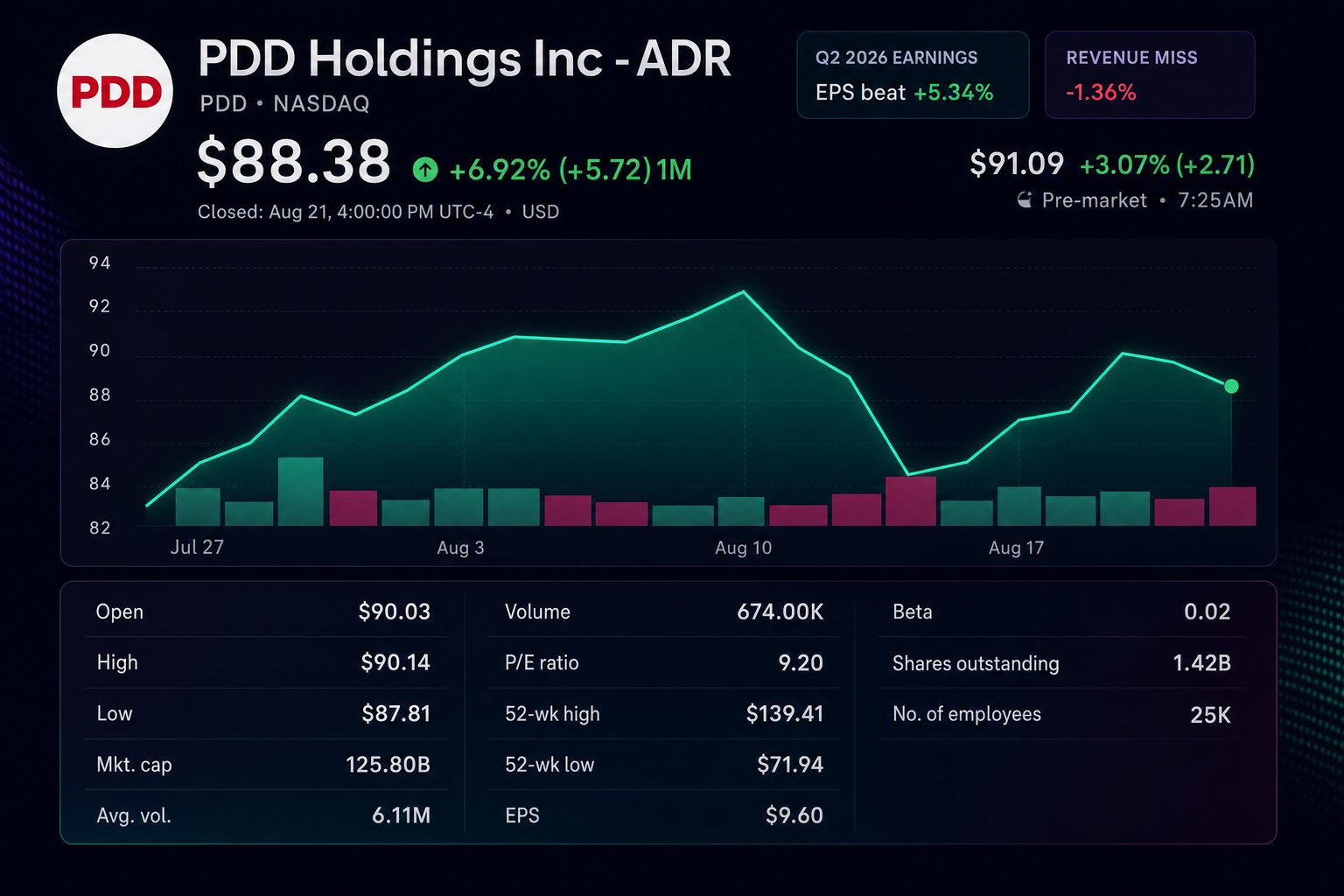
- The stock was up 1.57% at $89.77 as of 06:41 EDT ahead of the U.S. market open on Monday.
PDD Holdings posted second-quarter results showing a significant non-operating impact and a deceleration in sales momentum. The company’s revenue increased 8% to RMB112.36 billion, falling short of the RMB116.35 billion forecast from LSEG. Shares of the Temu parent traded in the U.S. rose 1.57% ahead of the market open.
The important information lies beneath the headline. Operating profit rose by 8%, and cash flow from operations was up 19%. However, net income dropped 12% as “other” items shifted by about RMB7.52 billion.
| Q2 measure | 2026 | 2025 | Change |
|---|---|---|---|
| Revenue | RMB112.36bn | RMB103.99bn | +8% |
| Operating profit | RMB27.76bn | RMB25.79bn | +8% |
| Net income attributable to shareholders | RMB27.20bn | About RMB32.0bn | -12% |
| Operating cash flow | RMB25.70bn | RMB21.60bn | +19% |
| Cash and short-term investments | RMB456.40bn | RMB422.30bn at Dec. 31 | +8% |
The bridge is important as it distinguishes platform economics from below-the-line fluctuations. PDD reported an RMB7.40 billion loss in this category, compared with RMB119 million in income a year before. Interest and investment income increased to RMB13.51 billion, helping offset some of the loss.
Core growth showed inconsistency. Transaction-services revenue rose 13%, driven by marketplace activity. Online-marketing revenue grew just 3%, marking the slower segment of the business.
| Operating line | Q2 2026 | Q2 2025 | Change |
|---|---|---|---|
| Online marketing and other services | RMB57.60bn | RMB55.70bn | +3% |
| Transaction services | RMB54.70bn | RMB48.30bn | +13% |
| Sales and marketing | RMB29.67bn | RMB27.21bn | +9% |
| General and administrative | RMB2.34bn | RMB1.53bn | +53% |
| Research and development | RMB4.57bn | RMB3.59bn | +27% |
Expenses climbed at a quicker pace, with total operating costs up 13%, outpacing revenue growth. Research and development spending advanced 27%, and general and administrative expenses surged 53%. The figures suggest increased investment in compliance and platform improvements.
Chairman and co-CEO Lei Chen stated that global trade and regulatory environments had “evolved significantly.” Chen added that PDD would continue to invest in developing a reputable platform. The company did not provide guidance for the quarter. Company statement
The balance sheet offers flexibility. Cash, cash equivalents, and short-term investments stood at RMB456.4 billion, or $67.3 billion. This amount is equivalent to about four quarters of present revenue.
Investors prioritized profit quality after the sales miss. Shares of PDD were trading at $89.77 at 06:41 EDT, compared to a close of $88.38 on Friday. The reaction was limited, with premarket conditions often impacting initial pricing.
| Analyst recommendation | Count | Share of 37 |
|---|---|---|
| Strong Buy | 18 | 49% |
| Buy | 4 | 11% |
| Hold | 14 | 38% |
| Sell | 1 | 3% |
| Average price target | $116.51 | Roughly 32% over Friday’s close |
The majority viewpoint remains positive. Out of 37 analysts, 22 recommend PDD as Buy or Strong Buy. However, 14 Hold ratings indicate persistent concerns about regulatory risks and decelerating growth.
Valuation indicates some degree of caution is priced in. At Friday’s close, PDD was trading at approximately 9.5 times its trailing earnings and 7.9 times its forward earnings. The shares stood 37% beneath the highest point in their 52-week range.
The key test on Monday is if the early rise holds during standard market hours. If the increase lasts, it may mean investors believe the other loss is short-term. Should shares fall back, concerns about missing revenue targets and rising costs could take precedence again.
Risks: Intense domestic price rivalry continues. Temu must also navigate evolving trade regulations and increased oversight abroad. Higher compliance costs, support for merchants and ongoing expenses may weigh on margins.