
LONDON, Aug 24, 2026, 18:45 BST
- Media outlets reported that hackers with ties to Iran knocked a small, unidentified British power generator offline for four days in July; confirmation of attribution is still pending.
- UK officials reported that power was maintained for all customers and there was no risk to the broader grid.
- The proposed regulations would mandate an initial notification of an incident within 24 hours, followed by a comprehensive report within 72 hours.
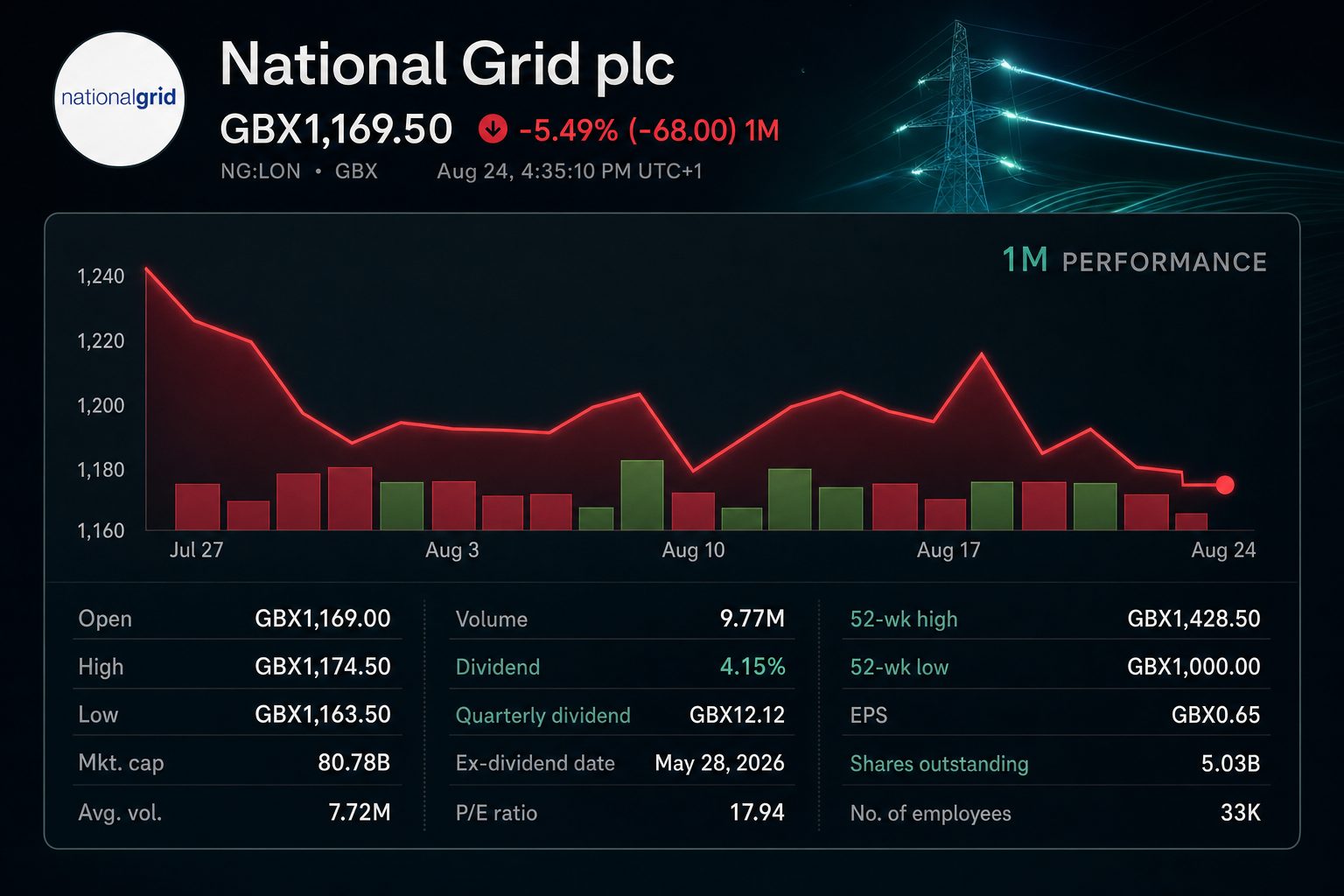
- National Grid’s London listing, reported late, stood at 1,165.5p at 13:12 BST, a decrease of 0.44%. The company’s £70 billion investment plan is increasing the importance of cyber resilience.
The Google search phrase “iranian hackers shut down uk power plant” took on an investor angle on Monday after the UK briefed energy sector leaders about a reported cyberattack from July. According to media, the attack took a small, unidentified generator offline for four days. The government has not disclosed who was responsible. Reuters
The outage was minimal. However, the regulatory message is significant. Utilities will now contend with stricter reporting requirements, increased oversight of technology vendors, and a tougher evaluation of whether cybersecurity spending matches the scale of physical grid growth.
National Grid plc LSE:NG. was not named as the operator of the impacted plant. It remains the most prominent listing for investors, as it controls the high-voltage electricity network in England and Wales, and is carrying out the UK’s largest listed grid-investment programme.
| Incident point | Verified status | Investor consequence |
|---|---|---|
| Operator | Withheld | No identifiable earnings effect for individual companies |
| Duration | Spanned four days per media outlets | Technology operations may be disrupted for several days |
| Grid effect | No broader hazard; zero customer interruptions | Short-term impact to system and revenue considered negligible |
| Attribution | Allegedly tied to Iran; official confirmation lacking | Geopolitical exposure remains a hypothetical, unproven risk |
| Policy response | Sector briefings and calls for more timely disclosure | Possible increases in compliance and supply chain costs |
Energy Minister Michael Shanks stated “there was no threat to the wider grid and nobody lost power.” He described the generator as small in scale compared to a standard power station. Authorities are coordinating with regulators and the National Cyber Security Centre to evaluate risks. Reuters
Regulation of funds operates via rules and procurement. Britain is weighing measures to limit high-risk suppliers and gradually remove vulnerable technology from key infrastructure. The planned Cyber Security and Resilience Bill would further expand requirements for incident notification.
Under the bill, operators must submit an initial notification within 24 hours, followed by a complete report in 72 hours. The narrower timeframe speeds up internal triage and increases the importance of monitoring, forensic, and vendor-governance solutions.
| National Grid share marker | Price | Change | Timestamp |
|---|---|---|---|
| Aug 14 close | 1,193.5p | Reference level | 16:30 BST close |
| Aug 21 close | 1,171.0p | Losed 1.89% week-on-week | 16:30 BST close |
| Aug 24 delayed quote | 1,165.5p bid | Session down 0.44% | 13:12 BST, 15-minute delayed |
| 52-week range | 1,000.0p–1,428.5p | Trading 18.4% beneath 52-week peak | Aug 24, 13:12 BST |
The stock did not register a cyber-focused drop. It slipped 1.9% for the week to Friday, then was down 0.44% at 1,165.5p in Monday’s delayed session. The FTSE 100 ended the day up 0.35% at 10,854.32.
The subdued response aligns with the facts. The targeted location remained unidentified, and there was no broader impact on systems. Investors are expected to assess the event in terms of potential operating expenses, regulatory considerations, and the risk of execution.
| National Grid metric | FY2026 | FY2025 | Change |
|---|---|---|---|
| Statutory operating profit | £5.431bn | £4.934bn | +10% |
| Underlying EPS | 78.0p | 73.3p | +6% |
| Capital investment | £11.576bn | £9.847bn | +18% |
| Net debt | £44.160bn | £41.371bn | +7% |
| Dividend per share | 48.49p | 46.72p | +3.8% |
National Grid’s capital investment reached £11.6 billion in the year to March, up 18%, while net debt increased by 7% to £44.2 billion. Additional expenses for cybersecurity and supply chains would add to an already demanding project schedule.
The group aims to invest at least £70 billion by the end of fiscal 2031. It is seeking around 10% growth in assets each year and 8%–10% growth in underlying EPS annually. Chief Executive Zoë Yujnovich stated that “modern, resilient networks are fundamental to economic growth.” National Grid regulatory announcement
Regulation presents both advantages and risks. Authorised resilience investments may increase the regulated asset base and help maintain returns. However, weak performance, unrecovered costs or penalties could strain cash flow at a time when leverage is already increasing.
| Analyst | Rating | Target | Latest action |
|---|---|---|---|
| UBS | Sell | 1,150p | Unchanged, Aug 3 |
| Jefferies | Hold | 1,300p | Unchanged, Aug 3 |
| Barclays | Buy | 1,500p | Unchanged, Jul 2 |
| RBC Capital | Hold | 1,375p | Unchanged, Jul 1 |
| 15-analyst consensus | Hold | 1,355p average | Range: 1,060p–1,500p |
Opinions among analysts are divided. S&P Global’s group of 15 analysts includes seven with positive recommendations, six with hold ratings, and two with negative outlooks. The average price target stands at 1,355p, indicating roughly 16% potential growth from the Monday morning delayed reference of 1,171.5p. However, targets vary between 1,060p and 1,500p.
The upcoming test for investors is transparency. Revealing the operator, the technique of the attack, or which vendor was impacted may shift the risk from the entire sector to certain firms. For now, cyber resilience should be viewed as part of National Grid’s performance metrics, rather than as a record of outages.
Risks: The attribution has not been confirmed and the operator has not been identified. Upcoming rules could be altered before implementation, and regulators might permit operators to recoup effective security expenditures from customers.