
NEW YORK, August 24, 2026, 15:45 EDT — U.S. equities traded during regular hours.
- At 14:02 EDT, the S&P 500 had fallen 0.26%; the SPY tracker declined 0.23% by 15:29 EDT.
- Semiconductor stocks dropped 2.33%, as the equal-weight S&P 500 hovered near flat.
- Nvidia is set to report results and July PCE inflation data will also be released on Wednesday.
The S&P 500 fell in late afternoon trading on Monday, pressured by a drop in chip stocks despite easing Treasury yields. The benchmark index was down 0.26% at 7,654.13 as of 14:02 EDT. The SPDR S&P 500 ETF Trust NYSEARCA:SPY traded 0.23% lower at $763.94 at 15:29 EDT, reflecting a steady, mild retreat.
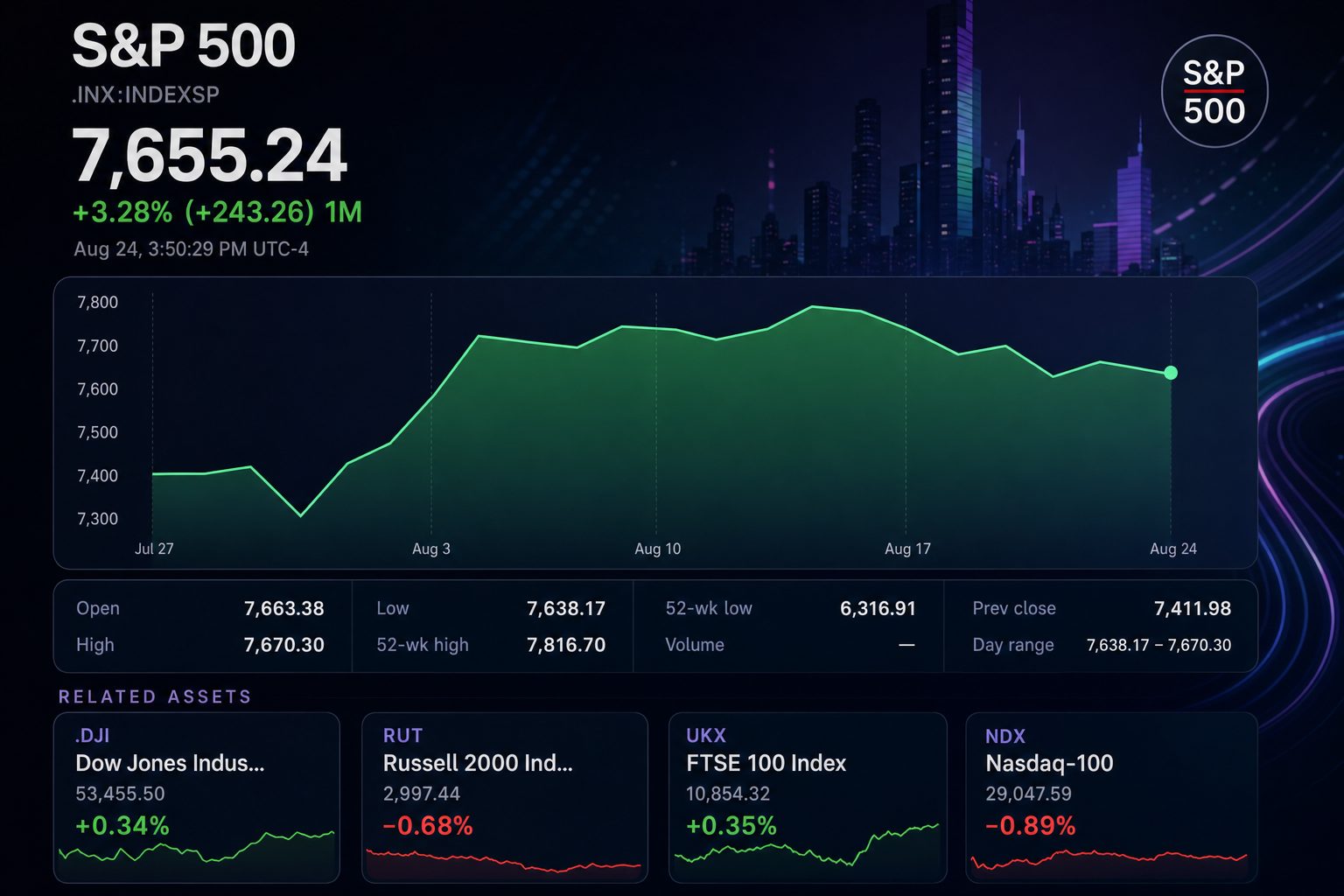
A more notable development occurred below the SPX. The Invesco S&P 500 Equal Weight ETF NYSEARCA:RSP edged higher by 0.03%. This created a difference of 0.26 percentage points compared to SPY, indicating that losses were focused among larger components of the index rather than being distributed across the board.
The S&P 500 carries significant weight by market value, a crucial factor, as it represents roughly 80% of U.S. market capitalization, S&P Dow Jones Indices data shows. As a result, large swings in several mega-cap technology stocks can have a greater impact than more stable action in other parts of the index.
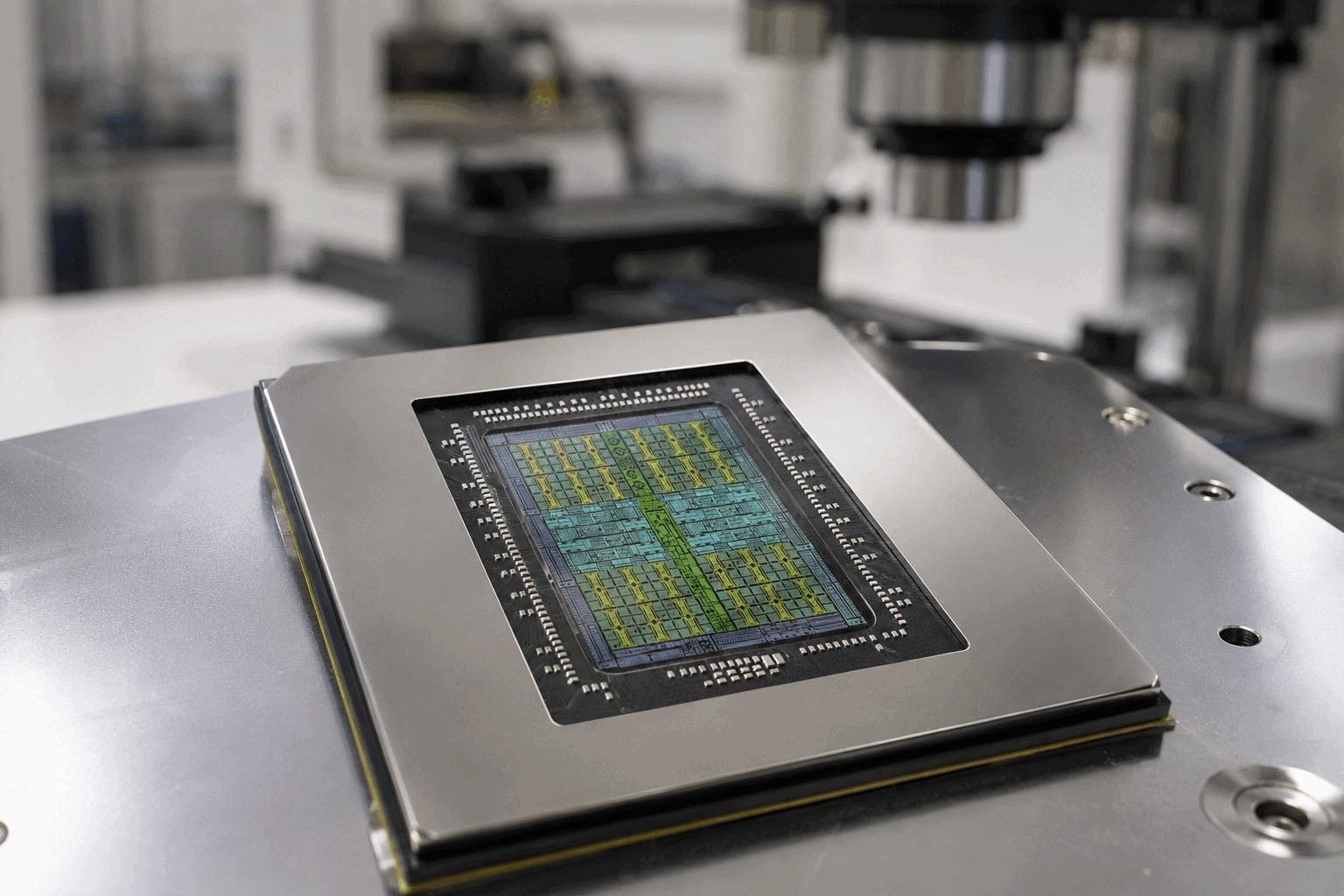
The iShares Semiconductor ETF NASDAQ:SOXX slipped 2.33% to trade at $507.92 by 15:29 EDT. NVIDIA Corporation NASDAQ:NVDA dropped nearly 2.45% to $209.47. Reuters previously reported moves including a 5.6% loss for Micron Technology, Inc. NASDAQ:MU and a 2.1% decrease for Broadcom Inc. NASDAQ:AVGO.
Technology trailed while other sectors withstood the strain. The Technology Select Sector SPDR Fund (NYSEARCA:XLK) slipped 1.50%, in contrast to a 1.13% rise for the Financial Select Sector SPDR Fund (NYSEARCA:XLF). The 2.63-point differential marked the session’s most evident sign of sector rotation.
Intraday overview by segment
| Exposure | Ticker | Price | Day move | Read-through |
|---|---|---|---|---|
| S&P 500 tracker | SPY | $763.94 | -0.23% | Large caps under pressure |
| Equal-weight S&P 500 | RSP | $221.74 | +0.03% | Wider market remains steady |
| Semiconductors | SOXX | $507.92 | -2.33% | Main area of weakness |
| Technology | XLK | $180.56 | -1.50% | Exposed to AI and chips |
| Financials | XLF | $58.13 | +1.13% | Sector offers support |
| Nasdaq-100 tracker | QQQ | $707.73 | -0.80% | Growth stocks down further |
Semiconductors bounced back from intraday lows, though they did not fully erase losses. SOXX dipped to $499.06, later climbing 1.78% to reach $507.92. SPY saw a modest recovery, gaining 0.24% off its session low of $762.12. While this rebound helped ease short-term strain, it did not offset the lag in chip performance.
The upcoming test is scheduled for Wednesday. Nvidia plans to announce its fiscal second-quarter earnings at 14:00 PDT, which is 17:00 EDT, as detailed on the company’s investor calendar. During the previous quarter, the company posted $81.6 billion in revenue, with $75.2 billion attributed to data centers.
“Nvidia must deliver strong results if it wants to help stabilize a key part of the stock market,” Richard Reyle, chief investment officer at Questar Capital Partners, told Reuters.
Rates are still a key factor. The 30-year Treasury yield held above 5%, despite news suggesting potential Treasury bond-buyback assistance. According to the U.S. Treasury, official daily par yields rely on market quotes gathered around 15:30 EDT.
July personal income and outlays are due on Wednesday at 08:30 EDT. This release includes the PCE inflation gauge, regarded by the Federal Reserve as its preferred inflation measure. According to the Bureau of Economic Analysis, the next update is scheduled for August 26.
Market breadth appeared weak, though not deteriorated. On the NYSE, declining stocks outnumbered advancing ones by a ratio of 1.21 to 1. Despite this, the S&P 500 posted 16 new 52-week highs, compared to seven new lows. This pattern is more consistent with a focused technology retracement than with a broad-based equity selloff.
Risks: Robust Nvidia results combined with steady long-term yields may quickly close the gap between sectors. A miss in guidance, softer AI demand, or a fresh climb in the 30-year yield could extend semiconductor losses to the wider index. Friday’s Jackson Hole speech brings an additional catalyst for rates.
Related articles: NASDAQ:NVDA