
CAMBRIDGE, Massachusetts, August 24, 2026, 16:55 EDT —
- Moderna ended down 4.3% at $138.89, as trading volume reached roughly 2.4 times its three-month average.
- The stock is still up 120.6% from its August 18 close, which was before the favorable Phase 3 cancer-vaccine results.
- The analyst consensus target of $95.67 suggests a valuation gap of about $17 billion compared to the market value on Monday.
Shares of Moderna, Inc. NASDAQ:MRNA dropped 4.3% on Monday, as investors weighed the extent to which a milestone cancer-vaccine result could sustain the company’s value ahead of regulators reviewing the complete data.
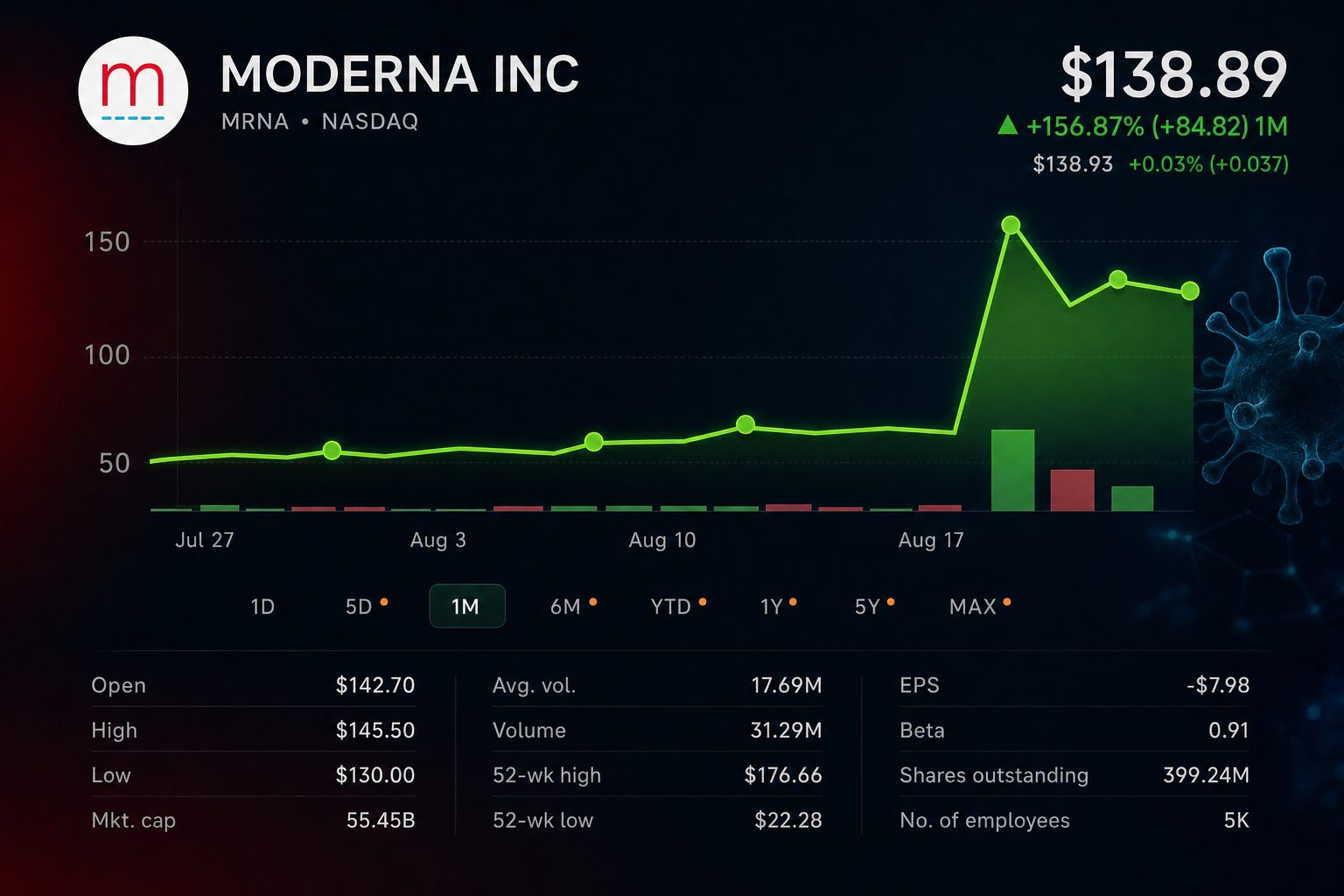
The stock ended the session at $138.89, moving within a range of $130.00 to $145.50. Trading volume totaled around 31.5 million shares, about 2.4 times the stock’s typical average. In after-hours trading as of 16:30 EDT, the price held nearly steady at $138.86.
The drop was slight compared to the volatility seen last week. Moderna surged 177% on August 19 before falling 23.6% the following day. At Monday’s close, shares remained up 120.6% from the pre-readout price of $62.96.
This puts the firm’s valuation at around $55.5 billion, using 399.24 million shares outstanding. With a consensus target of $95.67, the company’s equity would be valued closer to $38.2 billion. The gap between the two figures is approximately $17.3 billion.
The main issue for investors is the valuation gap. Advances in positive science have moved intismeran autogene from an early-stage project to a possible product. However, Wall Street continues to wait for Phase 3 effect size, overall survival data, and details on regulatory filing plans.
Moderna and Merck & Co., Inc. NYSE:MRK reported the INTerpath-001 melanoma study, involving 1,137 participants, achieved both primary endpoints. The individualized treatment, used with Keytruda, led to better recurrence-free and distant-metastasis-free survival outcomes compared to Keytruda alone. Full data will be shared at an upcoming medical conference.
Chief Executive Stéphane Bancel said, “Today marks an extraordinary milestone for Moderna, for mRNA science and, most importantly, for patients with cancer,” following the readout. The outcome represents the first successful Phase 3 trial for both an individualized neoantigen therapy and an mRNA-based cancer therapy. Moderna investor-relations insight
Merck says updated five-year Phase 2b results provide additional perspective but do not replace Phase 3 data. The combination lowered the risk of recurrence or death by 49% over five years. Risk of distant metastasis or death fell by 59%.
| Firm | Rating | Current target | Latest action |
|---|---|---|---|
| Barclays | Hold | $125 | Target increased from $48 on Aug. 24 |
| UBS | Hold | $150 | Target lifted from $50 on Aug. 20 |
| Morgan Stanley | Hold | $89 | Target raised from $39 on Aug. 19 |
| Jefferies | Hold | $60 | Hold reiterated on Aug. 19 |
| BofA | Hold | $170 | Upgraded; target boosted from $40 on Aug. 19 |
On Monday, Barclays analyst Eliana Merle raised her price target to $125, more than twice the previous level, while maintaining an Equal Weight rating. Merle noted that the market currently assigns material value to several tumor types. She also emphasized that differences across tumors remain significant.
Even the higher target remains roughly 10% under Monday’s closing price. The wider consensus suggests a 31% decline. However, the span is notably large, between $25 and $170, reflecting how a single clinical outcome has disrupted valuation assessments.
Moderna’s available funds give it additional breathing room. The firm projects ending 2026 holding $4.7 billion to $5.2 billion in cash and investments. It has also cut its full-year operating-expense forecast by roughly $200 million following a second-quarter net loss of nearly $800 million.
Analysts expect revenue to reach $2.11 billion in 2026, with a per-share loss of $8.62. In 2027, revenue is projected at $2.46 billion, as the loss per share reduces to $4.58. Most of the new market value is attributed to the cancer segment.
Risks: Phase 3 hazard ratios have not been revealed, overall-survival findings are still early, and authorities may require additional follow-up. Constraints such as personalized production, available treatment capacity, and reimbursement could restrict uptake. Any disappointing data release may put the premium above consensus forecasts at risk.
The forthcoming key development is expected after the complete Phase 3 presentation or further regulatory feedback. In the meantime, Monday’s high trading volume indicates investors are adjusting their risk assessments rather than simply acknowledging proof of concept.
Related articles: NASDAQ:MRNA