
NEW YORK, August 25, 2026, 07:56 EDT — U.S. premarket activity remained robust.
- Nvidia stock gained roughly 1.3% in premarket trading following seven consecutive losing sessions.
- Options are indicating a 5.4% swing after results, equivalent to about $280 billion in market capitalization.
- LSEG consensus forecasts quarterly revenue of $92.18 billion, almost twice as much as the prior year.
- The main challenges are Rubin’s timing, 75% margins, and customer financing supported by Nvidia.
Nvidia Corporation NASDAQ:NVDA advanced approximately 1.3% during premarket trading on Tuesday ahead of its fiscal second-quarter results. Options indicate a possible 5.4% swing after the close on Wednesday, which would translate to about $280 billion in market capitalization.
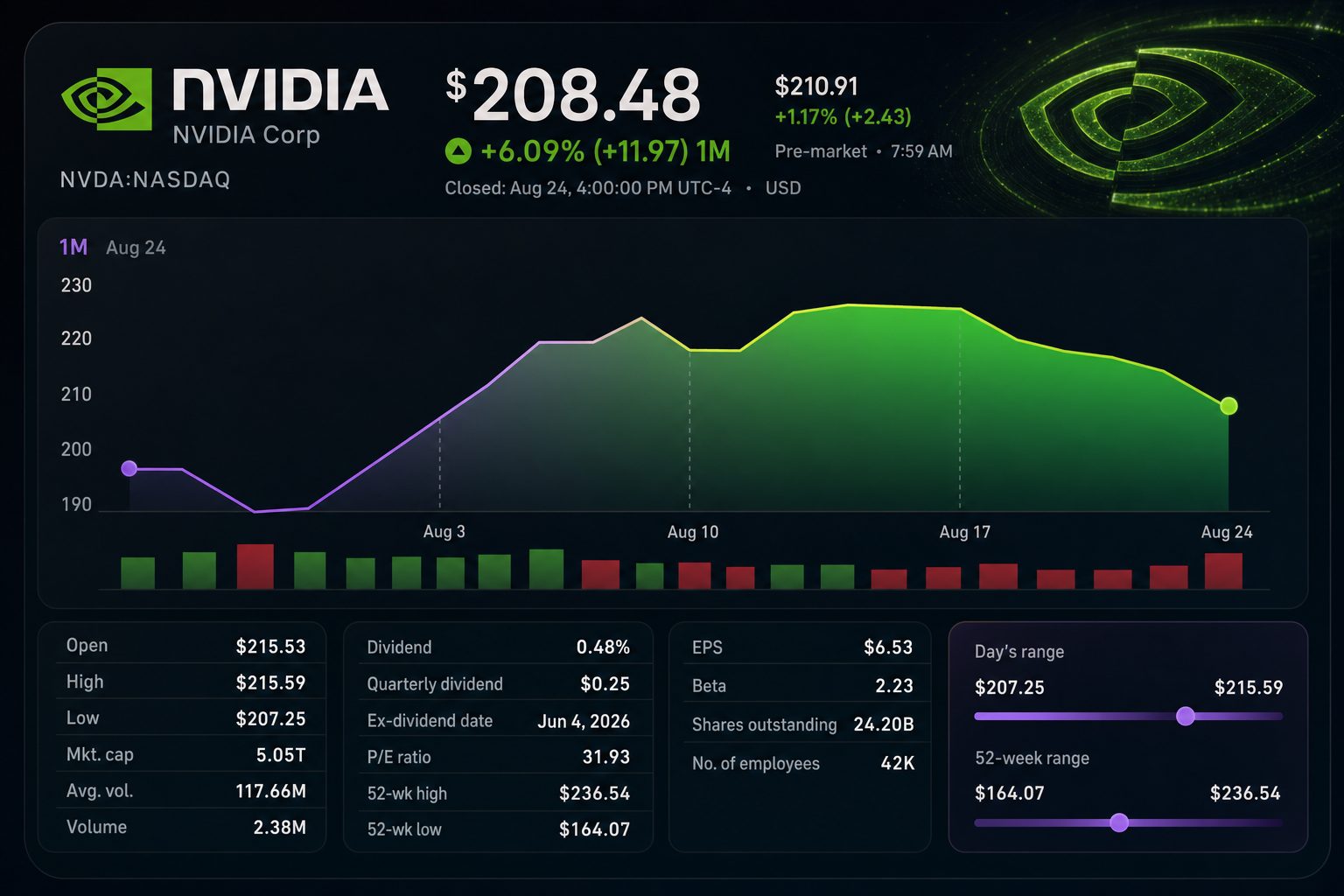
The dollar shift is significant. The percentage change, however, is more subdued. The 5.4% implied move stands 27% under Nvidia’s typical 7.4% average response over the previous 12 quarters.
Based on Monday’s closing price of $208.39, options are indicating a possible range between $197.14 and $219.64. This is a market-implied range rather than a prediction of future prices. ORATS founder Matt Amberson said the pricing indicated “some complacency for Nvidia.”
Analysts surveyed by LSEG project second-quarter revenue at $92.18 billion, which exceeds Nvidia’s midpoint guidance of $91 billion by $1.18 billion, or 1.3%. Nvidia’s forecast did not account for revenue from China data-center compute sales.
| Metric | Q1 FY2027 actual | Q2/Q3 earnings test |
|---|---|---|
| Total revenue | $81.6 billion; up 85% from a year ago | Q2 estimate $92.18 billion |
| Data-center revenue | $75.2 billion; up 92% | Rubin shift and cloud demand |
| Non-GAAP gross margin | 75.0% | Roughly 75% projected for Q2 and Q3 |
| Next-quarter sales | Not applicable | $104.20 billion estimate; up 82.8% compared to last year |
The previous quarter establishes a tough comparison. Nvidia posted $81.6 billion in revenue, with $75.2 billion generated by data centers. Data centers contributed 92% of overall sales, heightening exposure to both cloud expenditure and investment in AI infrastructure.
The next phase hinges on Vera Rubin, with shipments anticipated in the autumn. According to Morgan Stanley, Rubin may generate close to $9 billion in the October quarter, or roughly 8.6% of the $104.20 billion in projected sales.
The issue of revenue now extends past just demand for chips. Nvidia aided in setting up financing options aimed at over $500 billion for artificial intelligence infrastructure. The company also committed to backing as much as $105 billion for OpenAI’s data center lease in Ohio.
Brian Mulberry, chief market strategist at Zacks Investment Management, which holds shares in Nvidia, described the company as “a kind of central banking figure in the AI space.” He noted that backing from its balance sheet can broaden the market, while also intensifying exposure to customer economics. Reuters
| Research firm | Recommendation | Price target | Date |
|---|---|---|---|
| Benchmark | Buy reiterated | $335 | August 21, 2026 |
| BMO Capital | Buy; initiated coverage | Not stated | August 20, 2026 |
| Oppenheimer | Buy reiterated | $265 | August 20, 2026 |
| Stifel | Buy reiterated | $282 | August 19, 2026 |
| TD Cowen | Buy reiterated | $275 | August 18, 2026 |
Analysts still advise buying, yet the stock’s performance has trailed its sector. Nvidia gained 11.7% in 2026 as of Monday, closely tracking the S&P 500’s 11.8% increase. Meanwhile, the Philadelphia Semiconductor Index climbed 61%, outpacing by 49.3 percentage points.
The gap increases the pressure on outlook. Investors are seeking proof that Rubin can drive growth while maintaining margins. They are also looking for indications that hyperscalers can achieve sufficient returns from spending on data centers.
Risks: Shares could fall beneath the options range if the company issues a weaker $104.20 billion outlook, reports a margin under about 75%, experiences delays in Rubin shipments or sees disappointing cloud returns. Conversely, more robust guidance may suggest the relatively low implied volatility is overly relaxed.
Nvidia is set to announce results after the close of U.S. markets on Wednesday. How shares open on Thursday will indicate if investors correctly anticipated less percentage volatility for the market’s biggest earnings event.
Related articles: NASDAQ:NVDA