
BOSTON, August 28, 2026, 04:20 (EDT) — DraftKings stock (DKNG.O) lost 2.3% after the NFL rekindled its rivalry with FanDuel just as the league readies for a $30 billion season.
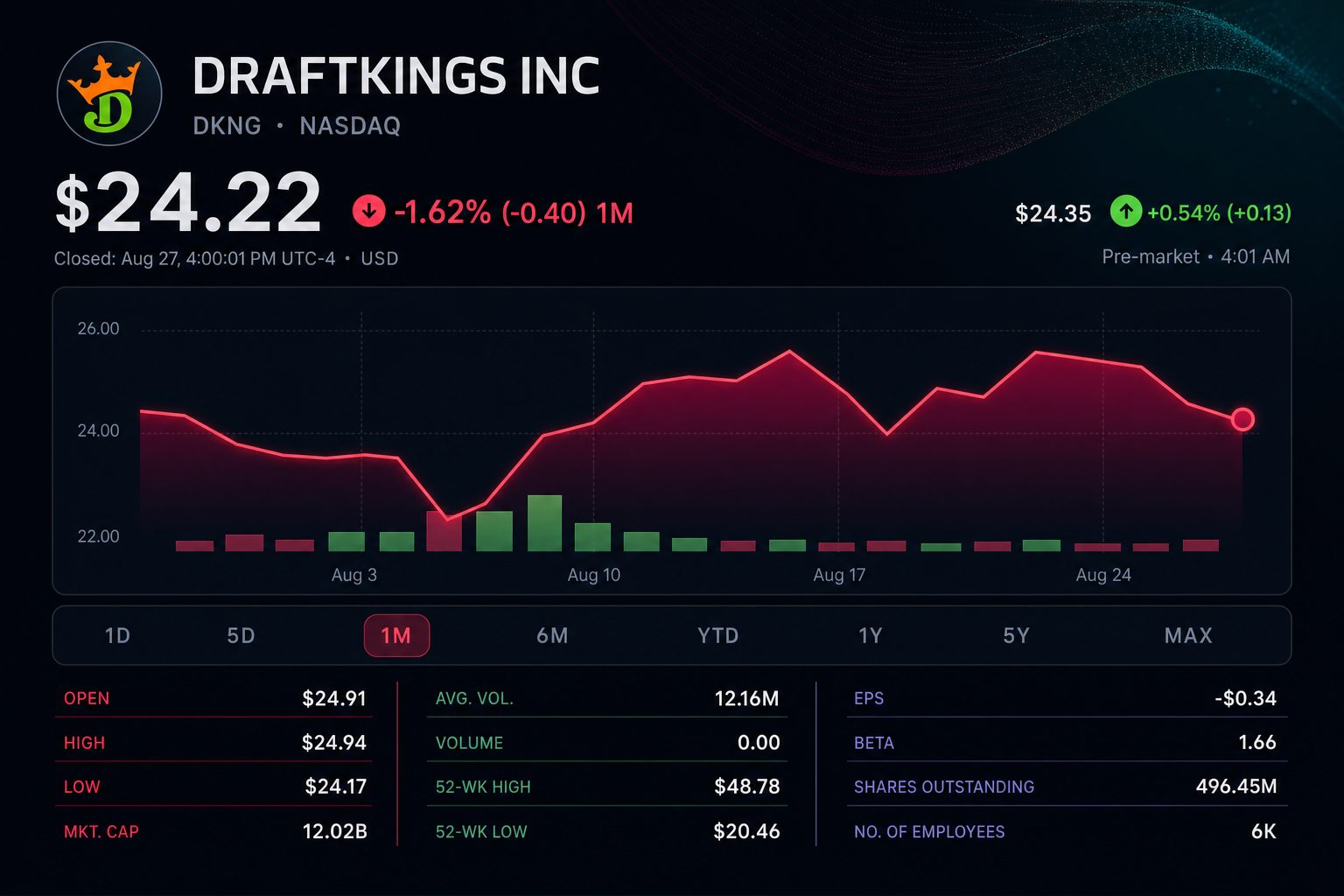
- DraftKings ended the session at $24.22, falling 2.3%, before climbing 0.9% in premarket trading.
- The NFL has extended its multi-year agreements with DraftKings and FanDuel.
- Estimates put legal bets on the 2025 NFL season at $30 billion.
- DraftKings reported a 15% increase in second-quarter betting volume, though revenue declined by 5%.
The NFL has extended its multi-year sportsbook agreements with DraftKings Inc. (NASDAQ: DKNG) and Flutter Entertainment plc (NYSE: FLUT)‘s FanDuel, and introduced Fanatics, a privately owned company, as its third operator. DraftKings’ shares ended Thursday’s session at $24.22, a decrease of 2.3%, with 7.42 million shares exchanging hands. In premarket trade at 04:01 EDT Friday, the stock was at $24.44, a gain of 0.9% market data.
The renewal secures an important customer acquisition source ahead of the September 9 start. The partnership includes exposure across online and in-person betting, live statistics, signature events, and NFL-operated digital assets. These opportunities tap into a legal betting market projected at $30 billion for the 2025 NFL season partnership announcement.
The agreement does not ensure profitable growth. Financial specifics have not been revealed. Investors should consider broader distribution in light of marketing expenses, promotional activity and player-oriented game results.
DraftKings reported in its most recent quarter that Sports Consumer Volume increased by 15% to $13.1 billion. However, revenue declined by 5% to $1.443 billion, impacted by positive player outcomes and promotional activity related to acquisitions which lowered the operator’s hold company results.
The number of monthly unique payers rose 9% to 3.6 million. Average revenue per payer fell 13% to $132. The NFL deal may drive reach and engagement, but yield remains difficult to improve.
| Metric | DraftKings | FanDuel parent Flutter | Investor read-through |
|---|---|---|---|
| Q2 2026 revenue | $1.443B, down 5% | $4.326B, up 3% groupwide | Flutter’s scale is expanding more rapidly |
| Q2 volume / profitability | $13.1B sports volume, up 15% | $508M adjusted EBITDA, down 45% | Margins remain pressured for both |
| Current market signal | $24.22, down 2.3% | $95.01, down 3.1% | Renewals have not resolved sector uncertainty |
| NFL role | Sportsbook and fantasy partner | Sportsbook through FanDuel | Both maintain direct league relationships |
DraftKings reaffirmed its 2026 revenue outlook, keeping the forecast in the range of $6.5 billion to $6.9 billion. The company also left its adjusted EBITDA guidance unchanged at $700 million to $900 million. Executives stated that the core business is still projected to deliver close to $1 billion of adjusted EBITDA, prior to investment in Predictions.
Flutter reported a 3% year-on-year increase in group revenue for the second quarter, reaching $4.326 billion. Adjusted EBITDA declined by 45% to $508 million, with the company citing increased marketing expenses, tax charges, and softer sportsbook performance in the U.S. as factors affecting performance Flutter results.
Rivalry grew stronger. Fanatics took Caesars’ place on the official lineup and secured marketing rights for online casinos. DraftKings kept its position as daily-fantasy provider, a status it has maintained since 2019.
DraftKings chief marketing officer Stephanie Sherman stated, “Nothing compares to football season for DraftKings and our millions of customers.” The league’s extension ensures continued access. Details on the cost of that access remain undisclosed.
The broader trend for the stock continues to show weakness. DraftKings shares have declined 29.7% in 2026 and dropped 49.5% over the past year. The 52-week price range is between $20.46 and $48.78, making its valuation vulnerable to fluctuations in hold rates or promotional expenditures.
Risks: Revenue may decline even with increased handle if customer results are favorable. FanDuel and Fanatics’ aggressive promotions could inflate customer acquisition expenses. Additionally, regulatory limits or competitiveness from prediction markets have potential to impact NFL channel economics.
The next major test will take place on September 9 with the start of the NFL season. Key areas for investors to monitor include payer growth, revenue generated per payer, and the level of promotional activity. The significance of the renewal hinges on whether the $30 billion betting pool leads to profitable customer retention.
Related articles: NASDAQ:DKNG