
NEW YORK, August 29, 2026, 20:10 EDT
- PayPal closed Friday at $53.66, down 12.71%, on 36.34 million shares.
- The abandoned Stripe-Advent proposal valued PayPal at $60.50 a share, or about $53 billion.
- Second-quarter revenue rose 5%, while GAAP operating margin fell 171 basis points.
- The $58.54 average analyst target implies 9.1% upside from Friday’s close.
PayPal Holdings Inc. (NASDAQ: PYPL) lost about $6.7 billion of market value Friday. The stock fell 12.71% after the Stripe-Advent takeover effort ended.
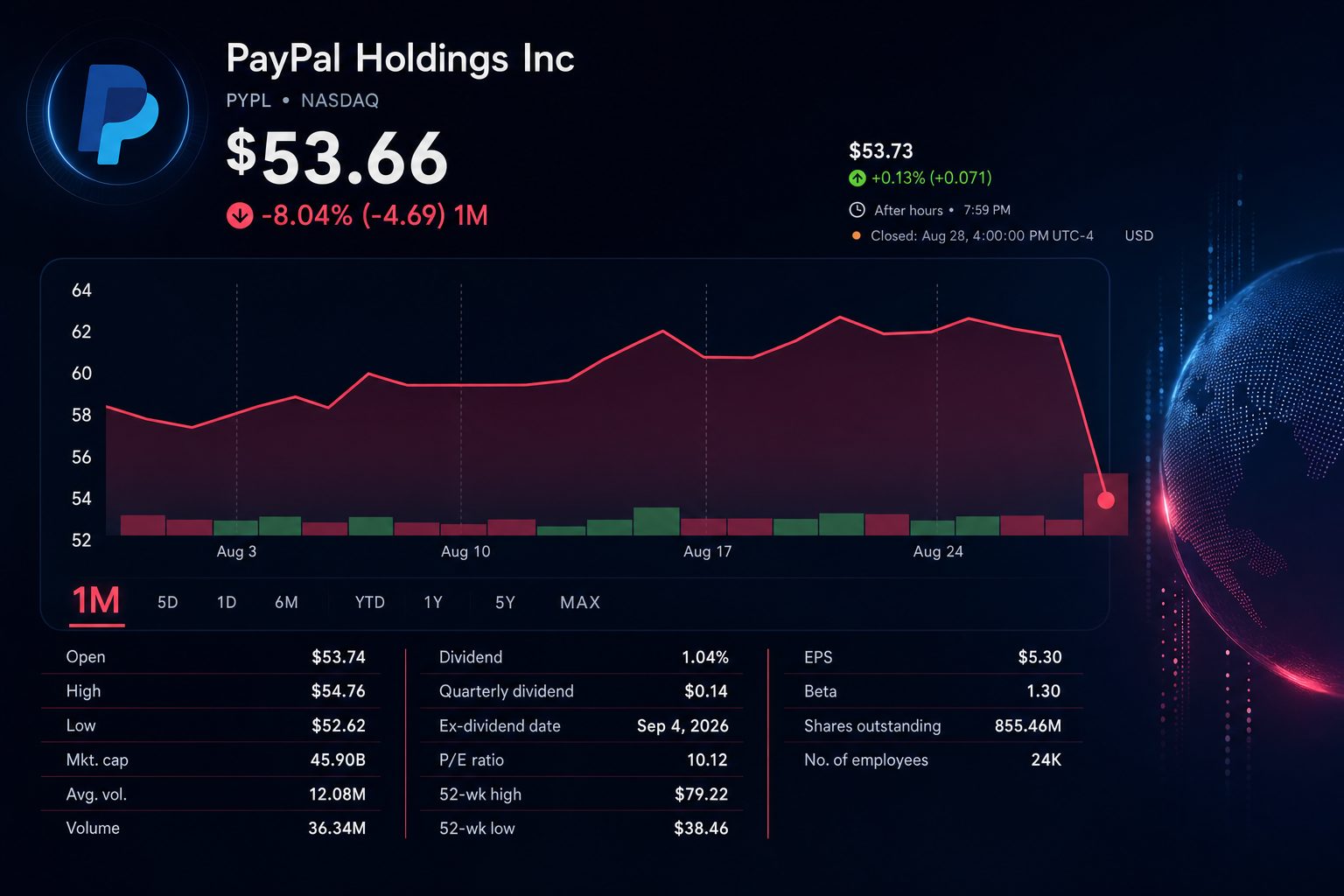
The reversal removes a visible valuation floor. PayPal now trades $6.84 below the consortium’s $60.50 proposal.
That gap shifts attention back to operating execution. The board had considered the initial offer inadequate, according to Reuters.
The valuation is inexpensive by payments-sector standards. LSEG put PayPal’s forward multiple at 10.85 times, versus nearly 15 times for the industry median.
| Reference | Value | Difference from $53.66 |
|---|---|---|
| Friday close | $53.66 | — |
| Stripe-Advent proposal | $60.50 | +12.7% |
| Analyst average target | $58.54 | +9.1% |
| Analyst low target | $45.00 | −16.1% |
| Analyst high target | $70.00 | +30.5% |
The latest quarter offered progress without clean operating leverage. PayPal reported revenue of $8.68 billion, up 5%.
Total payment volume grew 10% to $486.4 billion. Active accounts increased only 0.3% to 439 million.
Margins remain the harder test. GAAP operating margin narrowed to 16.4% from 18.1%, while net income declined 12%.
Cash generation was stronger. Free cash flow reached $1.78 billion, and PayPal repurchased $1.5 billion of stock.
Management raised full-year non-GAAP EPS guidance to about $5.38. Friday’s close equals roughly 10.0 times that outlook.
Wall Street remains cautious. Google Finance shows four buys, 23 holds and two sells among 29 recent ratings.
Friday’s 36.34 million shares were three times average volume. The move therefore looks broader than a thin-session reaction.
Risks run both ways. Branded checkout faces Apple Pay and Shop Pay, while faster margin recovery could expose the stock’s discounted multiple.
The next test is operational, not transactional. Investors need payment growth to produce steadier margins before paying for a takeover premium again.
Related articles: NASDAQ:PYPL