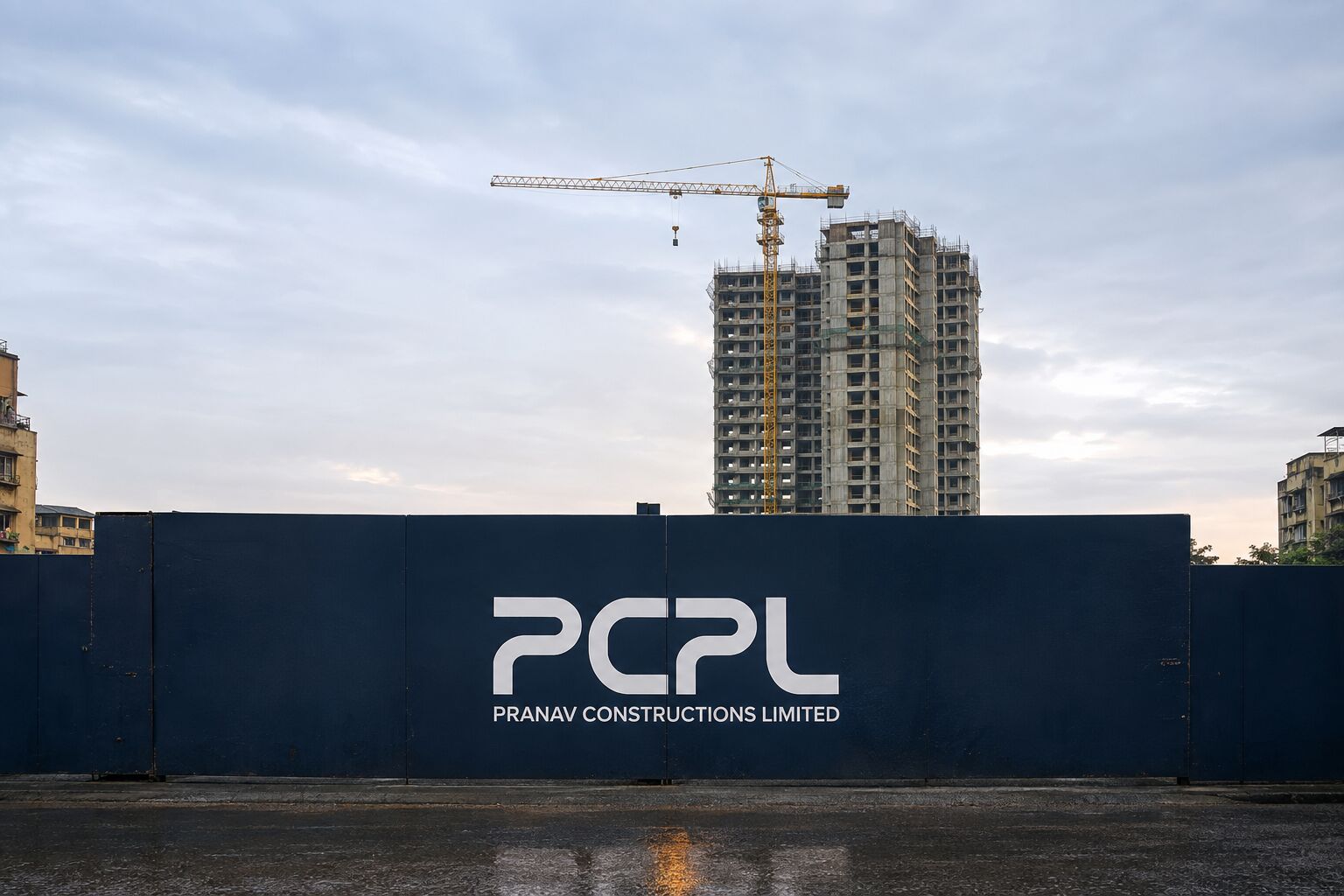

MUMBAI, September 6, 2026, 10:24 a.m. IST — Pranav Constructions Limited will open its ₹351.03 crore initial public offering on Monday. Already, anchor investors have taken 24% of the book at ₹124 a share.
The upper price equals 15.16 times fiscal 2026 earnings in the company’s official valuation document. Counting the fresh shares changes that figure.
At unchanged profit, post-issue earnings would be about ₹6.33 a share. That lifts the cap-price multiple to roughly 19.58 times, according to a TS2 calculation.
The adjustment does not make the offer costly by itself. It sets a clear hurdle: the new capital must lift earnings enough to absorb dilution. That is the central test.
Nearly 90% of the deal brings money into the company, while the smaller offer-for-sale sends about ₹35.43 crore to BioUrja India Infra at the cap price.
BioUrja’s weighted acquisition cost was ₹42.55 a share. The ₹124 cap is 2.91 times that figure, before expenses and taxes.
The equity cheque already has a job
At ₹124, Pranav would issue about 25.45 million new shares. Its count would rise 22.6% to roughly 112.62 million, based on the red herring prospectus.
That implies a post-issue equity value near ₹1,396.5 crore at the cap. It also explains the adjusted earnings multiple.
The prospectus assigns ₹145.72 crore to approvals, extra development rights and resident compensation. Another ₹91.50 crore is earmarked for repaying borrowings.
That repayment equals 34.4% of fiscal 2026 total debt. Actual leverage will also depend on new borrowing and deployment timing.
The distinction matters because total debt rose 31.7% last year to ₹265.64 crore, even as debt-to-equity improved to 1.08 times.
Growth and returns moved apart
Fiscal 2026 revenue grew 19.7% to ₹761.60 crore. Profit increased more slowly, rising 14.6% to ₹71.32 crore.
EBITDA margin widened to 17.18%, yet net margin slipped 41 basis points. Financing and the expanding capital base still shape shareholder returns.
Return on equity fell to 33.78% from 47.17% in one year. Total equity grew 40.5%, well ahead of profit.
Pranav had 65 redevelopment projects at March-end, including 20 under construction. Completed area during the year fell to 0.17 million square feet from 0.21 million. Annual delivery became thinner.
Mumbai concentration cuts both ways
The Municipal Corporation of Greater Mumbai region supplied 99.70% of fiscal 2026 revenue. Local knowledge is central to the model, while geographic diversification is almost absent.
Approval delays, compensation disputes or weaker Mumbai housing demand could therefore reach most projects together. The large proceeds allocation to approvals and development rights shows that exposure plainly.
Friday’s anchor round provided an early demand marker. Pranav placed 6.794 million shares for ₹84.24 crore with funds including Goldman Sachs Investments (Mauritius), ITI Mutual Fund and Taurus Mutual Fund, Press Trust of India reported.
Anchor participation does not establish the listing price. It does show that institutions accepted the cap before the public book opened.
Bidding closes Wednesday, with a 120-share minimum lot costing ₹14,880 at the cap. The tentative NSE and BSE listing date is September 15.
The immediate risks are execution, leverage and concentration. There is no established market for the shares, and the final trading price can differ sharply from the offer band. That gap can be wide.
Subscription mix will supply the next evidence. After listing, debt reduction and ROE will reveal whether the new shares financed productive growth or merely a larger balance sheet.