
RALEIGH, North Carolina, August 23, 2026, 06:12 EDT — U.S. markets are closed.
- Advance Auto Parts fell 24.7% last week after second-quarter sales missed expectations.
- A $26 million tariff refund supplied about 30% of reported adjusted earnings per share.
- Eleven analysts cut price targets on Friday; the five largest brokers stayed neutral.
Advance Auto Parts, Inc. NYSE:AAP lost an estimated $851 million of equity value last week. The shares closed Friday at $42.58, down 24.7% from August 14.
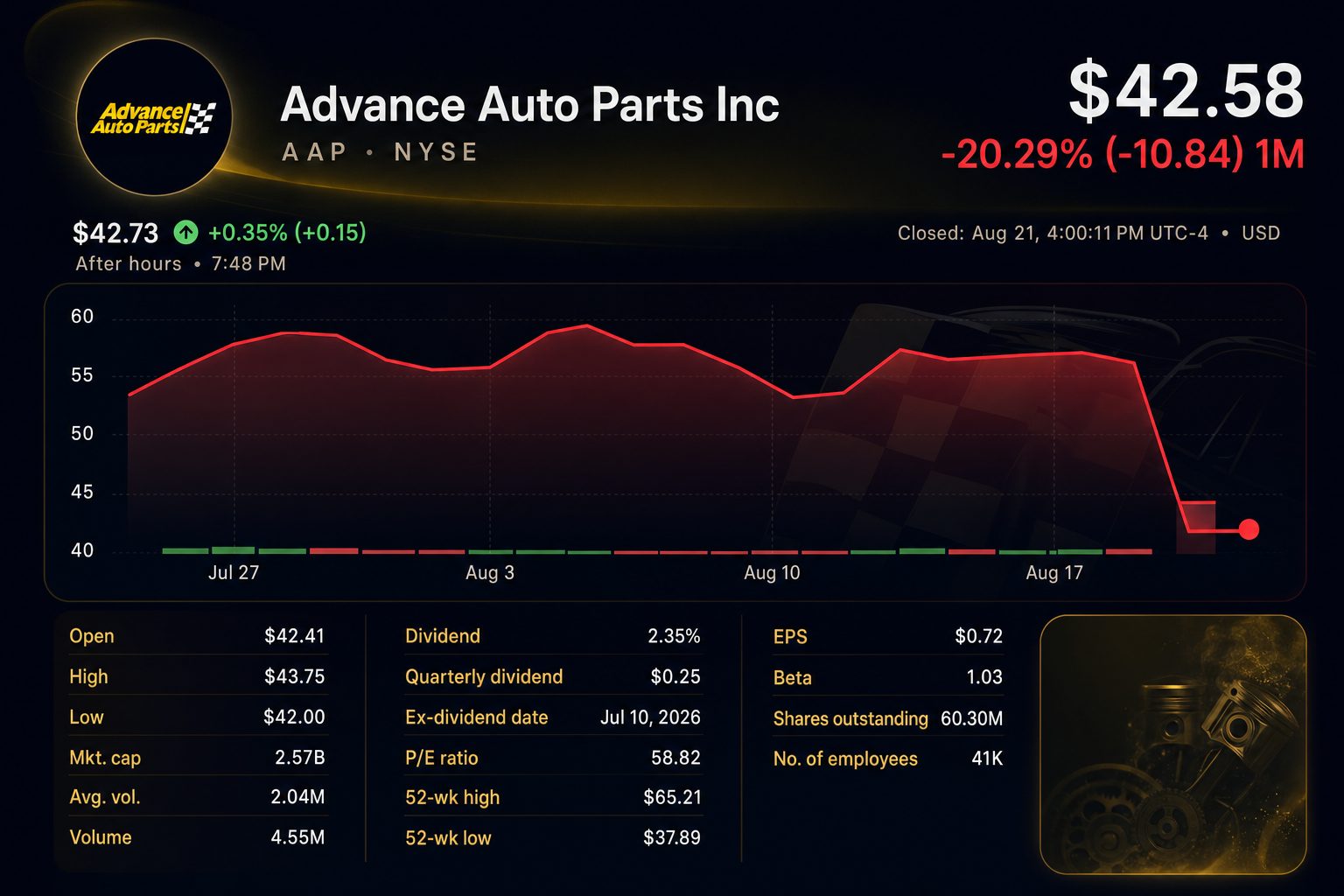
The selloff exposed an earnings-quality problem. A one-time tariff refund turned an underlying earnings miss into a reported beat.
| Price test | Close / value | Change |
|---|---|---|
| August 14 close | $56.55 | — |
| August 20 close | $42.39 | -24.55% that day |
| August 21 close | $42.58 | +0.45% Friday |
| Weekly move | -$13.97 | -24.70% |
| Estimated value erased | $851 million | Preliminary |
Adjusted earnings were $1.03 a share, above the $0.81 consensus. Yet the refund added about $0.31. Excluding that benefit, earnings were roughly $0.72, or 11% below consensus.
| Earnings-quality bridge | Q2 2026 | Investor read-through |
|---|---|---|
| Reported adjusted EPS | $1.03 | Beat $0.81 consensus |
| Tariff-refund contribution | $0.31 | 30% of reported EPS |
| EPS excluding refund | $0.72 | 11% below consensus |
| Adjusted operating margin | 5.6% | Up from 3.0% |
| Margin excluding refund | About 4.3% | Still improved |
Sales were $2.00 billion, down from $2.01 billion. Comparable-store sales fell 0.5%. Professional demand grew at a low-single-digit rate, but weaker do-it-yourself spending offset it.
“Tighter household budgets constrained spending more than we anticipated,” Chief Executive Shane O’Kelly said. He identified the final four weeks as the weakest period. Company statement
Margins did improve. Adjusted operating income rose to $112 million from $61 million. Even after subtracting the refund, the implied margin was about 4.3%, versus 3.0% a year earlier.
| 2026 outlook | Current | Previous |
|---|---|---|
| Net sales | $8.485B-$8.575B | Unchanged |
| Comparable sales | +1% to +2% | Unchanged |
| Adjusted operating margin | 3.8% to 4.5% | Unchanged |
| Adjusted EPS | $2.60-$3.30 | $2.40-$3.10 |
| Free cash flow | About $100M | Unchanged |
| Store openings | 30-35 | 40-45 |
Cash flow was the cleaner bright spot. Free cash flow reached about $120 million through 28 weeks, against a $201 million outflow a year earlier. Net leverage fell to 2.1 times from 2.4 times in the first quarter.
Wall Street responded by resetting targets, not ratings. Eleven firms cut targets on August 21. The five below retained hold-equivalent calls.
| Analyst / firm | Recommendation | Old target | New target |
|---|---|---|---|
| Christopher Horvers / JPMorgan | Hold | $65 | $55 |
| Simeon Gutman / Morgan Stanley | Equal-weight | $65 | $52 |
| Tristan Thomas-Martin / BMO | Market perform | $65 | $50 |
| Michael Lasser / UBS | Neutral | $65 | $47 |
| Max Rakhlenko / TD Cowen | Hold | $61 | $45 |
The broader consensus remains a hold. Twenty-five analysts include two strong buys, 20 holds and three sell-equivalent ratings. Their average target of $51.16 implies about 20% upside from Friday’s close.
Monday’s first test is $40.66, Thursday’s intraday low. A stable base would suggest the weaker DIY outlook is priced in. Another break would point to doubts about the second-half sales recovery.
The risk is that Pro growth slows while household budgets remain tight. Tariff refunds will not repeat, and fewer planned store openings reduce one route to sales growth.
The week ahead therefore hinges on evidence, not the higher EPS range. Investors need organic sales and cash conversion to replace one-off help.
Related articles: Earnings