
WASHINGTON, January 7, 2026, 21:00 EST
- Green Bank Telescope search reported no radio “technosignatures” from interstellar comet 3I/ATLAS
- New Gemini North image shows a green glow linked to gases boiling off as the comet warmed near the Sun
- NASA’s Europa Clipper ultraviolet instrument spotted the comet’s tails from deep space; scientists said some features need more work to explain
Astronomers scanning interstellar comet 3I/ATLAS for signs of alien technology came up empty, a result that adds weight to the case that the fast-moving visitor is natural, not a spacecraft.
That matters now because 3I/ATLAS is only the third object ever confirmed to have entered the solar system from interstellar space, and it is already on its way back out. As it recedes, it will dim and slip beyond the reach of many instruments, leaving researchers with a narrowing window.
The scrutiny is also a rehearsal. Astronomers expect future sky surveys to flag more interstellar passers-by, and they want a clearer picture of what “normal” looks like when a comet formed around another star gets briefly warmed by ours.
Researchers tied to the Breakthrough Listen search project used the Green Bank Telescope to look for “technosignatures” — telltale evidence of technology — and found none, Space.com reported. “We all would have been thrilled to find technosignatures coming from 3I/ATLAS, but they’re just not there,” Benjamin Jacobson-Bell of the University of California, Berkeley, told the publication, which said the work was posted as a pre-peer-reviewed paper on arXiv. https://www.space.com/astronomy/asteroids/interstellar-comet-3i-atlas-isnt-an-alien-spacecraft-astronomers-confirm-in-the-end-there-were-no-surprises
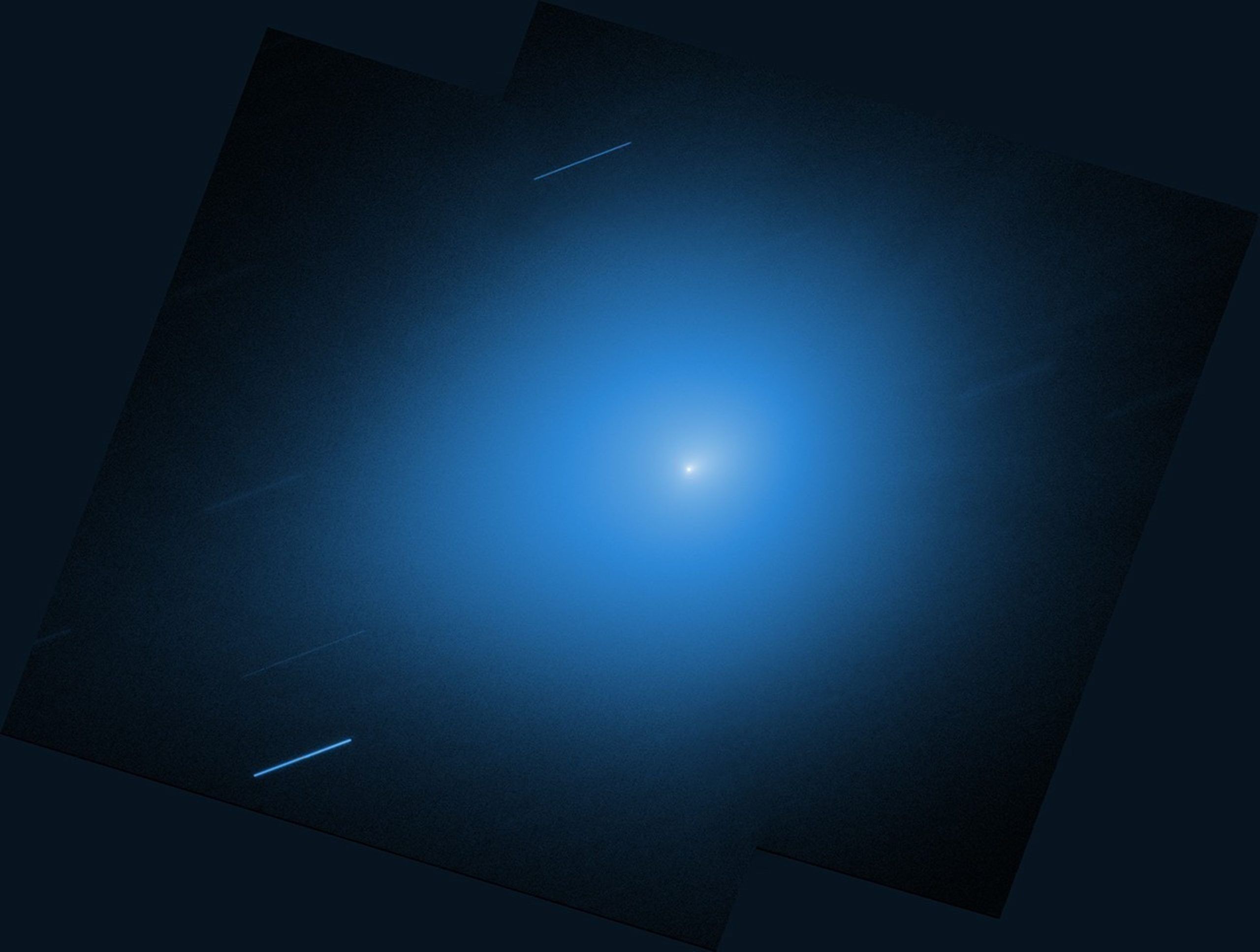
On the ground, the Gemini North telescope in Hawaii captured a newly released image of 3I/ATLAS from Nov. 26, showing the comet with a green hue. Scientists quoted by BBC Sky at Night Magazine said the color comes from light emitted by gases in the coma — the cloud of gas and dust around a comet — including diatomic carbon, which glows at green wavelengths.
A separate set of observations came from far closer in. NASA’s Europa Clipper spacecraft, headed for Jupiter’s moon Europa, used its ultraviolet spectrograph on Nov. 6 to study 3I/ATLAS days after perihelion — its closest pass to the Sun — when the comet was about 203 million km (126 million miles) from the Sun, IFLScience reported. “We’re still scratching our heads about some of the things we’re seeing,” said Kurt Retherford, the instrument’s principal investigator at Southwest Research Institute, after models did not fully account for what the spacecraft saw in the comet’s tails. https://www.iflscience.com/interstellar-comet-3iatlas-snapped-by-nasas-europa-mission-were-still-scratching-our-heads-about-some-of-the-things-were-seeing-82124
Retherford told IFLScience the team was “excited” to see gases streaming from the comet — “hydrogen and oxygen atoms for sure” — and said the European Space Agency’s JUICE mission also observed 3I/ATLAS, with full data from both missions expected later.
3I/ATLAS has drawn intense attention partly because it is rare: the only other confirmed interstellar visitors are 1I/‘Oumuamua, spotted in 2017, and 2I/Borisov, detected in 2019, Space.com said. Unlike typical comets bound to the Sun, it is passing through on a one-time trajectory and will leave the solar system.
But key questions will linger. The Breakthrough Listen study cited by Space.com is not yet peer-reviewed, and Europa Clipper and JUICE teams are still working through their datasets. Ground-based watchers also warn that comet activity can shift in fits and starts as heat works into the interior, raising the chance of late outbursts even as the object grows fainter.