
Alphabet Inc. NASDAQ:GOOGL is back at the centre of Wall Street’s attention today as investors juggle three big storylines: a make‑or‑break U.S. antitrust showdown, a historic wave of AI‑driven debt issuance, and a bold push into multi‑billion‑dollar carbon removal.
Below is a news‑style wrap of what’s moving Alphabet on 21 November 2025 and what it could mean for GOOGL shareholders.
Alphabet stock today: trading just below record highs
Alphabet shares are trading around $289–290 this afternoon, down roughly 1% on the day and a few dollars below this week’s all‑time high near $293. That still leaves the company with a market value close to $2.94 trillion, keeping it among the world’s most valuable firms.
Despite today’s modest pullback, Alphabet remains one of 2025’s best‑performing “Magnificent Seven” stocks, with year‑to‑date gains of roughly 50% that pushed the shares to record territory earlier this week. Reuters+1
The rally has been powered by:
- Surging confidence in Google’s AI roadmap (Gemini 3, Nano Banana Pro, and new AI agents)
- Cloud momentum and YouTube strength
- Fresh endorsement from Warren Buffett’s Berkshire Hathaway
- A perception that Alphabet is still cheaper than some AI peers on earnings multiples Reuters+1
But on 21 November, investors are also weighing regulatory risk and the rising cost of Alphabet’s AI ambitions.
1. Antitrust endgame: Google fights to avoid an ad‑tech breakup
In Washington, Alphabet’s legal team is making its final plea to avoid a breakup of Google’s advertising technology business as a long‑running U.S. Department of Justice (DOJ) antitrust case reaches a pivotal moment.
- U.S. District Judge Leonie Brinkema has already ruled that Google holds two illegal monopolies in ad tech.
- The DOJ and several states are pushing for a forced sale of Google’s AdX ad exchange, which takes a ~20% fee on publisher ad auctions.
- Google argues such a breakup would be technically complex and disruptive for customers, and says it will appeal any structural remedy.
Closing arguments today mark the end of evidentiary hearings, but the case is far from over:
- Brinkema must decide whether Google must divest key ad‑tech assets or accept behavioural remedies.
- Whatever the ruling, appeals could drag on for years, keeping regulatory risk in the backdrop for Alphabet investors.
At stake is not just ad tech revenue, but Google’s ability to bundle data and services across its ecosystem — a key ingredient in its AI and advertising strategies.
2. Italy closes data‑probe after Google changes consent flows
In Europe, Google notched a small regulatory win today.
Italy’s competition authority announced it has closed a probe into Google’s use of personal data, after the company agreed to overhaul how it asks users for consent.
The investigation, opened in 2024, alleged that:
- Google’s consent prompts could be “misleading and aggressive”, and
- The information shown to users about data combination and cross‑use across services was incomplete.
To resolve the case, Google has committed to:
- Providing clearer explanations of how personal data is combined and reused across its products.
- Adjusting consent screens so users better understand the implications of opting in.
For Alphabet, the Italian decision underscores two themes:
- Regulatory risk is global, not just U.S.‑based.
- Transparent data practices are becoming a competitive necessity as AI models rely on ever‑larger pools of user information.
3. The AI arms race gets expensive: $25B bonds & “double compute every 6 months”
Massive bond issuance to fund AI data centers
Since September, Alphabet and other “hyperscalers” (Meta, Amazon, Oracle) have flooded the bond market, raising nearly $90 billion in public debt to finance AI‑ready infrastructure. Alphabet alone has issued about $25 billion in bonds, according to reporting based on Reuters calculations. The Economic Times+1
Analysts now estimate:
- 2025 hyperscaler debt issuance has surged to over $120 billion, far above the ~$28 billion average in recent years.
- AI capital expenditure could reach $600 billion by 2027, with net debt issuance forecast to hit $100 billion in 2026.
Despite the jump in borrowing, major tech firms — including Alphabet — remain lightly leveraged relative to their cash flow, and investor appetite for their bonds is still strong. But spreads have widened slightly, signalling growing caution about the AI spend‑fest.
A separate analysis from BCA Research, highlighted today by Benzinga, warns that by 2030 hyperscalers could hold more than $2.5 trillion in AI assets, implying annual depreciation near $500 billion — a figure that could rival or exceed projected profits if AI returns disappoint.
Inside Google: “We must double compute every 6 months”
Internally, Google executives are making clear just how aggressive the AI build‑out needs to be.
At a recent all‑hands, Amin Vahdat, Google’s head of AI infrastructure, told employees the company must now double its compute capacity every six months to satisfy AI demand — targeting a 1,000x increase in 4–5 years, according to a CNBC‑sourced report summarised by the Times of India.
Key points from that internal presentation:
- Google sees AI infrastructure as “the most critical and most expensive part of the AI race”.
- The company is betting on custom chips (like its new Ironwood TPUs) and more efficient models to deliver huge performance gains without a similar explosion in power usage.
- CFO Anat Ashkenazi has already raised Alphabet’s 2025 capex guidance to $91–93 billion, signalling a “significant increase” again in 2026. The Times of India+1
Taken together, today’s bond‑market jitters and Vahdat’s comments paint a clear picture: Alphabet is all‑in on AI infrastructure, but the bill is enormous and increasingly scrutinised.
4. Climate strategy: Alphabet joins Microsoft in $10B+ carbon removal push
Amid concerns about AI’s energy demands, Alphabet is also trying to show that its growth can be compatible with climate goals.
A new analysis from CarbonCredits.com today highlights that Microsoft and Alphabet have become the two biggest forces behind durable carbon removal, together committing over $10 billion to long‑duration carbon‑removal technologies.
According to that report:
- Microsoft leads with around $8 billion in commitments, but Alphabet is “close behind”.
- Alphabet is a major participant in the First Movers Coalition, where it has pledged $500 million for early carbon‑negative technologies aimed at scaling to gigaton levels.
- Both companies are backing solutions such as direct air capture, mineralisation, and biomass carbon removal, with durability targets of 1,000+ years.
For investors, this highlights a strategic shift: AI expansion and climate mitigation are now intertwined. If AI pushes data‑center emissions higher, durable carbon removal becomes a core tool for maintaining net‑zero commitments — and Alphabet clearly wants to be seen as a leader in that space.
5. Wall Street is split: Buffett & Cramer vs. valuation skeptics
Buffett’s rare big‑tech bet boosts Alphabet’s credibility
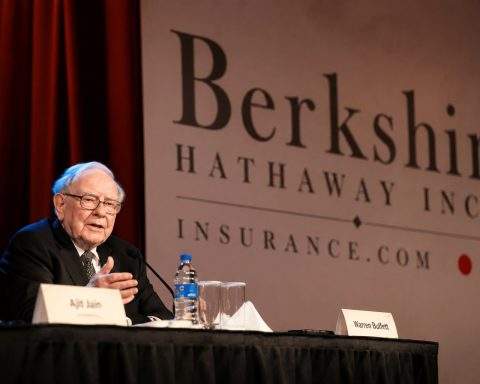
One of the year’s most important catalysts for GOOGL came earlier this week, when filings revealed that Warren Buffett’s Berkshire Hathaway has taken a new stake in Alphabet worth roughly $4.9 billion (17.85 million shares).
Reuters notes that:
- The move marks a rare foray into big tech for historically tech‑averse Berkshire.
- Alphabet is now the best‑performing “Magnificent Seven” stock this year, with a ~46% gain at the time of the filing. Reuters+1
The Berkshire seal of approval has been widely interpreted as an endorsement of Alphabet’s AI strategy, cloud business, and robust free cash flow.
TV personality and investor Jim Cramer went further today, describing Alphabet as a “Buffett‑endorsed company” that investors are effectively getting at a discount because Wall Street is nervous about its data‑center spending. He argued that the recent pullback from record highs could offer an attractive entry point. Insider Monkey
Valuation concerns: “full” pricing after a 60%+ rally
Not everyone is comfortable chasing the stock at these levels.
A new note on Seeking Alpha this morning downgraded Alphabet to Hold, arguing that: Seeking Alpha
- The shares now trade at over 9x sales and around 28x earnings, well above historical valuation bands.
- After a 63% rally, the risk‑reward looks less favourable, especially if AI‑driven earnings growth slows.
- Technical indicators (like a high RSI) suggest the stock may be overbought in the short term.
Other research houses remain more upbeat. A Zacks report today again highlighted why Alphabet is considered a top long‑term growth stock, pointing to its dominant position in search, YouTube and cloud, plus new monetisation opportunities from Gemini, Nano Banana Pro and Waymo.
Even policymakers are weighing in on AI valuations. Federal Reserve Vice Chair Philip Jefferson said today he does not see the current surge in AI‑linked stocks as a repeat of the late‑1990s dot‑com bubble, stressing that today’s AI leaders have real earnings and less reliance on leverage.
Bottom line: sentiment is bullish but increasingly nervous, with the market trying to balance Alphabet’s leadership in AI against the cost and pace of that leadership.
6. Product & AI updates: Gemini 3, Nano Banana Pro and Waymo’s expansion
While regulation and financing dominate the headlines, Alphabet continues to ship new technology at a rapid clip.
Gemini 3 embedded directly into Search
On Tuesday, Google launched Gemini 3, calling it its “most intelligent model” yet and, for the first time, embedding it into Google Search from day one. Reuters
Key points:
- Gemini 3 underpins a range of revenue‑generating products: Search, Workspace, Gemini apps and Cloud.
- Google unveiled “Gemini Agent”, a multi‑step AI assistant that can handle tasks like inbox triage or trip planning autonomously.
- A new developer platform, Antigravity, will allow AI agents to plan and execute coding tasks, deepening Google’s push into AI‑assisted software development.
Nano Banana Pro: next‑gen AI image generation
Building on Gemini 3, Google DeepMind this week released Nano Banana Pro, an upgraded AI image generation and editing model built on Gemini 3 Pro Image.
Nano Banana Pro:
- Delivers sharper text rendering on images (a traditional weakness for AI image tools).
- Can blend up to 14 reference images and multiple people into a single composition.
- Is rolling out across the Gemini app, Vertex AI and Workspace, with C2PA metadata embedded to show when images were created or edited with Google AI.
Waymo pushes further into U.S. cities
Alphabet’s autonomous driving unit Waymo is expanding again, announcing plans to broaden its robotaxi footprint to Minneapolis, Tampa and New Orleans.
- The rollout starts with human‑driven vehicles to map and collect data, followed by supervised autonomous testing and then fully driverless robotaxis.
- Waymo already operates paid driverless services in several U.S. cities and remains one of the few companies offering fully driverless rides without onboard safety drivers.
These updates reinforce a key narrative: Alphabet’s AI is not just in models, but in products, from search and creative tools to self‑driving cars.
7. What today’s news means for GOOGL investors
For investors watching Alphabet on 21 November 2025, several themes stand out:
- Regulatory risk is real but nuanced
- The DOJ ad‑tech case could, in a worst‑case scenario, force a breakup of Google’s ad exchange business.
- At the same time, the Italian regulator’s decision shows that constructive remedies can resolve some privacy disputes without heavy structural penalties.
- AI capex is both a strength and a concern
- Massive bond issuance and Vahdat’s “double compute every 6 months” mandate confirm that Alphabet is spending aggressively to stay ahead in AI. The Times of India+1
- Analysts are increasingly debating whether the returns on this investment justify the risk, valuation and balance‑sheet pressure.
- Long‑term structural advantages remain intact
- Gemini 3, Nano Banana Pro and Waymo’s expansion highlight the depth of Alphabet’s AI and platform ecosystem.
- Climate‑focused initiatives like durable carbon removal commitments improve the narrative with regulators, customers and ESG‑minded investors.
- Valuation is no longer cheap
- With the stock up ~50–60% this year and trading above historic earnings and sales multiples, Alphabet is priced for continued AI success.
- That’s exactly why markets are sensitive to any hint of an AI spending “bubble” or regulatory setback. Reuters+1
As always, today’s moves don’t guarantee tomorrow’s performance. But on 21 November 2025, Alphabet sits at the intersection of AI innovation, regulatory scrutiny, and climate leadership — and the decisions it makes now on spending, privacy and product strategy will define whether GOOGL’s record‑breaking run can continue.
This article is for informational purposes only and does not constitute investment advice.
Related articles: NYSE:BRK.B