
December 18, 2025 — Amazon is reshaping its artificial intelligence leadership at a moment CEO Andy Jassy calls an “inflection point,” moving longtime AWS executive Peter DeSantis into a newly expanded organization that brings together Amazon’s most ambitious AI model work, custom silicon development, and quantum computing efforts. The change comes as Rohit Prasad, the senior vice president and head scientist who helped build Alexa and later led Amazon’s “AGI” organization, plans to depart at the end of 2025. About Amazon+1
The reorganization is one of the clearest signals yet that Amazon wants to treat next-generation AI as a “full stack” priority — not just a set of services inside AWS, but a companywide, foundational platform spanning models, chips, and infrastructure. About Amazon+1
What Amazon announced today: one leader for models, silicon and quantum
In a message posted to Amazon’s official news site, Jassy said DeSantis will lead a new organization that “drives” Amazon’s biggest AI models — including the Nova family and the team Amazon calls “AGI” — alongside silicon development such as Graviton, Trainium and Nitro, plus quantum computing. DeSantis will report directly to Jassy. About Amazon
Amazon also confirmed a major research leadership assignment inside the AGI org: Pieter Abbeel will lead the “frontier model research team” (the group responsible for building the base model), while continuing work with Amazon’s robotics team. About Amazon+1
Jassy’s memo makes the strategic intent explicit: Amazon believes it has reached a point where consolidating leadership over models + chips + cloud infrastructure can accelerate performance, efficiency, and time-to-market for products that will underpin future customer experiences.
Rohit Prasad’s exit: a key Alexa architect, and the face of Amazon’s AGI push
Prasad joined Amazon in 2013 during Alexa’s early days and became a defining technical leader behind the voice assistant’s growth. In Jassy’s message, Amazon credited Prasad with helping Alexa evolve from an “ambitious idea” into a service touching “hundreds of millions” of customers. About Amazon
Over the past two years, Prasad also oversaw the creation of Amazon’s Nova foundation model lineup and helped build out the AGI organization and its foundation-model portfolio — which Amazon says includes twelve foundation models used by tens of thousands of companies across industries.
Amazon and Reuters both noted Prasad is leaving at year-end by his own choice, and the company did not disclose what he will do next.
Who is Peter DeSantis, and why Jassy is betting on him
DeSantis is a 27-year Amazon veteran and one of the most influential builders of AWS’s underlying infrastructure. In his announcement, Jassy highlighted DeSantis’s role leading Amazon EC2 at its launch in 2006, and later overseeing core AWS services that became foundational to cloud computing.
Amazon also pointed to DeSantis’s long-running influence on Amazon’s custom silicon strategy. Jassy wrote that DeSantis spearheaded the 2015 acquisition of Annapurna Labs — the team behind major AWS chip initiatives — and has continued to manage that silicon group.
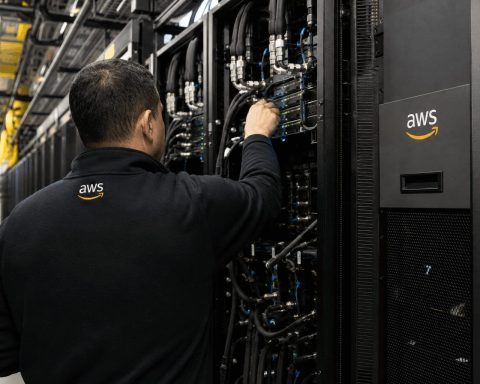
In recent years, DeSantis led AWS Infrastructure (data centers, networking, hardware and supply chain) and later AWS Utility Computing. Jassy underscored the scale of that footprint, citing 38 geographic regions and 120 Availability Zones worldwide.
The move effectively elevates DeSantis from running a massive piece of AWS to steering a broader, cross-cutting “new technologies” portfolio that Amazon sees as central to the next decade of computing — and central to how Amazon wants to compete in the AI era. About Amazon+1
Pieter Abbeel’s role: frontier models meet robotics
By naming Pieter Abbeel to lead frontier model research, Amazon is blending serious model research leadership with one of its biggest real-world differentiators: robotics at massive scale.
In its internal message, Amazon described Abbeel as a leading AI researcher and noted he co-founded Covariant, a robotics startup Amazon hired/acqui-hired, and that he will continue his robotics work while leading the base-model builders in AGI.
The Register’s analysis framed this as an underappreciated angle: if “embodied AI” becomes a major category, Amazon has a uniquely large robotics deployment environment to test systems in real-world operations. The Register
Why merge AI models, chips and quantum — and why now
Amazon’s stated rationale is optimization and speed: Jassy pointed directly to the “advantages of optimizing across models, chips, and cloud software and infrastructure,” especially with Nova 2 models freshly launched at AWS re:Invent and custom silicon scaling quickly. About Amazon
That emphasis matters because training and serving cutting-edge AI models has become a hardware-and-infrastructure race as much as a software race. By putting Nova, custom chips like Trainium/Graviton/Nitro, and quantum computing under one leader, Amazon is betting that tighter coordination can deliver:
- Better price-performance for customers (a major AWS selling point)
- Faster iteration cycles between model teams and chip teams
- More consistent execution across research, engineering, and deployment
CIO Dive noted that this reorg comes directly after Amazon’s re:Invent push, where it positioned Nova and tooling like Nova Forge as an enterprise play — enabling companies to build and tailor frontier models rather than simply consuming off-the-shelf AI via APIs.
Quantum is the outlier for many readers — it’s not an immediate revenue engine in the way chips and model services can be — but bundling it into the same leadership structure suggests Amazon wants long-term “deep tech” investments governed alongside the infrastructure and compute platforms that would ultimately be needed to commercialize them. About Amazon+1
The competitive backdrop: Amazon wants to erase the “late to AI” narrative
The reorganization lands amid persistent industry chatter that Amazon has lagged rivals in mindshare around consumer-facing AI, despite AWS’s dominance in cloud. Reuters reported Amazon has been working to shake a reputation that it trails competitors like Google, Microsoft, and OpenAI in AI model development.
That perception has been amplified by the bumpy, delayed modernization of Alexa with generative AI. The Verge pointed to repeated delays around Alexa’s AI overhaul and noted Prasad has publicly criticized popular benchmark scorecards, arguing that many model “evals” don’t reflect real-world value. The Verge
Amazon’s counter-message is clear: it wants to compete not only on model quality, but also on cost, infrastructure, and integration — offering AI that is tightly linked to the AWS stack, tuned for enterprise deployment, and supported by Amazon-designed chips.
Investments, partnerships, and the hardware war
Beyond internal reorgs, Amazon continues to use capital and partnerships to stay central in the generative AI ecosystem. Reuters reiterated that Amazon has invested roughly $8 billion in Anthropic and integrated Anthropic’s technology into internal and consumer products, and also reported Amazon is considering an investment of up to $10 billion in OpenAI.
Those relationships matter because they drive demand for AWS infrastructure and chips, while also influencing which foundation models customers choose to build on. The AI cloud market is increasingly shaped by “multi-cloud” behavior — model makers and enterprises spreading workloads across providers — which makes differentiation through performance-per-dollar and vertical integration more valuable. Reuters+1
What changes immediately — and what to watch next
Amazon’s announcement answered the “who” but left the “how” to be detailed in follow-ups.
Here’s what is clear as of today:
- DeSantis will lead the combined org spanning Nova/AGI, silicon, and quantum — and will report directly to Jassy.
- Prasad will depart at the end of 2025.
- Abbeel will lead frontier model research inside AGI while continuing robotics work.
- Amazon says Matt Garman will share an updated AWS structure in a follow-up note as leadership responsibilities shift.
What to watch next (without assuming outcomes Amazon hasn’t confirmed):
- A clearer org chart and product roadmap: Jassy indicated DeSantis will share the organizational design soon.
- Nova’s next enterprise push: after re:Invent, the market will look for customer wins, model upgrades, and tooling adoption that prove Nova can compete at scale.
- Trainium and silicon momentum: Amazon has repeatedly argued custom chips will be a key differentiator in AI economics; how quickly that translates into broad customer adoption will be closely watched.
- Alexa’s next chapter: Prasad’s departure raises questions about whether Alexa’s generative AI experience accelerates under the new structure — and whether Amazon can turn its “AI everywhere” strategy into a standout consumer product. The Verge+1
Bottom line
Today’s leadership shakeup is less about a single executive departure and more about Amazon’s strategic reset: the company is putting one of its most senior infrastructure builders in charge of a unified “AI stack,” tying together models (Nova/AGI), chips (Graviton/Trainium/Nitro), and even quantum computing under a direct line to the CEO. About Amazon+1
If Amazon’s bet pays off, customers could see tighter integration, better price-performance, and faster shipping cycles across AI products. If it doesn’t, the reorg will be seen as another attempt to catch up in an AI race that has increasingly rewarded speed, clarity, and standout products.
Related articles: NASDAQ:AMZN