
NEW YORK, August 21, 2026, 14:23 EDT — Apple Inc. NASDAQ:AAPL shares declined 0.67% to $309.22 on Friday, underperforming the Nasdaq Composite, which gained 0.39%. Apple’s trailing price-to-earnings ratio of 35.57 leaves the stock with just 5.5% potential upside to analysts’ average target.
- At 14:23 EDT, Apple trailed the Nasdaq by 1.06 percentage points.
- The consensus analyst price target of $326.34 suggests a potential upside of 5.5%.
- Quarterly EPS received a $0.11 boost, or 5.4%, from tariff refunds.
The margin is tight for a stock subject to product-cycle risk. Apple’s $4.51 trillion market capitalization also amplifies minor movements in the multiple.
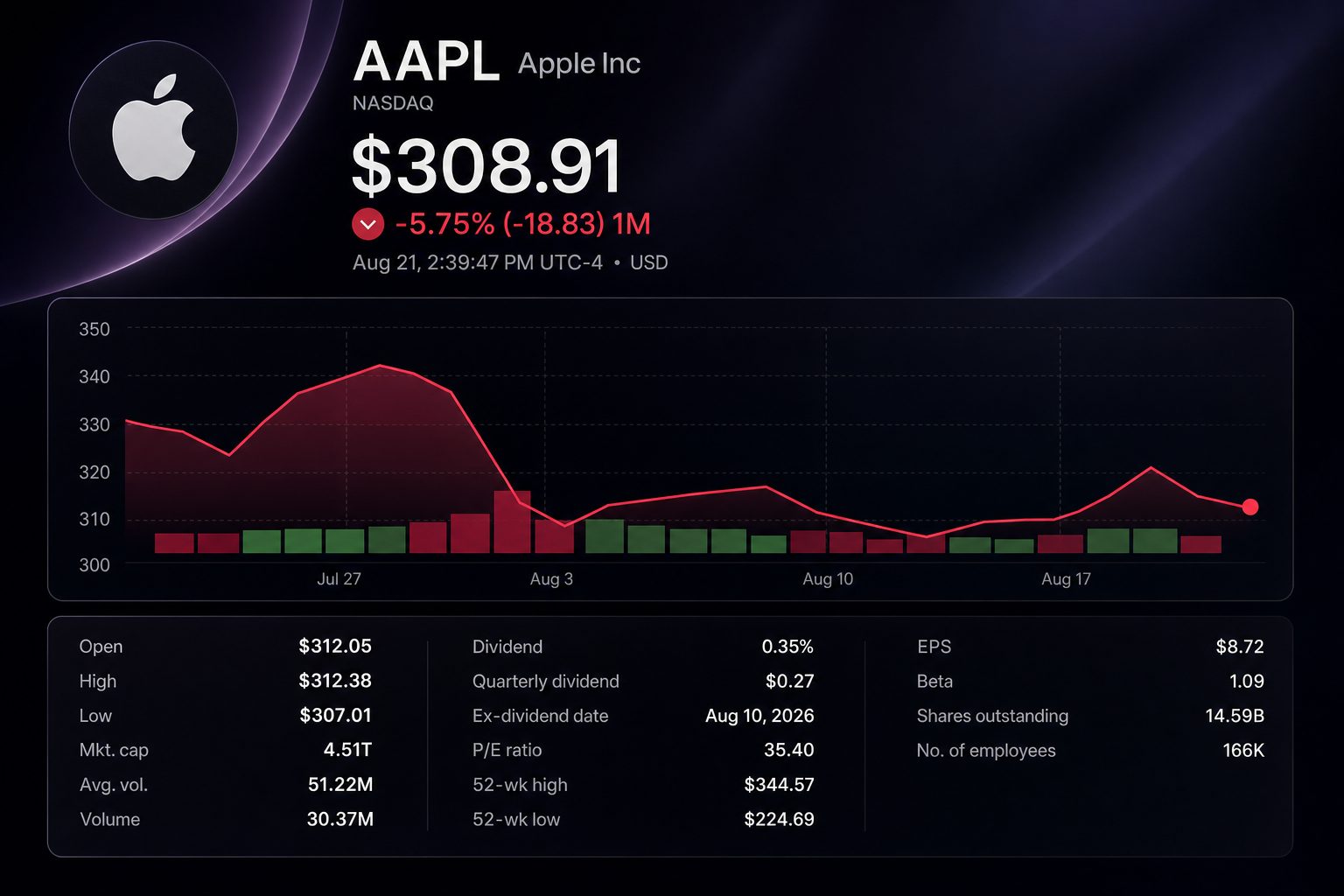
The valuation prompts investors to consider a straightforward question: Will the upcoming product and AI cycle be able to surpass the impact of a higher discount rate?
| Market snapshot | Level | Session move |
|---|---|---|
| Apple | $309.22 | down 0.67% |
| Nasdaq Composite | 26,167.55 | up 0.39% |
| S&P 500 | 7,673.36 | up 0.42% |
| Dow Jones Industrial Average | 53,196.36 | up 0.83% |
U.S. stocks recovered some ground, while technology stocks trailed behind, weighed by persistent strength in long-term Treasury yields. Elevated yields added to the strain on high-priced shares.
Apple delivered strong operational gains last quarter. Revenue climbed 16% to $109.4 billion and diluted earnings per share advanced 29% to $2.02.
| Fiscal Q3 measure | Reported | Approx. excluding tariff refunds |
|---|---|---|
| Revenue | $109.4 billion | $109.4 billion |
| Revenue growth | +16% | +16% |
| Gross margin | 50.1% | 48.1% |
| Diluted EPS | $2.02 | $1.91 |
| EPS growth | +29% | About +22% |
The strength of the beat is significant. Tariff refunds accounted for approximately two margin points and 5.4% of stated EPS. Without these refunds, EPS still rose by about 22%.
Chief Executive Tim Cook described it as Apple’s “strongest June quarter ever, with double-digit revenue growth across iPhone, Mac and Services.” The number of active devices also hit an all-time high. Apple’s official results
Analyst sentiment stays upbeat overall, though not unanimous. Of the 46 recommendations, 27 are Buy or Strong Buy, while 19 are Hold or lower.
| August analyst rating | Number | Percentage of 46 |
|---|---|---|
| Strong Buy | 21 | 45.7% |
| Buy | 6 | 13.0% |
| Hold | 14 | 30.4% |
| Sell | 2 | 4.3% |
| Strong Sell | 3 | 6.5% |
There is significant variation in target outcomes. The low scenario suggests a decrease of 30.5%, while the high scenario indicates a potential increase of 29.4%.
| 12-month price forecast | Estimate | Change from $309.22 |
|---|---|---|
| Lowest | $215.00 | -30.5% |
| Consensus | $326.34 | +5.5% |
| Median | $335.00 | +8.3% |
| Highest | $400.00 | +29.4% |
New analysis highlights that division. Bank of America reiterated its Buy rating with a $380 price target on August 20. On August 17, Rothschild & Co Redburn raised Apple to Buy and set a $400 target.
Evercore ISI’s Amit Daryanani added Apple to his list of six top AI-hardware picks for the remainder of 2026, citing the company’s product pipeline, artificial intelligence capabilities, and shareholder value.
The next hurdle is execution. Investors seek proof that fresh devices and Siri AI are capable of maintaining double-digit earnings growth once the tariff boost diminishes.
Risks: Earnings and valuation multiples could be pressured by factors such as a product release delay, softer demand for premium phones, elevated trade expenses or slower-than-expected AI uptake. Conversely, if growth accelerates, the current target gap may ultimately appear overly conservative.
Related articles: NASDAQ:AAPL