
SINGAPORE, May 30, 2026, 17:34 (SGT)
Asia stocks finished the week mixed, as traders bought chip names on the AI theme while others stuck to defensives in India and mainland China. Markets are closed Saturday. Investors now look ahead to a busy first week of June for data.
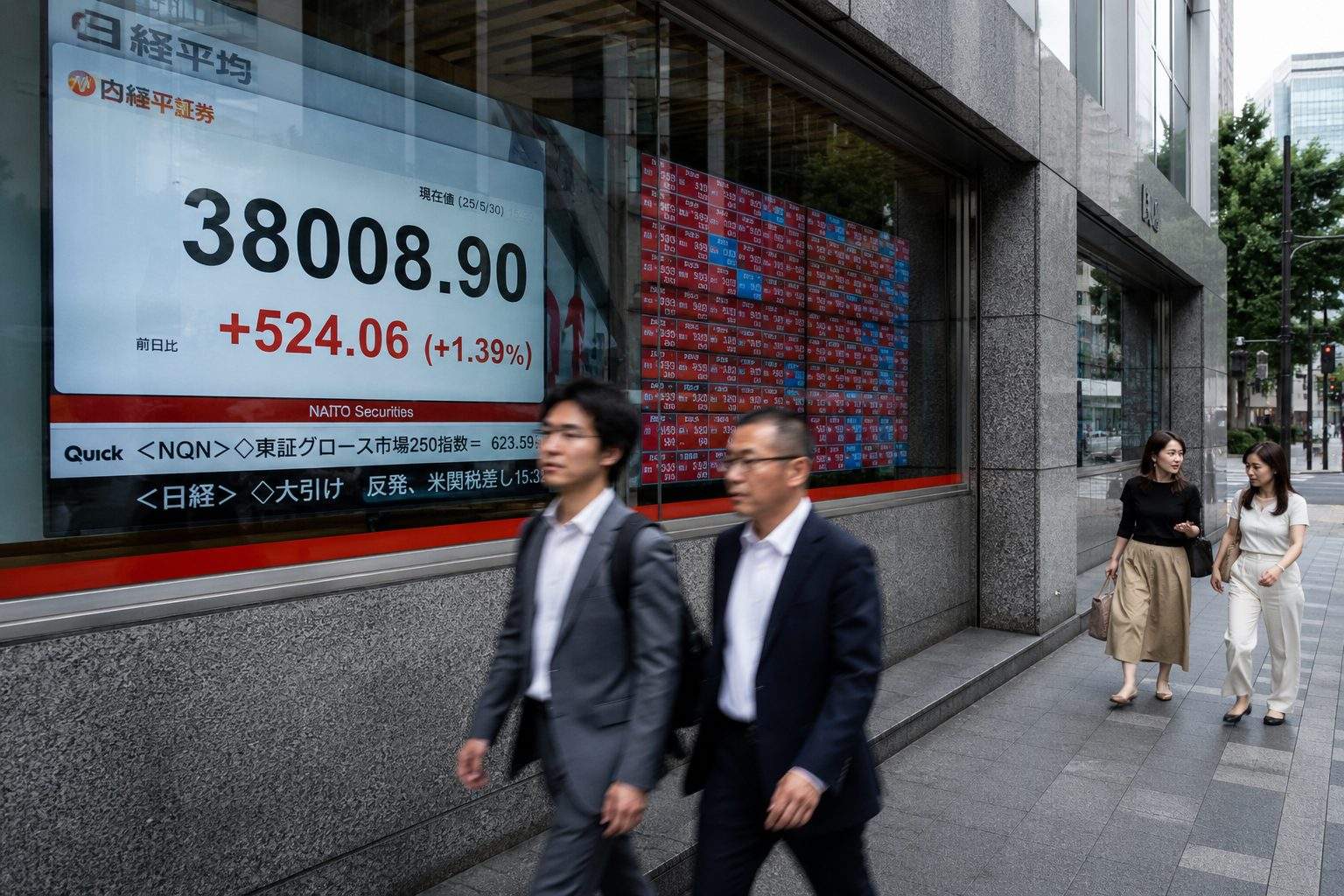
Nikkei 225 jumped 2.53% to finish at 66,329.50 on Friday. Hong Kong’s Hang Seng rose 0.70% to 25,182.39. Sensex in India dropped 1.44% to 74,775.74, while Shanghai slipped 0.73%. Gains in the region were mixed even as Wall Street’s tech stocks pushed U.S. indexes to new closing highs on hopes tied to a Middle East deal.
Why it matters: The AI trade isn’t just about big U.S. tech anymore. Global funds are moving more money into Asia, especially Japan, Taiwan, and South Korea. Markets exposed to higher oil import costs or with less connection to AI hardware are falling behind.
Japan is still the big developed market seeing the clearest flow shift. Foreign investors bought a net 1.08 trillion yen of Japanese equities in the week ending May 23, making it eight weeks in a row of inflows. AI stocks rallied and oil prices slipped during the period, with traders buying names like SoftBank Group and chip designer Socionext.
Tokyo’s rally has pushed valuations higher. A Reuters survey this week put the Nikkei at 69,000 by end-2027, but Nomura Securities’ Yunosuke Ikeda said market mood on AI was “choppy.” IG Markets analyst Tony Sycamore told clients he sees risk of “a 20% pullback before year-end.” Reuters
Taiwan drew notice after the government raised its 2026 GDP growth outlook to 9.64%, set to be the fastest pace in 16 years. Exports are forecast to gain 39.77% with support from AI, high-performance computing and cloud infrastructure. Kevin Wang from Masterlink Investment Advisory said Taiwan’s central bank is seen holding rates steady this year: “Raising or cutting interest rates will not happen this year.” Reuters
Computex kicks off in Taipei next week, putting the tech trade back in the spotlight. Nvidia CEO Jensen Huang is set for the opening keynote. Investors are also tracking AMD and Intel. McKinsey partner Ryan Fletcher said Taiwan’s story is “moving from a semiconductor story to an infrastructure story.” Reuters
Foxconn jumped 9.9% on Friday after Chairman Young Liu said the typical mid-year slowdown for tech suppliers wasn’t happening this year. “The second half of the year looks very good,” Liu said, unless a severe “black swan” event hits. The Nvidia supplier rallied after Dell posted a strong outlook for AI servers. Reuters
South Korea is seeing strong moves too. The National Pension Service lifted its end-2026 goal for domestic stocks to 20.8% after the KOSPI jumped almost 90% this year. Barclays analyst Bum Ki Son pointed to big gains from semiconductor exports that he thinks could keep going for another two or three years.
China and Hong Kong traded more stable, with no real signs of excitement. Hong Kong edged higher Friday as investors balanced tech gains against losses from China’s property sector. A Reuters poll pointed to Chinese home prices dropping 3.5% this year, with a small rise expected in 2027. Yingxue Ren at S&P Global China Ratings said policy makers only want to avoid “a sharp loss of momentum,” not deliver a full property rebound. Reuters
India stocks slid Friday, with the Nifty 50 down 1.5% and the Sensex off 1.44%. Both posted losses for the month. Investors locked in gains as doubts over a possible U.S.-Iran peace deal lingered. “Indian stocks were unlikely to rise consistently until that conflict risk was clearly behind us,” Arun Malhotra at CapGrow Capital said. Reuters
Macro pressure is building too. India’s finance ministry warned Saturday that retail inflation might pick up if fuel prices climb and the monsoon stays weak. The ministry called the length of any disruption at the Strait of Hormuz the “single most consequential variable” for India’s external balance and price outlook. Reuters
Rates and oil are the problem. More Fed officials are now saying U.S. rates might have to go up again, and markets are betting the Fed’s next move is a hike from 3.50%-3.75%, probably by year-end. That means higher U.S. yields, which would make it tougher to justify high-priced Asian growth stocks—especially if oil stays high and importers keep feeling the squeeze.
China’s official manufacturing PMI opens the week, with economists in a Reuters poll predicting a dip to 50 from 50.3. The index tracks factory growth, where 50 is the dividing line. Investors are also watching for India’s June 5 rate call, updates out of Computex in Taipei, and U.S. reports on jobs and ISM manufacturing to see if the AI rally can stay ahead of inflation worries.
Related articles: Inflation