
AMSTERDAM, June 4, 2026, 22:03 CEST
- ASML shares in Amsterdam last traded at €1,498.00 after reaching €1,499.00 earlier. The company’s U.S. ADRs climbed $40.45 to $1,766.81 in late New York trading.
- BofA and Barclays both lifted their ASML price targets, pointing to improved outlook on demand and EUV tool capacity.
- TSMC said AI demand is still pressuring the chip supply chain. Broadcom’s drop left chip sentiment shaky.
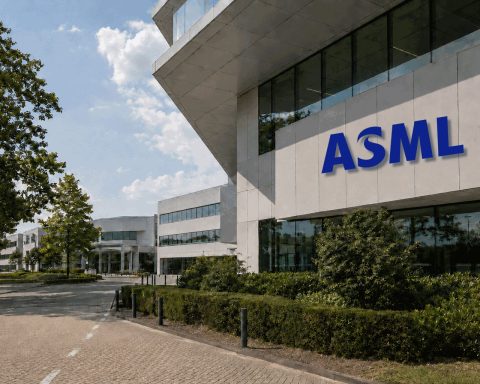
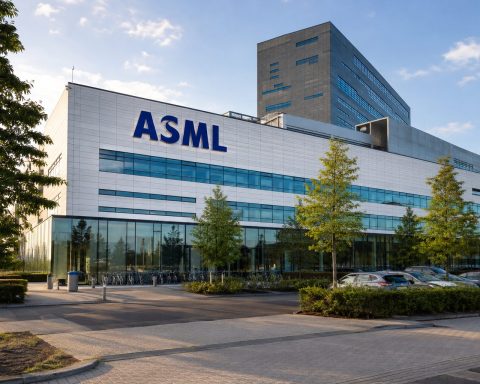
ASML Holding shares nearly hit €1,500 in Amsterdam on Thursday, building on their AI-fueled rally. The stock got a boost after two brokerages lifted their price targets. Its key end-market is still seeing tight supply.
ASML is getting attention right now since it’s right at the main bottleneck in the AI supply chain. Its extreme ultraviolet lithography machines, or EUV tools, use light to print tiny circuit designs onto silicon wafers. That process is required for building top-end chips.
ASML traded at €1,498.00 in Amsterdam, climbing from its last close at €1,485.20 and holding just shy of the day’s high at €1,499.00, Investing.com data showed. The company’s U.S. ADRs were up 2.3% to $1,766.81 late in the Nasdaq session.
BofA bumped its target on ASML up to €1,921 from €1,710 and kept its buy rating, according to Investing.com. Barclays also raised its ASML target, going to €1,900 from €1,575 and kept an overweight call. The brokerages said they are more confident in ASML’s ability to grow EUV output beyond current bottlenecks.
BofA says “Customers are giving unusual visibility to ASML as their own demand forecasts continue to trend higher,” with capital spending picking up from major cloud firms and more long-term deals across graphics chips, CPUs, custom AI chips and memory. Investing.com
ASML got a lift after new remarks from Taiwan Semiconductor Manufacturing Co, the top contract chipmaker and one of its key customers. TSMC chief C.C. Wei said Thursday that demand from customers remains strong and the company is taking steps to make sure it does not slow down the AI supply chain.
TSMC has picked up ASML’s High-NA EUV machines, CEO C.C. Wei said, but isn’t using them in production yet because of the price. High-NA is a step up in EUV tech for sharper chip features. “Once the economics make sense, we will bring it into production,” Wei said. Investing.com
The broader market looked choppy. Reuters said global stocks traded mixed. Broadcom dropped over 14% as its results missed expectations, disappointing investors hoping for higher custom AI chip demand. “Today’s action in tech specifically is emblematic of how fragile sentiment can be,” James St. Aubin, chief investment officer at Ocean Park Asset Management, told Reuters. Reuters
STOXX 600 closed up 0.5% in Europe. Chipmakers lagged, with Infineon and STMicroelectronics falling after Broadcom’s results, but ASML bucked the trend. The broader sector has not traded in lockstep with the AI story.
ASML lifted its forecast in April. The company posted first-quarter sales of €8.8 billion and a gross margin of 53.0%—the portion of revenue left after production costs. It now expects 2026 sales between €36 billion and €40 billion. “Demand for chips is outpacing supply,” Chief Executive Christophe Fouquet said at the time. ASML
ASML is still the only company making EUV lithography machines, according to Reuters. Nikon and China’s SMEE compete with ASML in deep ultraviolet, or DUV, tools, but investors are mostly interested in EUV because those machines are rare.
Market risk is that much of the scarcity could be in the price already. BofA and Barclays cited China’s export curbs and less capital spending in chips as risk factors, while ASML said its 2026 outlook lets in a range of export control scenarios.
Right now, the stock story is straightforward. If TSMC, companies tied to Nvidia, and memory producers keep up their AI-driven spending, ASML has what they want. But if that spending drops off, there may not be much cushion for a stock trading close to its record highs.