NEW YORK, July 28, 2026, 06:12 EDT — U.S. premarket trading Google
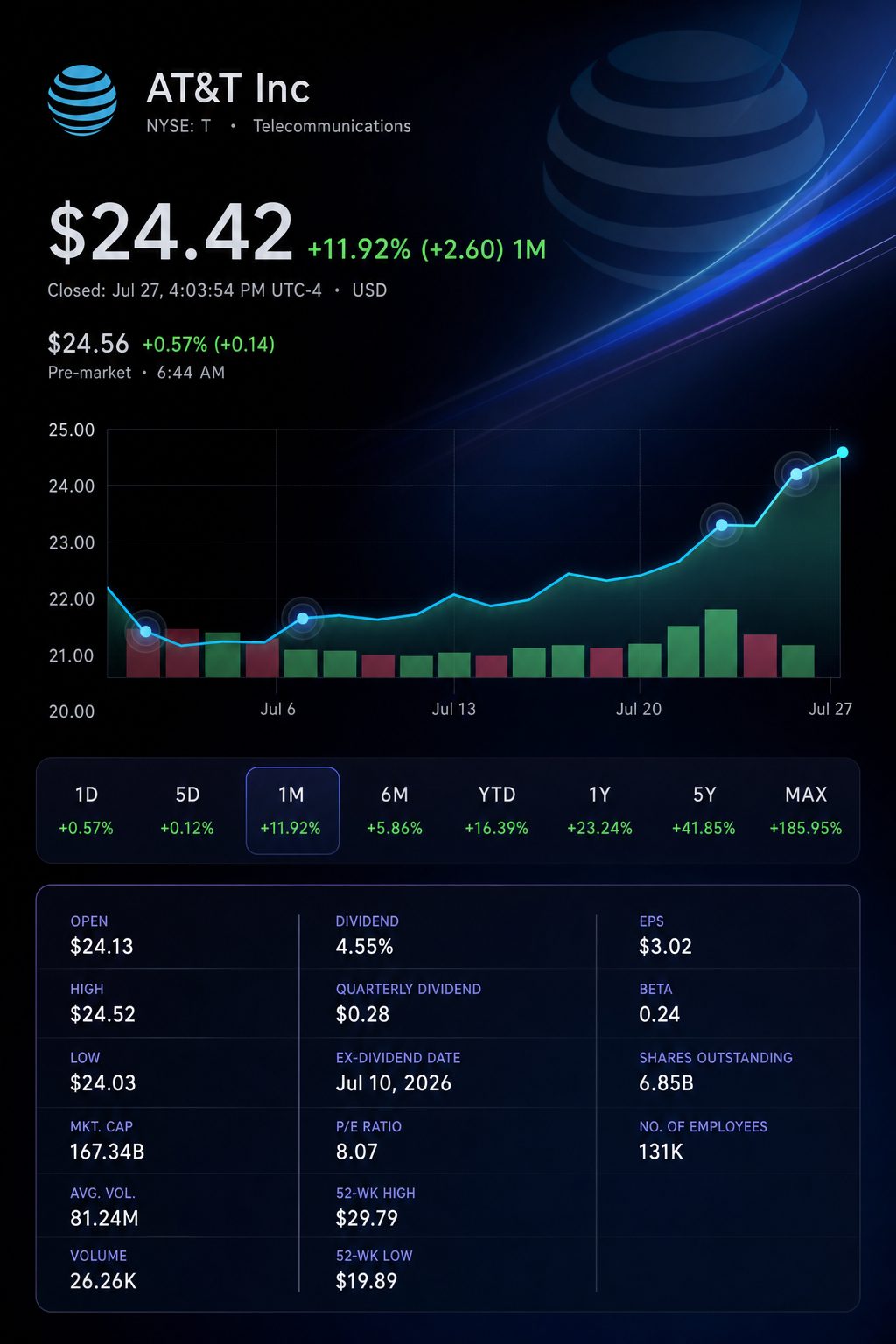
AT&T moved up 0.4% to $24.52 in early trading, following a 1.2% increase on Monday.
The stock gained 10.6% over the past week. Its buyback goal for 2026 amounts to 6.0% of the company’s market capitalization as of Monday.
The $23 billion EchoStar spectrum closing, scheduled for this week, represents the primary balance-sheet event.
AT&T Inc. rose 0.4% to $24.52 in premarket activity on Tuesday. The main U.S. trading session was shut.
Shares rose 1.2% on Monday, extending last week’s 10.6% gain as the company posted robust subscriber growth and broadened its buyback program.
Investors are focusing on the scale of the buyback. AT&T plans to repurchase about $10 billion in shares, representing 6.0% of its $167.34 billion market capitalization.
Including the present 4.55% dividend yield results in a 10.5% shareholder-yield metric. This figure does not represent a total-return projection.
The $10 billion amount represents an annual goal. AT&T reported expenditures of $4.44 billion by the end of June.
The firm acquired 86.2 million shares in the second quarter, paying an average price of $25.01 per share.
Shares finished Monday at $24.42, marking a 2.4% decline from the average. At this level, every additional dollar could buy back roughly 2.4% more shares.
The contrast with Verizon Communications Inc. NYSE:VZ highlights the trade-off.
Companies use different definitions for internet and broadband additions.
AT&T’s buyback goal is 2.6 times higher compared to its market capitalization, while Verizon produced $1.7 billion more in quarterly free cash flow.
AT&T announced Monday that it has broadened its partnership with D-Wave Quantum Inc. NASDAQ:QBTS to enhance network optimization.
An initial workload that previously took roughly one hour now completes in less than 15 seconds. The technology could be applied to outage management, technician deployment, and planning for network infrastructure.
“The speed we’re seeing with D-Wave challenges what’s currently possible,” said Lucus Haugen, an AT&T data-science director. The statement did not reveal a contract value or specify a savings target. Business Wire
Results on earnings are more solid. AT&T reported a quarterly gain of 432,000 postpaid phone users and 646,000 advanced internet subscribers.
Adjusted earnings were $0.65 a share, topping the consensus of $0.59. Revenue came in at $31.56 billion, falling short of the $31.81 billion estimate.
“The cross-selling they have been working on is now appearing in the figures,” said David Wagner with Aptus Capital Advisors. Reuters
Management maintained its projection for free-cash-flow in 2026 at above $18 billion and forecasts adjusted earnings per share between $2.25 and $2.35.
EchoStar Corp. NASDAQ:ECHO is in focus for the week ahead. AT&T anticipates finalizing its spectrum acquisition by Friday, July 31.
The purchase will be financed through a combination of cash and term loans. AT&T targets a net leverage ratio close to 2.5 times in roughly three years.
Risks persist. Spectrum acquisitions financed through debt and increased bad-debt expenses may offset the advantages of the buyback.
Did AT&T’s second-quarter results truly surpass forecasts?
AT&T posted revenue of $31.6 billion, marking a 2.3% increase compared to the prior year. Adjusted earnings climbed 20.4% to $0.65 per share, surpassing the analyst consensus of $0.59. Revenue came in just under the estimated $31.8 billion. Subscriber gains and an 8.0% rise in Advanced Connectivity EBITDA were among the stronger highlights.
Is AT&T able to maintain its pace of wireless subscriber growth?
AT&T posted 432,000 net additions for postpaid phones, surpassing last year’s 401,000 and well above the 338,500 analyst consensus. Postpaid phone churn dropped by one basis point to 0.86%. Wireless service revenue was up 3.3%, boosted by both subscriber growth and pricing moves. According to management, reduced churn this quarter was also helped by fewer device upgrades, though they cautioned this positive effect may not last.
What portion of broadband expansion resulted from the Lumen acquisition?
A portion was not acquired. AT&T gained 367,000 new fiber connections and 279,000 fixed-wireless subscriptions. Revenue from advanced home internet climbed 27.3% to $2.93 billion. The company did not break out the quarter's organic revenue figures. Revenue per fiber customer slipped 1.3%, but remained nearly unchanged when excluding Lumen. The acquisition expanded scale, decreasing the average revenue reported per customer.
Is AT&T on track to achieve a minimum of $18 billion in free cash flow by 2026?
Free cash flow for the first half reached approximately $7.2 billion. Hitting the full-year goal means generating at least $10.8 billion in the second half. Management anticipates third-quarter cash flow will be essentially unchanged from the previous year. Achieving the prior year's $4.9 billion in the third quarter would mean $5.9 billion must be reached in the fourth quarter. That would mark an increase of about 40% over fourth-quarter 2025 cash flow. This is presented as a scenario, not official company guidance. The capital investment outlook remains set at $23 billion to $24 billion.
Is the company financially able to support both the dividend and accelerated share buybacks?
AT&T’s $1.11 annual dividend amounts to around $7.6 billion based on quarter-end shares outstanding, representing about 42% of the company’s $18 billion minimum cash flow. AT&T is also targeting close to $10 billion in share buybacks for 2026. Together, expected shareholder returns are projected to reach $18 billion this year, nearly matching forecasted free cash flow. The next dividend of $0.2775 is set for August 3. Share repurchases provide flexibility for capital allocation.
What level of balance-sheet risk is associated with EchoStar’s spectrum acquisition?
AT&T has agreed to purchase 50 MHz of spectrum for around $23 billion. The deal received Federal Communications Commission approval in May. The company expects to complete the transaction by the end of July, though that date remains subject to change. As of the second quarter, AT&T reported total debt of $144.0 billion, which includes $126.4 billion in net debt. Net leverage stood at 2.68 times and is projected to rise to nearly 3.2 times following the acquisition. The company's target is to reduce that figure to about 2.5 times within three years post-closing, depending on cash generation and disciplined capital spending.
Does AT&T’s share price remain low around $24.42?
AT&T is priced at $24.42, with adjusted guidance implying a multiple between 10.4 and 10.9. The midpoint stands close to 10.6 times estimated 2026 profit. Its $1.11 yearly dividend generates an approximate yield of 4.5%. These valuations are modest for a firm with rising adjusted profit and EBITDA. However, net debt of $126.4 billion makes the balance sheet sensitive. Valuation is low, but leverage is high.
Is Advanced Connectivity positioned to surpass the declining copper segment?
At present, this holds true. Advanced Connectivity accounts for more than 90% of service revenue and contributes almost all adjusted EBITDA. Service revenue for this segment increased by 5.1%, and adjusted EBITDA was up 8.0%. Operating income climbed 20.3%. By contrast, Legacy service revenue declined 26%, and its EBITDA was down roughly 46%. Management forecasts that Legacy EBITDA will go negative after 2027. Approvals in California could push the scheduled copper shutdown past 2029.
Does Starlink pose a significant short-term challenge for AT&T?
There is no announced wholesale deal between AT&T and Starlink. AT&T’s CEO stated the company manages approximately 98% of customer network traffic directly, with external arrangements covering mainly the remaining 2%. SpaceX’s acquisition of EchoStar spectrum increases its prospects in direct-to-device services. The exact timing, network capacity and customer profit outlook for these efforts is unclear. There is no clear evidence yet of negative impact on near-term earnings.
Will the broader D-Wave deal impact AT&T’s earnings expectations?
Not at this time. AT&T expects to ramp up quantum applications for outages, routing and managing network traffic. A pilot optimization workload dropped from about an hour to under 15 seconds. The announcement did not state a contract value or anticipated cost savings. No update was given on AT&T’s financial outlook. This should be viewed as an efficiency measure, not a current earnings contributor.
Khadija Saeed is a financial markets reporter at TS2.tech. Her coverage ranges from stocks and technology to emerging industries and developments across global markets. She studied economics and finance at the London School of Economics and worked in market research before becoming a financial journalist. Follow Khadija Saeed on Google News.
A figure above or below the 12.0 consensus could impact Treasury yields, the dollar, and cyclical stocks by influencing short-term growth outlooks.
#2
NAHB Housing Sentiment
A reading above or below 33 will influence expectations for housing demand, mortgage rate trends, and homebuilder stocks.
#3
Fabrinet After the Close
Investors are focusing on revenue, margins, and comments on datacom as key factors for companies involved in optical networking and AI infrastructure supply chains.