
NEW YORK, August 4, 2026, 11:34 a.m. EDT
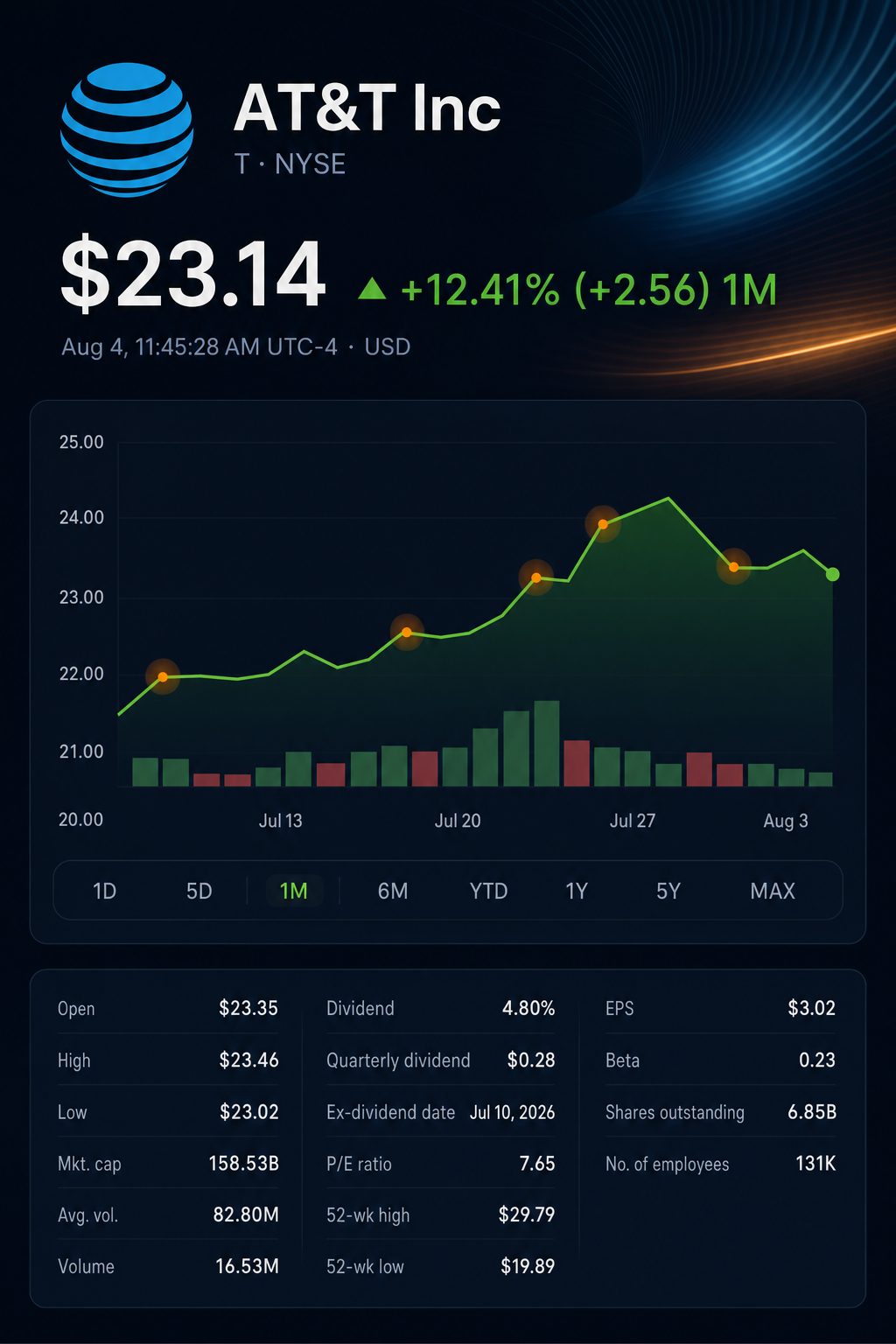
- AT&T shares were down 2.1% at $23.10, as the SPDR S&P 500 ETF Trust NYSEARCA:SPY advanced 1.3%.
- AT&T will implement a $1 rise in its postpaid wireless cost, effective August 5.
- An initial estimate based on phones suggests annual gross revenue could reach as much as $899 million.
U.S. markets traded with gains, but shares of AT&T Inc. NYSE:T slid 2.1% to $23.10 by late morning, lagging the broader market. The drop followed the announcement that a wireless fee hike would take effect the following day.
The discrepancy raises a cash-flow issue. Based on AT&T’s disclosed phone customer base, the rise could equate to a gross annual run-rate approaching $900 million. This estimate does not take exemptions, churn, or associated expenses into account.
| Security | Price | Day move | Trailing P/E |
|---|---|---|---|
| AT&T Inc. NYSE:T | $23.10 | down 2.1% | 7.7x |
| Verizon Communications Inc. NYSE:VZ | $46.34 | down 2.2% | 12.0x |
| T-Mobile US Inc. NASDAQ:TMUS | $175.66 | off 0.8% | 18.4x |
| SPDR S&P 500 ETF Trust NYSEARCA:SPY | $767.26 | up 1.3% | — |
Prices are based on transactions occurring at approximately 11:19 a.m. EDT. Changes for the day are measured from prior closing levels.
AT&T will increase its consumer Administrative & Regulatory Cost Recovery Fee on August 5, raising it to $4.99 from $3.99 per postpaid line. For business and government accounts, the administrative fee will also go up by $1, reaching a maximum of $3.49. AT&T states that these fees are company charges and not government-mandated taxes.
AT&T reported 74.921 million postpaid phone customers as of June 30. Charging an extra $1 each month across this group would generate $899.1 million in annual gross revenue. This figure serves as an early revenue estimate and does not represent company guidance.
| Portion of phone base billed | Lines estimated | Yearly gross gain | Portion of 2026 FCF minimum |
|---|---|---|---|
| 25% | 18.7 million | $225 million | 1.2% |
| 50% | 37.5 million | $450 million | 2.5% |
| 75% | 56.2 million | $674 million | 3.7% |
| 100% | 74.9 million | $899 million | 5.0% |
Initial estimates are based on $1 per month over a 12-month period. The assessment is drawn from AT&T’s anticipated free cash flow of more than $18 billion for 2026.
Coverage of 50% would generate approximately $450 million. AT&T states that this fee assists in offsetting costs tied to interconnection, cell sites, and regulatory expenses. Gross revenue should not be confused with profit.
| 2026 cash target | AT&T amount | $899 million example as percentage |
|---|---|---|
| Lowest projected free cash flow | $18.0 billion | 5.0% |
| Average capital investment | $23.5 billion | 3.8% |
| Expected buybacks | About $10.0 billion | 9.0% |
Capital spending is based on the midpoint of AT&T’s projected $23 billion to $24 billion range.
The additional revenue could help after AT&T completed a $23 billion spectrum purchase on July 28. The acquired licenses bring approximately 50 MHz of low- and mid-band spectrum to nearly every market in the United States.
AT&T’s second-quarter performance shows potential for price adjustments. The company reported a net addition of 432,000 postpaid phone subscribers and 646,000 new internet connections. Postpaid phone churn remained steady at 0.86%, with free cash flow totaling $4.7 billion.
“The cross-selling that they’ve been working toward is now evident in the results,” said David Wagner, head of equity at shareholder Aptus Capital Advisors. AT&T reported that 42.5% of advanced-home-internet households also subscribe to its wireless service. Reuters
| Second-quarter measure | AT&T | Verizon | T-Mobile |
|---|---|---|---|
| Subscriber-growth measure | 432,000 phone net adds | 184,000 phone net adds | 277,000 net account additions |
| Relevant service-revenue growth | 5.1% | 2.8% | 9.0% |
| Free cash flow | $4.7 billion | $6.4 billion | $4.8 billion, adjusted |
Definitions of subscribers and revenue vary. AT&T discloses Advanced Connectivity growth, Verizon provides mobility and broadband figures, while T-Mobile reports total service revenue.
AT&T reported a higher number of phone additions than Verizon. T-Mobile posted quicker service-revenue growth, but its subscriber reporting counts accounts instead of individual phone lines. Investors are watching to see if AT&T can maintain its 0.86% churn rate after implementing a fee increase.
Chief Executive John Stankey stated, “We are accelerating the pace of our planned share repurchases this year to approximately $10 billion.” The full-base fee proxy represents nearly 9% of that goal. AT&T Newsroom
Valuation continues to weigh on the stock. AT&T trades at 7.7 times its trailing earnings, compared with 12.0 times for Verizon and 18.4 times for T-Mobile. The company’s annual dividend of $1.11 offers a yield of around 4.8% at Tuesday’s close.
The immediate driver is operational. Increased charges take effect on August 5. The key investment assessment will come with third-quarter churn and service revenue figures, allowing investors to determine if the pricing increment offset customer pushback.
Risks: Some postpaid phone lines might not incur the extra fee. Increased bills could raise churn rates or necessitate bigger promotional offers. Much of the gross revenue could be consumed by network and spectrum investments.
Related articles: NYSE:T