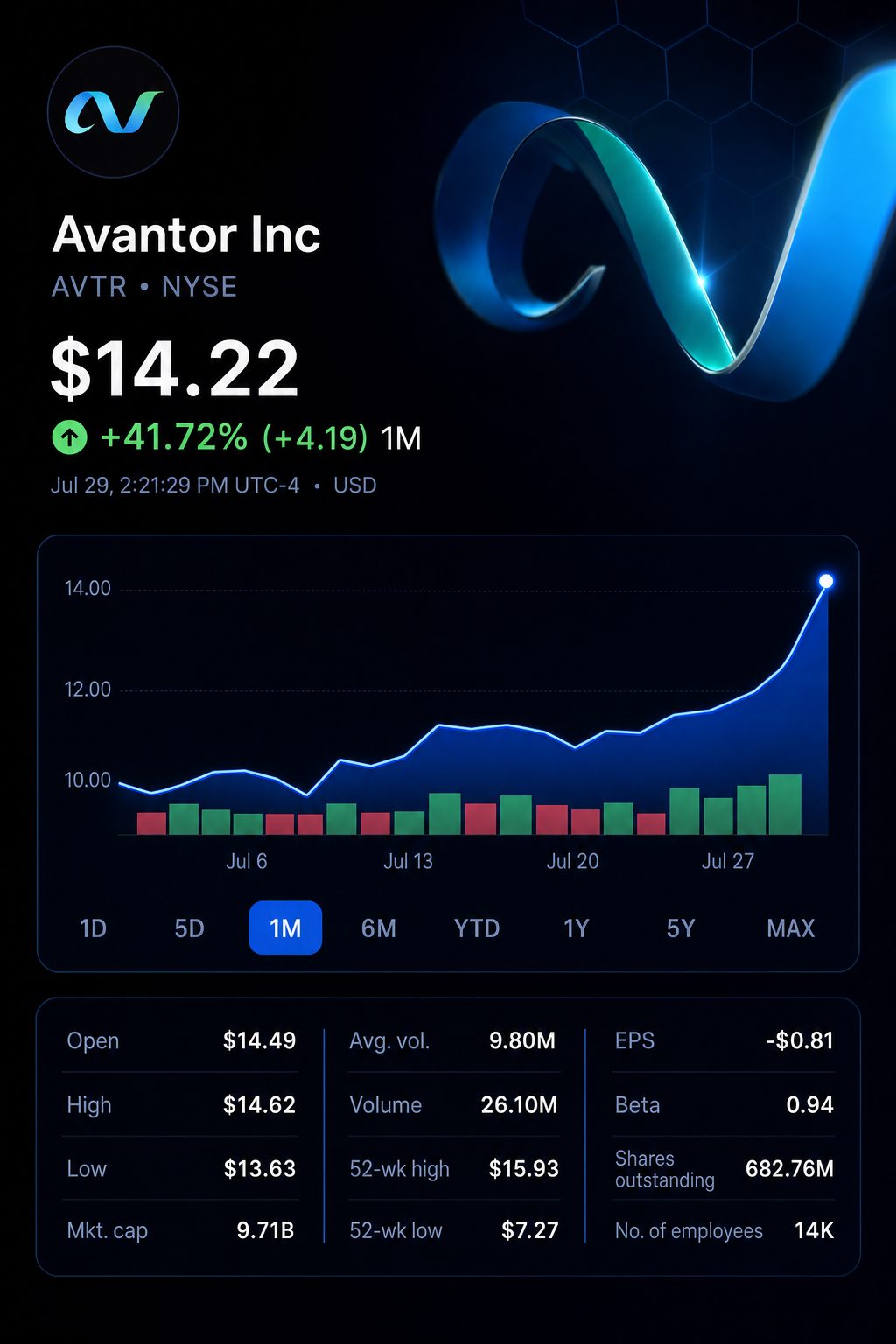
Avantor rose 14.8% to $14.26 during regular U.S. trading.
Quarterly sales beat preliminary FactSet consensus by roughly $82 million.
Organic-sales guidance improved. Margin and cash-flow targets did not.
Avantor, Inc. NYSE:AVTR shares surged after second-quarter revenue and adjusted profit beat estimates. The laboratory-supplies group also raised its full-year organic-sales range.
The numbers point to a demand reset, not a margin recovery. The organic-sales midpoint improved 150 basis points to flat. Adjusted EPS midpoint rose only 1.9%.
Management changed its 2026 outlook as follows:
Metric
April 29 guidance
July 29 guidance
Midpoint change
Organic revenue growth
-2.5% to -0.5%
-0.5% to +0.5%
+1.5 percentage points
Adjusted EPS
$0.77 to $0.83
$0.80 to $0.83
+1.9%
Adjusted EBITDA margin
14.8% to 15.3%
14.8% to 15.3%
None
Free cash flow
$500 million-$550 million
$500 million-$550 million
None
Midpoint changes were calculated from the company’s published ranges.
That gap is the investor issue. Growth returned in Avantor’s lower-margin distribution arm. Its richer-margin products business still contracted.
Second-quarter segment
Sales
Revenue share*
Organic growth
Adjusted operating margin
VWR Distribution & Services
$1.241 billion
73.3%
+1.7%
10.2%
Bioscience & Medtech Products
$451.8 million
26.7%
-5.6%
26.0%
Revenue shares were calculated from company data.
The mix hurt profitability. Gross margin fell 120 basis points to 31.7%. Adjusted EBITDA margin dropped 160 basis points to 15.0%.
Management blamed unfavorable product mix, inflation and lower volumes. Chief Executive Emmanuel Ligner said VWR returned to organic growth “more quickly than we anticipated.” SEC
VWR gained from controlled-environment consumables and specialty procurement. Lower laboratory-consumables sales offset part of that growth. Fluid Handling and NuSil products weighed on the Bioscience division.
Unaudited revenue reached $1.692 billion, versus preliminary FactSet consensus of $1.61 billion. Adjusted EPS of $0.21 topped the $0.19 estimate. However, adjusted EPS fell from $0.24 a year earlier.
Cash generation offered further support. Free cash flow reached $142.8 million, up from $125.4 million. Avantor used $112.1 million to repay debt. Adjusted net leverage ended the quarter at 3.3 times.
Still, first-half free cash flow fell 19% to $168 million. Lower operating cash and higher capital spending drove the decline. The full-year cash target remained unchanged.
The reaction was company-specific. Thermo Fisher Scientific NYSE:TMO slipped 0.5%, while Danaher NYSE:DHR was nearly flat.
Risks remain. The high-margin Bioscience business has not stabilized. VWR’s estimated fair value exceeded its carrying value by only 5.5% at March 31. The unit carried about $2.8 billion of goodwill. Avantor warned that weaker forecasts could trigger a material non-cash charge.
The next test is simple. VWR must sustain growth. Bioscience must stabilize before a broader margin recovery can follow.
AVTR was last seen at $14.26 at 17:47 UTC, climbing close to 14.8%. Shares touched an intraday high of $14.61 after closing at $12.42 on Tuesday. Adjusted EPS came in at $0.21, topping the consensus of $0.19 by roughly 11%. Revenue stood at $1.692 billion, surpassing the referenced estimate by about $81 million. Pricing is intraday and not final.
Did the second-quarter results mark a solid outperformance?
Sales increased by 0.5%, while organic revenue slipped 0.4%. Adjusted EBITDA stood at $254.3 million, representing a 9.1% drop year-on-year. The adjusted margin was 15.0%, lower compared to 16.6% in the same quarter a year earlier. GAAP net income declined to $38.1 million from $64.7 million. The result topped expectations, but profitability lagged compared to the previous year.
Is Avantor now showing clear signs of an underlying sales rebound?
VWR posted $1.241 billion in revenue, accounting for about 73% of the company’s total quarterly sales. Organic growth improved to 1.7%, rebounding from a 4.8% decline in Q1. Management attributed the majority of the gains to targeted commercial initiatives. BMP revenue, meanwhile, dropped 5.6% organically to $451.8 million. Improvements are evident, yet the rebound remains uneven.
How has Avantor updated its 2026 guidance?
Organic growth outlook was revised to a range of negative 0.5% to positive 0.5%, compared with the earlier forecast of a 0.5% to 2.5% decline. Adjusted EPS guidance is now set between $0.80 and $0.83, up from $0.77 to $0.83. Full-year EBITDA margin is still projected at 14.8% to 15.3%. Free cash flow guidance is unchanged at $500 million to $550 million. Third-quarter guidance includes EPS of $0.20 to $0.21 and approximately 2.5% organic growth.
Is a return to growth possible for the Bioscience and Medtech Products segment?
BMP order volumes climbed at a double-digit pace, lifting the book-to-bill ratio to 1.1. This indicates demand picked up ahead of conversion into revenue. Adjusted operating income dropped 10.5% from a year earlier to $117.6 million. Management foresees second-half expansion and anticipates Q3 reported revenue to remain about unchanged. A discrete 150-basis-point headwind continues to weigh on Q3 organic growth rates. The new orders provide a positive signal, but execution remains crucial.
Are margins showing signs of recovery, or are they just holding steady?
Adjusted EBITDA for Q2 climbed approximately 16% sequentially from $219.4 million. The margin for the quarter increased to 15.0%, up from 13.9% in Q1. However, EBITDA was still 9.1% lower than the second quarter a year ago. Management kept the full-year margin outlook unchanged in spite of higher revenue, indicating a priority on stabilization before potential expansion.
Is Avantor’s balance sheet showing greater stability?
Gross debt stood at $3.715 billion, with available cash totaling $306.8 million. Net debt at the end of the quarter was roughly $3.409 billion. Avantor paid down $112.1 million in Q2 and $498 million over the past year. Adjusted net leverage held steady at 3.3 times from the prior quarter. Management continues pursuing a leverage ratio of below 3.0 times before year-end. Current cash-flow guidance backs that objective, though execution will be key.
Does AVTR remain undervalued following the latest surge?
Shares at $14.26 represent approximately 17.5 times earnings at the guided midpoint. The company’s market capitalisation was about $9.65 billion at the latest price. After including net debt, enterprise value is around $13.06 billion. Revenue and margin guidance from management projects EBITDA of about $970 million to $1.01 billion, meaning enterprise value stands near 13 times EBITDA on guidance. The projected free cash flow yield currently ranges from roughly 5.2% to 5.7%. The picture is no longer one of distress.
What is an expected price projection for AVTR over the next twelve months?
After today’s rerating, a base-case range of $14 to $16 looks reasonable. This scenario assumes 2027 adjusted EPS recovers close to $0.90 at a 16–18 multiple. A bear case of $9 to $11 reflects stalled growth and renewed margin pressures. A bull scenario of $18 to $20 would require EPS approaching $1.00 and continued BMP growth. Consensus target aggregates remain around $10.4 to $10.6, still trailing the market; those estimates could shift quickly on the back of today’s stronger earnings. The base-case outlook remains uncertain.
Mateusz Kaczmarek is a financial and technology journalist at TS2.tech. His coverage ranges from stocks and artificial intelligence to semiconductors and developments across global markets. He graduated from the Poznań University of Economics and Business and worked in financial analysis before becoming a business journalist. Follow Mateusz Kaczmarek on Google News.
Surprising starts and permits data can impact homebuilders, mortgage-sensitive stocks, Treasury yields, and the dollar if results deviate significantly from consensus estimates.
#02
Home Depot Q2
The results and outlook provide key insights into housing turnover, renovation demand, professional customer activity, and U.S. discretionary spending.
#03
09:15 ET industrial production
A robust or disappointing factory or utilities report can shift expectations for economic growth, cyclical stocks, bond yields, and the Federal Reserve’s policy direction.