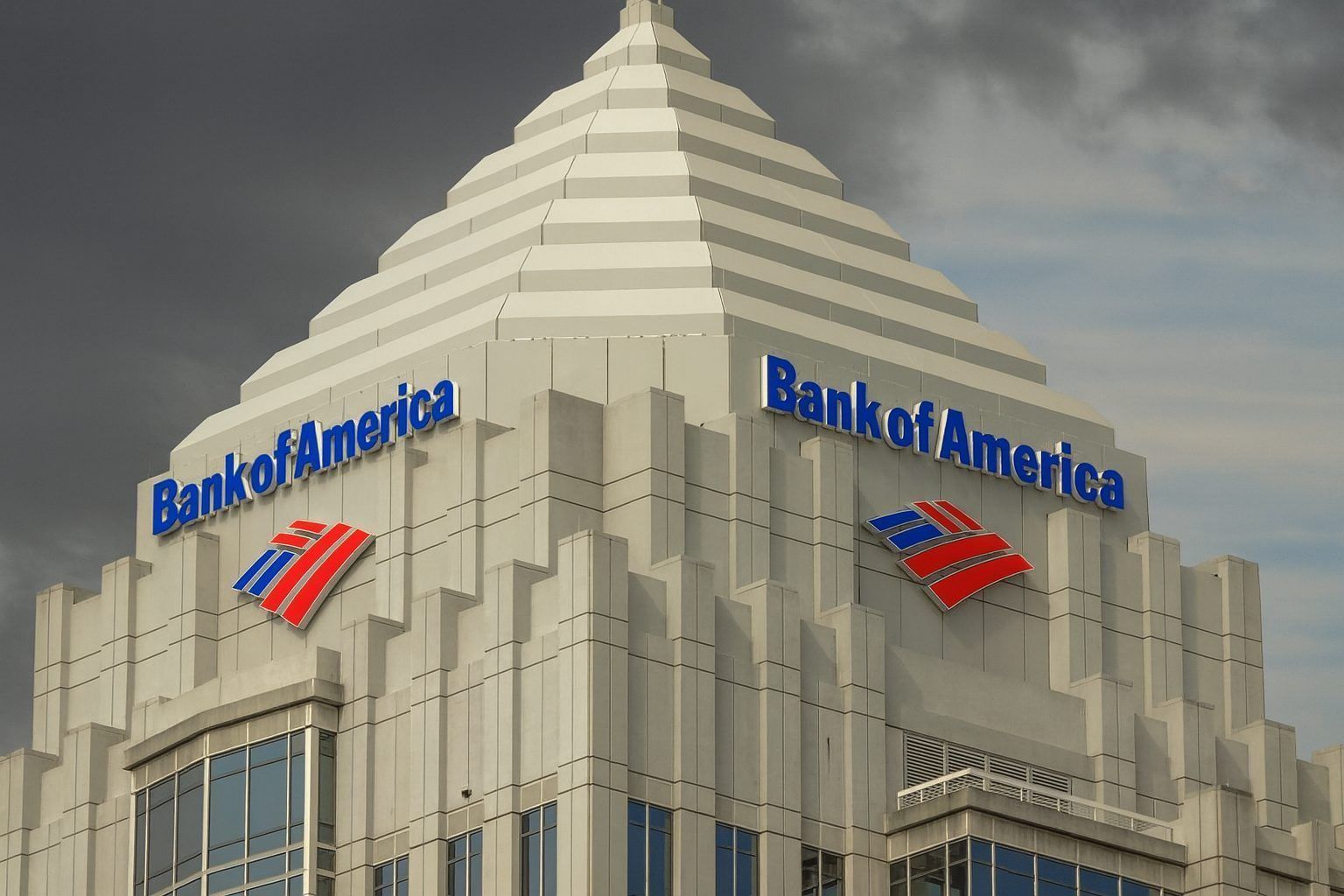

Bank of America Corporation NYSE:BAC stock is in focus on Monday, December 15, 2025, as investors weigh two big cross-currents: a shifting U.S. rate outlook after the Federal Reserve’s December cut, and fresh momentum behind the “banks-as-AI-efficiency-winners” narrative that has been gaining traction across global financials.
As of 15:40 UTC on Dec. 15, BAC shares were trading around $55.54, up about 0.73% on the session.
Below is what’s moving the story today—plus the latest forecasts, price targets, and technical read-throughs investors are using to frame the next leg for Bank of America stock.
Where BAC stock stands on Dec. 15, 2025
BAC is trading near the top end of its recent range, with multiple market-data providers showing the shares hovering just below the upper end of the 52-week band. Investing.com lists a 52‑week range of $33.07 to $56.07.
That proximity to a fresh high matters for two reasons:
- Positioning risk increases when a stock is near recent highs—any disappointment (rates, credit, capital markets revenue) can spark profit-taking.
- Breakouts attract trend-followers, especially if the broader market rotates away from crowded themes into financials.
The macro news hitting bank stocks today: Fed policy, yields, and “what’s next” for rates
The Fed’s December cut is now the baseline
A major driver for U.S. money-center banks is the path of policy rates and the yield curve. In remarks reported Monday, New York Fed President John Williams said the Fed’s quarter-point cut on Dec. 10 took the benchmark rate to 3.50%–3.75%, and characterized policy as moving from “modestly restrictive” toward neutral. Reuters
Williams also flagged a cooling labor market and projected inflation moderating over time—comments that reinforce the idea that rate cuts could continue into 2026, even if timing remains uncertain.
Why this matters for Bank of America (BAC):
- Lower rates can pressure net interest income over time (less yield on assets, faster repricing on deposits in some cycles).
- But easier policy can support loan demand and credit performance, and it often helps capital markets activity if volatility stabilizes.
Markets are rotating after an AI-driven shakeout
Reuters’ global markets commentary on Monday pointed to investors digesting a bruising AI-related selloff late last week while attention shifts to upcoming data and rates catalysts. The note highlighted sector rotation dynamics and the role of Treasury yields into year-end.
For BAC and peers, that kind of rotation can be constructive—especially if “value” and cyclicals catch bids while mega-cap tech cools.
Bank of America-specific developments investors are using to frame BAC
1) Management’s tone: markets revenue growth and buybacks
While not released today, the most market-relevant recent company update came at the Goldman Sachs U.S. Financial Services Conference (Dec. 10). Reuters reported CEO Brian Moynihan expects Global Markets revenue to rise high-single digits to 10% in Q4, while investment banking fees should be “broadly flat.” Reuters
Crucially for equity holders, Reuters also reported Moynihan said the bank expects to buy back more stock in the fourth quarter, and that consumer credit quality remains “good,” with charge-offs “basically” flattening. Reuters
Stock implication: If buybacks accelerate into year-end while credit stays stable, it can help support EPS and provide a backstop on pullbacks.
2) Technology and AI spending: a direct tie-in to the efficiency story
Reuters reported on Dec. 11 that Bank of America’s technology division had the largest percentage jump in managing director promotions, amid heavy investment in digital tools aimed at boosting productivity.
In the same report, Reuters said BofA plans to allocate $4 billion into new technology capabilities from its $13 billion tech budget, and expects to use AI more widely across businesses.
That lines up with a broader banking theme highlighted today in a Nasdaq.com article (Zacks-authored) describing AI moving from pilot projects into core workflows at major U.S. banks. The piece specifically notes BofA’s stated approach: investing $4 billion of a $13 billion technology budget in AI and related initiatives, with examples including productivity gains in client coverage and software testing, plus continued scaling of its virtual assistant Erica.
3) Bloomberg: BofA joins funding push behind the Texas Stock Exchange effort
On Monday, Bloomberg reported that Goldman Sachs and Bank of America are “headlining” a group investing about $20 million into the parent company of the Texas Stock Exchange, lifting the total capital raised by TXSE Group to $270 million. Bloomberg listed other investors including JPMorgan Chase, BlackRock and Citadel Securities. Bloomberg
This is not an earnings driver on its own, but it adds to the narrative of major incumbents positioning around market structure evolution—a topic that can matter over long horizons for trading, listings, and capital markets ecosystems.
AI and bank stocks on Dec. 15: why “cost-winner” framing matters for BAC
A Reuters analysis today focused on European banks, but the takeaway has direct relevance for U.S. mega-banks: investors increasingly view banks as potential “cost winners” from AI adoption. Reuters cited BlackRock commentary that the market has focused heavily on AI “revenue winners,” while “cost winners” could also benefit materially. Reuters
For Bank of America, this theme connects to:
- its explicit multi‑billion‑dollar AI and technology spend (noted above), Reuters+1
- and management’s broader focus on operating leverage and profitability targets.
The Zacks/Nasdaq article also cautions that near-term AI investment can pressure expenses and that governance/model-risk requirements can slow rollouts—meaning the payoff may not be immediate or linear.
BAC stock analyst forecasts and price targets (latest available as of Dec. 15, 2025)
Consensus view: “Buy,” with mid‑single‑digit upside implied by averages
Two widely followed aggregators show a broadly positive Street stance:
- Investing.com shows an overall “Buy” consensus, with 21 Buy / 4 Hold / 0 Sell, and an average 12‑month price target of 58.98 (about +6.13% upside in its snapshot). It also lists recent firm-level target updates including Morgan Stanley (Buy, $68) and RBC (Buy, $59) maintained on Dec. 12, and Piper Sandler (Hold, $56) maintained on Dec. 11. Investing.com
- TipRanks lists a “Strong Buy” consensus based on 19 ratings, with an average 12‑month price target of $58.88 and a stated high forecast of $68 and low of $55. TipRanks
A third data point: Fintel/Nasdaq highlights Morgan Stanley’s Overweight and target dispersion
A Nasdaq-hosted Fintel item notes Morgan Stanley maintained an Overweight rating (reported Dec. 12), and cites an average one‑year price target around $58.04 (as of Dec. 5), with a wide forecast range shown in that dataset.
How to read this:
When multiple services cluster around a high‑$50s average with $68 as a common “high case,” it suggests analysts generally see BAC as fairly valued to modestly undervalued at current levels—but not a deep-value setup, given the stock’s proximity to its 52‑week high.
BAC technical analysis snapshot on Dec. 15, 2025
TipRanks’ technical dashboard (timestamped Dec. 15) shows many moving-average signals skewing “Buy,” including:
- 20‑day EMA around 53.35 vs. share price 55.14 (Buy)
- 50‑day EMA around 52.26 vs. share price 55.14 (Buy)
- RSI (14) at 67.66 (Neutral)
- MACD noted as “Sell” in that snapshot, alongside some mixed oscillator signals TipRanks
Practical takeaway: Trend signals look constructive, but momentum gauges are mixed—often a sign the stock may be extended in the short term even if the medium-term trend remains positive.
Fundamentals check: what Bank of America last reported, and the next big date for BAC
Bank of America’s investor relations page lists its latest financial results for Q3 2025 (quarter ended Sept. 30, 2025) as:
- $28.1B revenue (net of interest expense)
- $8.5B net income
- $1.06 diluted EPS
- 15.4% return on tangible common equity Bank of America Corporation
Next earnings date: Jan. 14, 2026
BofA also lists its next quarterly earnings release date as Wednesday, January 14, 2026.
Dividend: confirmed payment date in late December
For income-focused investors, Bank of America declared a regular quarterly common dividend of $0.28 per share, payable Dec. 26, 2025 to shareholders of record Dec. 5, 2025.
What to watch next: the catalysts most likely to move BAC stock
1) The rate path into 2026 (and the yield curve)
Williams’ “policy is well positioned” framing after the Dec. 10 cut reinforces that the Fed’s baseline has shifted. Reuters
For BAC, the market will keep translating that into expectations for:
- net interest income trajectory,
- deposit pricing dynamics,
- and loan growth.
2) Capital markets revenue follow-through
Moynihan’s Q4 markets revenue growth expectation (high-single digits to 10%) sets a measurable bar. Reuters
If trading and client activity hold up into earnings season, it can support the stock even if rate cuts compress margins elsewhere.
3) Buyback pace and capital return
Management’s comment that BofA expects to buy back more stock in Q4 is supportive, but the market will want to see:
- the pace,
- the pricing discipline,
- and the impact on capital ratios.
4) AI execution: real efficiency vs. just bigger budgets
Both Reuters and the Zacks/Nasdaq analysis emphasize that banks are spending heavily on AI—and that the payoff may come through slower-burn efficiency gains rather than immediate cost cuts.
Bottom line for Bank of America (BAC) stock on Dec. 15, 2025
BAC stock is trading near its 52‑week highs as investors enter the last full trading week of 2025 with a fresh Fed rate cut in the rearview mirror and a growing belief that large banks could be durable beneficiaries of AI-driven productivity.
The Street’s current consensus skews positive, with average 12‑month targets clustered around the high‑$50s and many firms maintaining “Buy”-equivalent ratings—implying mid‑single‑digit upside from recent levels rather than a high-conviction “deep value” gap. Investing.com+1
The next decisive test is likely January 14, 2026 earnings, where investors will look for confirmation on (1) markets revenue momentum, (2) credit stability, and (3) whether Bank of America’s technology and AI spending is translating into durable operating leverage.
Related articles: NYSE:BAC