
NEW YORK, August 4, 2026, 18:12 EDT — After daily U.S. cash market close, trading continued briskly in after-hours session.
- Booking shares climbed roughly 6% in after-hours trading after reporting earnings above expectations.
- Room nights rose 5% and adjusted earnings per share climbed 15%.
- Expedia Group Inc. NASDAQ:EXPE is scheduled to report on Wednesday, with Airbnb Inc. NASDAQ:ABNB set to release results Thursday.
Shares of Booking Holdings Inc. NASDAQ:BKNG gained roughly 6% after-hours on Tuesday. The company posted adjusted earnings of $2.54 per share, surpassing the $2.45 estimate from LSEG. Revenue increased by 8% to $7.35 billion, topping the anticipated $7.19 billion.
The key detail is found beneath the headline. Room nights rose by just 5%, while adjusted earnings per share climbed at a pace three times as fast.
That difference stems from two factors. Merchant revenue grew more quickly than demand, and buybacks lowered the total shares eligible for those earnings.
| Demand-to-earnings measure | Q2 2026 | Year-on-year change |
|---|---|---|
| Room nights | 325 million | +5% |
| Gross bookings | $51.0 billion | +9% |
| Revenue | $7.35 billion | +8% |
| Adjusted EBITDA | $2.65 billion | +9% |
| Adjusted net income | $1.96 billion | +8% |
| Adjusted EPS | $2.54 | +15% |
Figures as reported by the company. Per-share amounts account for the stock split in April.
Adjusted net income increased by 8.4% based on the figures reported. Average diluted shares decreased 5.5% to 770 million. Together, these changes resulted in a 14.4% rise in adjusted EPS prior to rounding.
A reduced share count contributed approximately six percentage points, accounting for close to 40% of the rise in per-share figures.
The initial earnings bridge came from operating mix. Merchant revenue increased by 15%, whereas agency revenue dropped 6.9%. Merchant gross bookings accounted for 73% of the total, a rise of four percentage points.
| Mix and efficiency measure | Q2 2026 | Q2 2025 | Change |
|---|---|---|---|
| Merchant revenue | $5.127 billion | $4.457 billion | +15.0% |
| Agency revenue | $1.903 billion | $2.044 billion | -6.9% |
| Merchant share of gross bookings | 73% | About 69% | +4 points |
| Marketing expense/gross bookings | 4.7% | 4.6% | +0.1 point |
| Adjusted EBITDA margin | 36.0% | 35.6% | +0.4 point |
Management’s disclosure of a four-point gain forms the basis of the previous merchant-bookings proportion.
Connected Trip transactions increased by a low double-digit percentage, outpacing Booking.com’s total transaction growth by over two times. Management noted that customers engaging with multiple verticals are more likely to come back.
Costs stayed in check, but marketing activity saw an uptick. Marketing spending climbed 11%, outpacing the growth in gross bookings. Fixed operating costs were up 6%, trailing the 8% rise in revenue.
Booking raised its projected yearly transformation savings to $650 million, up from a prior goal of about $550 million. The company’s management anticipates most of the additional savings will be realized in 2027.
Chief Executive Glenn Fogel stated that “the underlying desire to travel remained resilient.” Lower long-haul international traffic was balanced by domestic and intra-regional demand. Q4 Capital
The second earnings driver was capital returns. Booking bought back $3.7 billion in shares in the quarter, a figure just above its free cash flow of $3.64 billion.
| Capital-allocation comparison | Cash amounts compared | Calculated result |
|---|---|---|
| Q2 buybacks as percent of free cash flow | $3.70B / $3.643B | 102% |
| Q2 overall capital return versus free cash flow | $4.10B / $3.643B | 113% |
| H1 total buybacks and dividends against free cash flow | $8.422B / $6.751B | 125% |
| Q2 diluted shares outstanding | 770M / 815M | -5.5% |
| Gross debt, comparison June with December | $20.180B / $18.736B | +$1.444B |
Figures for cash flow and the balance sheet are based on company data. Due to rounding, percentages might not add up precisely.
Buybacks and dividends in the first half surpassed free cash flow by $1.67 billion. Gross debt rose and cash and equivalents remained around $17.2 billion. The data does not show that debt funded the difference, but indicates capital returns were higher than cash generated internally.
Chief Financial Officer Ewout Steenbergen described the second quarter as “another record quarter of capital returns.” As of June 30, Booking held $14.5 billion in remaining repurchase authorization. Q4 Capital
Management anticipates slower growth in the third quarter. Room nights are projected to increase by 3% to 5%. Gross bookings, revenue and adjusted EBITDA are each expected to climb by 4% to 6%.
| Growth measure | Q2 actual | Q3 guidance | Full-year 2026 guidance |
|---|---|---|---|
| Room nights | +5% | +3% to +5% | Not specified |
| Gross bookings | +9% | +4% to +6% | High single digits |
| Revenue | +8% | +4% to +6% | High single digits |
| Adjusted EBITDA | +9% | +4% to +6% | High single digits |
| Adjusted EPS | +15% | Not specified | Low to mid-teens |
The company lowered its outlook for full-year gross bookings compared to its earlier forecast. Executives attributed the revision to slower growth in flight ticket sales. The accommodation forecast was kept mostly the same.
Domestic room nights saw growth in the high single digits in Q2, while international room nights posted only modest gains. Demand for long-haul travel remained limited due to elevated airfares and ongoing capacity constraints.
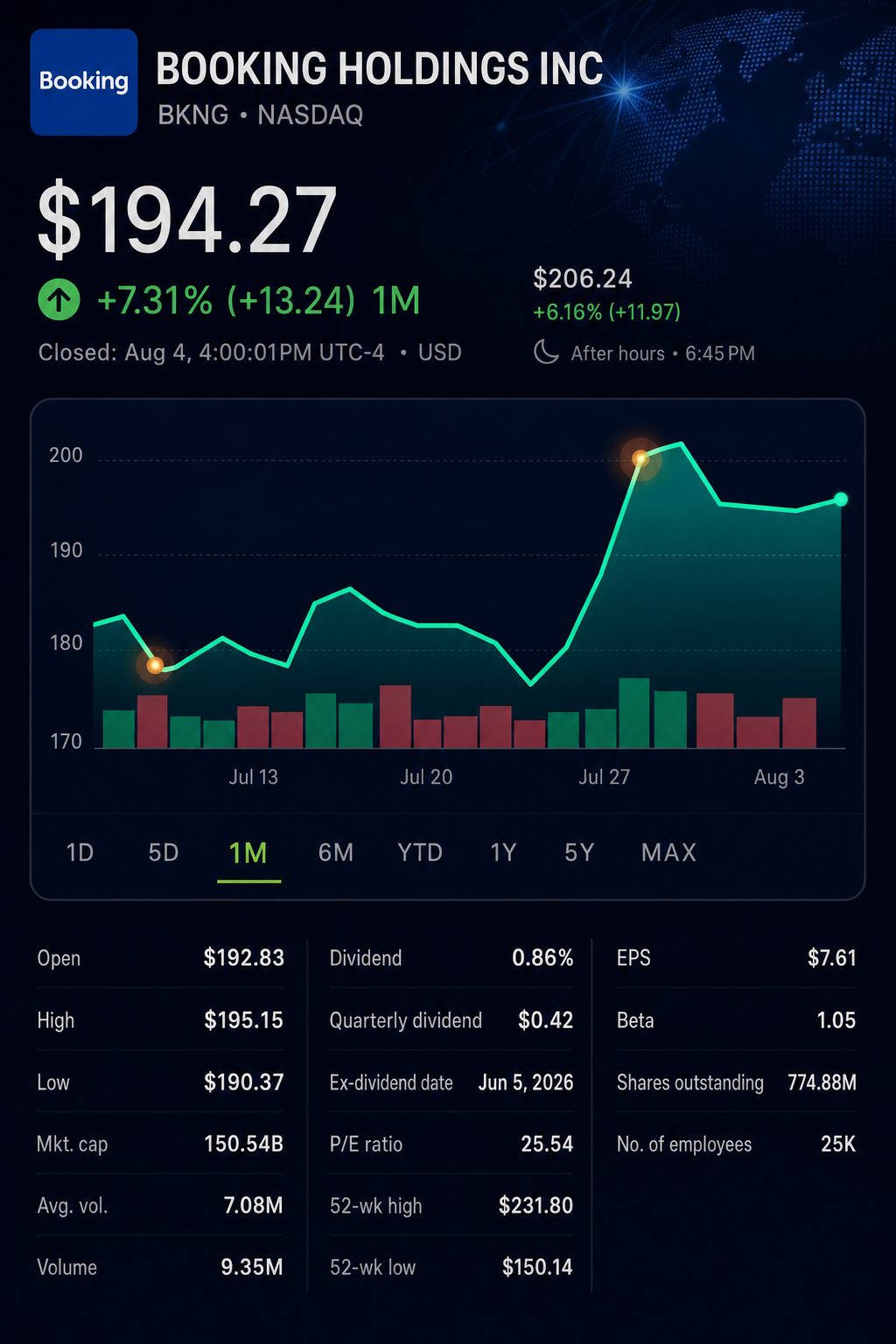
Booking rose 8.7% over the last week. Shares finished at $192.90 on July 31, up from $177.46 on July 24. TD Cowen analyst Kevin Kopelman described geopolitics as the sector’s “biggest near-term swing factor.” Booking Holdings
The stock ended Tuesday’s trading at $194.27, rising 0.8%. Expedia settled at $312.06, increasing 4.7%. Airbnb slipped 0.5% to close at $149.92.
Two rapid comparisons are set for the coming week. Expedia will announce its earnings following the market’s close on Wednesday, while Airbnb will post its results after the close on Thursday. The numbers from both companies are expected to indicate if Booking’s robust domestic business and softer international performance reflect an industry-wide pattern.
Main risks are still focused on disruption in the Middle East, increased airfares, and limited route availability. Expenses for marketing are rising more quickly than bookings. Search traffic could face challenges from AI-powered discovery, but management noted that AI referrals currently make up a minor share.
Booking delivered an earnings beat. Still, growth in volumes was modest. Additional gains will rely on merchant monetization, achieving savings, and maintaining a consistent buyback rate.
Related articles: Earnings