
NEW YORK, August 3, 2026, 07:00 EDT
- Bristol Myers gained roughly 8% in premarket trading. AstraZeneca slid 6.4% in London.
- Initial market-cap calculations wiped out about $6.2 billion from the combined value of the two firms.
- Bristol’s quarterly results surpassed expectations, and the company lifted its outlook, reinforcing its strength as an independent entity.
Bristol-Myers Squibb Company NYSE:BMY gained approximately 8% in premarket trade ahead of the start of regular U.S. trading, following news of initial discussions with AstraZeneca PLC LON:AZN.
The more notable indicator was the shift in value. Based on market capitalisations from Friday, Bristol added approximately $10.7 billion, while AstraZeneca’s value decreased by an estimated $16.9 billion. The initial net loss amounted to $6.2 billion.
| Early Monday deal sums | Bristol Myers | AstraZeneca | Combined |
|---|---|---|---|
| Market value as of Friday | $133.41 bln | $264.11 bln | $397.52 bln |
| Initial stock reaction | +8.0% | -6.4% | — |
| Estimated change in value | +$10.7 bln | -$16.9 bln | -$6.2 bln |
The calculation suggests optimism for Bristol, rather than certainty in a potential deal. Reuters was unable to confirm if talks are ongoing. AstraZeneca would not comment, and Bristol did not reply. No details have been disclosed.
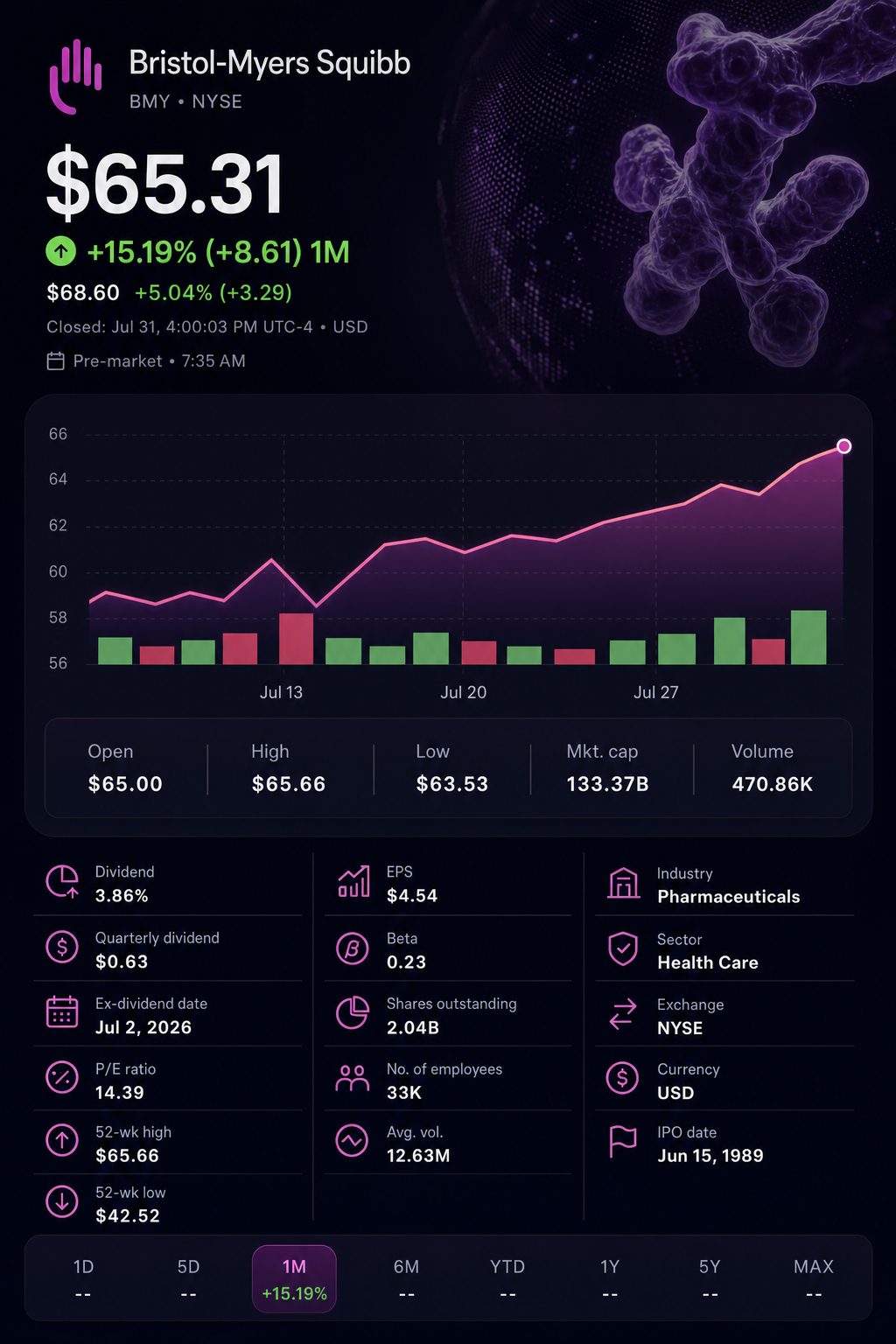
Bristol began Monday posting improved individual figures. The share price finished Friday at $65.31, having earlier touched a 52-week peak of $65.66. Second-quarter revenue climbed 6% to $12.97 billion. Adjusted earnings gained 40% to $2.04 a share.
The company surpassed LSEG forecasts and increased its 2026 guidance. Adjustments to midpoints below reflect Bristol’s stated ranges.
| Earnings update | Announced or updated | Previous or analyst view | Change |
|---|---|---|---|
| Q2 revenue | $12.973 bln | $11.750 bln | +10.4% |
| Q2 adjusted EPS | $2.04 | $1.59 | +$0.45 |
| 2026 revenue outlook | $49.0-$50.0 bln | $46.0-$47.5 bln | +5.9% midpoint |
| 2026 adjusted EPS outlook | $6.75-$7.00 | $6.05-$6.35 | +10.9% midpoint |
The revenue midpoint has increased by 5.9% over the earlier projection. The midpoint for adjusted EPS climbed 10.9%. This eases the need to agree to unfavorable deal terms.
Management reports that the sales composition is getting better. “We now have nine products that were growing double digits,” commercial chief Adam Lenkowsky said. He noted these medicines are still in the early stages of their commercial cycles. Reuters
Growth products accounted for 58.3% of revenue for the quarter, increasing by $964 million from the previous year. Revenue from legacy products fell by $251 million.
| Q2 portfolio breakdown | Revenue 2026 | Revenue 2025 | Change YoY | Share of revenue |
|---|---|---|---|---|
| Growth Portfolio | $7.560 bln | $6.596 bln | +15% | 58.3% |
| Legacy Portfolio | $5.422 bln | $5.673 bln | -4% | 41.8% |
| Company total | $12.973 bln | $12.269 bln | +6% | 100% |
Company totals account for $9 million in negative other revenue. Numbers are rounded.
Eliquis continued to have the largest impact, with revenue increasing 22% to $4.48 billion. Revlimid sales dropped 49% to $425 million. Sales for Camzyos, Breyanzi, and Reblozyl climbed by 60%, 41%, and 29% respectively.
The strategic rationale for AstraZeneca appears less straightforward. Bristol would contribute a significant U.S. sales presence along with recently launched drugs. However, AstraZeneca has already posted a 15% rise in oncology revenue for the first half, totaling $14.1 billion.
| First-half 2026 comparison | Bristol Myers | AstraZeneca |
|---|---|---|
| Total revenue | $24.46 bln | $30.7 bln |
| Oncology share | Over 40% | 46% |
| Competing checkpoint franchise | Opdivo | Imfinzi |
The two firms are already focused heavily on oncology. This boosts possible scale, while also raising regulatory risks.
Sean Conroy, analyst at Shore Capital, said a potential deal might benefit AstraZeneca after 2030. He noted investors are “not often fans of mega mergers of this ilk.” Reuters
Regulatory concerns are solid. Opdivo and Imfinzi are rivals in the checkpoint immunotherapy space. Antitrust attorney Andre Barlow stated that significant overlap may necessitate “meaningful divestitures.” Reuters
Investors are monitoring for confirmation, details, and board backing this week. No official timeline for the transaction has been provided. The next scheduled milestone for Bristol is the FDA’s target decision on iberdomide set for August 17.
Risks: Negotiations could be dormant or fall apart. Any agreement would encounter challenges related to antitrust, financing, and integration. Bristol must also contend with Eliquis and Opdivo patent expirations by 2028.
Monday’s premium for Bristol stems from two factors. Standalone value is backed by earnings momentum. The rest of the premium signals possible, but unverified, takeover speculation.