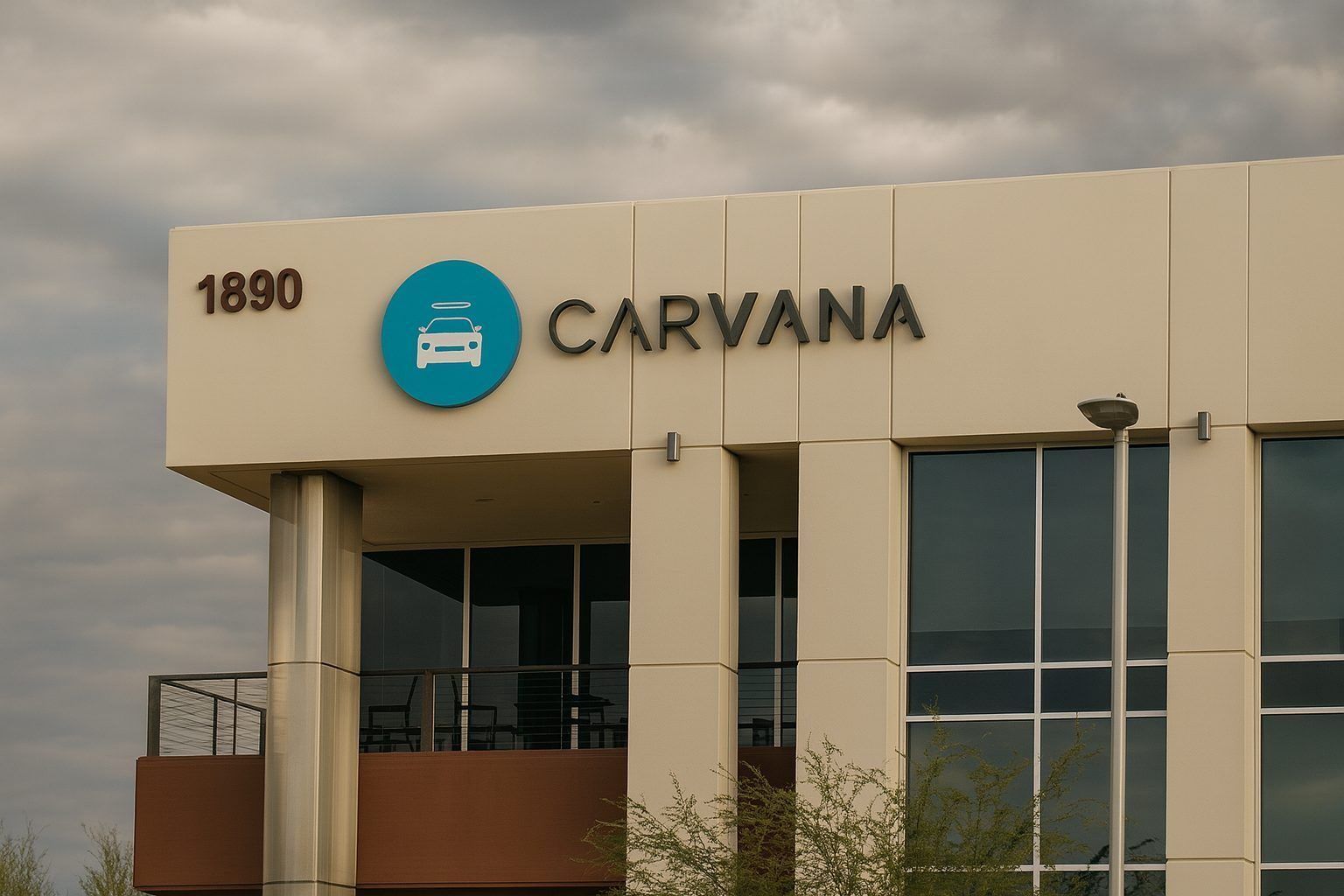

Carvana Co. NYSE:CVNA heads into Monday’s U.S. market open (December 1, 2025) riding a powerful year-end rally and a fresh wave of Wall Street attention.
As of the close on Friday, November 28, Carvana shares finished around $374.50, up roughly 4.8% on the day, near the upper end of their recent trading range and not far from a 52‑week high around $413. Investing.com+1 That move capped a roughly 17% gain since the company’s late‑October earnings report.
Between November 28 and 30, investors received a dense cluster of new research notes, valuation calls, institutional ownership updates and insider trading disclosures – all of which shape the setup for CVNA before Monday’s bell.
Below is a deep dive into what changed for Carvana from November 28–30, how Wall Street now values the stock, and the key levels and storylines to watch as trading resumes.
1. How Carvana Stock Is Positioned Before the December 1 Open
Strong recent performance vs. peers
- Friday, November 28: CVNA rallied about 4.8% to roughly $374.50, with intraday trading between the mid‑$350s and mid‑$370s and healthy volume above 2.2 million shares.
- Over the same session, traditional used‑car rival CarMax (KMX) gained only 1.2%, and remains more than 57% below its 52‑week high, according to MarketWatch. MarketWatch By contrast, Carvana is trading much closer to its own 12‑month peak around $413.
So, going into Monday, Carvana is the momentum name in used cars, outpacing both the broader market and legacy dealer peers.
Big picture: a huge year for CVNA
Several fresh analyses over the weekend highlighted just how far the stock has run:
- Year to date, Carvana is up more than 60%, per an Investopedia recap of Wedbush’s recent upgrade.
- A separate valuation piece from Simply Wall St calculates an 87.7% year‑to‑date gain, reflecting how aggressively traders have repriced the business since January.
- Zacks notes that shares have climbed about 17.1% in the month since Carvana’s Q3 earnings, comfortably beating the S&P 500 over the same period.
In other words: Carvana enters December 1 as a high‑beta winner with a lot of good news already embedded in the price.
2. Key News From November 28–30, 2025
2.1 Analyst upgrades and valuation calls
Although Wedbush’s upgrade hit earlier in the week (November 24), much of the Friday–Sunday coverage revisited it as the central driver of the latest leg higher:
- Wedbush raised Carvana from Neutral to Outperform and lifted its price target from $380 to $400, describing the company as the “new used car king” and arguing that the prior pullback was an opportunity. Investopedia+1
- Wedbush and other analysts now project that Carvana will overtake CarMax in used‑car unit volume by the fourth quarter of 2026, about six months earlier than previously expected.
Fresh weekend research amplified that message:
- MarketBeat’s November 27 rating roundup (still very topical for Friday‑Monday trading) shows Carvana with a consensus “Moderate Buy” from 23 research firms – 17 “Buy” and 6 “Hold” – and an average 12‑month price target of $420.70. Several firms, including Morgan Stanley and BTIG, are as high as $450. MarketBeat+1
- A November 29 valuation piece from Simply Wall St notes that Carvana’s closing price of $374.50 sits below a widely followed “fair value” estimate of about $419.45, implying the stock is roughly 10.7% undervalued in their model. Simply Wall St
Short‑term technical newsletters and trading services also weighed in between November 28 and 30:
- StocksToTrade and related coverage highlighted sequential weekly highs of $334.02, $352, $358.70 and $374.57, framing CVNA’s trend as a dominant uptrend fueled by analyst upgrades and strong Q3 results.
- Those reports frequently cited support in the $330–$350 area and initial resistance around $375–$418, anchoring many traders’ opening‑bell playbooks for Monday.
2.2 Institutional buying vs. insider selling
The weekend also delivered new information on who is trading Carvana behind the scenes.
Institutional accumulation
On November 30, MarketBeat reported that Korea Investment CORP boosted its Carvana stake by 4.1% in Q2, bringing its holdings to 97,833 shares worth about $32.97 million. The same piece notes that large firms like T. Rowe Price, Vanguard and Geode have also increased their positions, with institutional investors owning roughly 56.7% of the float.
From an “ownership quality” standpoint, that kind of broad institutional support tends to be viewed as a positive for long‑term stability.
Insider selling
However, that buying is offset by notable insider selling:
- MarketBeat tallies 366,452 shares sold by insiders over the last quarter, totaling about $133.5 million in value, leaving insiders with around 17% ownership.
- On November 28 specifically, TipRanks flagged that chief brand officer Ryan S. Keeton sold 10,000 shares, for proceeds of roughly $3.5 million.
TipRanks’ AI‑driven “Spark” model simultaneously rates CVNA as Neutral, despite labeling the technical signal “Strong Buy” and noting a year‑to‑date price performance of about 79% and a market cap near $78 billion. TipRanks
For Monday’s session, the tension between ongoing institutional accumulation and visible insider selling is likely to stay in the narrative mix.
2.3 Algorithmic and technical forecasts
Short‑term quantitative price models added more color over the weekend:
- CoinCodex’s November 30 update lists Carvana’s current price at $374.31 and projects a 5‑day target of $372.61 and a 1‑month target of $370.79, implying a modest ‑0.94% pullback by December 29.
- The same dashboard describes sentiment as “Bullish”, with 24 bullish vs. 2 bearish technical indicators, but a Fear & Greed Index reading of 39 (Fear) – suggesting that while the chart looks strong, investors remain somewhat cautious. CoinCodex
- Over the last 30 trading days, CVNA has logged 16 “green” days (53%) with around 5.76% daily volatility, underscoring how fast the stock can move on any surprise. CoinCodex
These algorithmic forecasts are not guarantees, but they do give a sense of the base‑case expectation among quant models: bullish trend, but near‑term consolidation rather than another explosive spike.
3. Wall Street’s View: Upside vs. Valuation Risk
Consensus rating and price targets
Pulling together the latest broker data:
- Rating: “Moderate Buy” consensus from 23 analysts
- Split: 17 Buy, 6 Hold
- Average 12‑month price target:$420.70
- High targets: Up to $450 from firms like Morgan Stanley and BTIG MarketBeat+1
With Friday’s close near $374.50, that average target implies roughly 12% upside over the next year, while Wedbush’s $400 target signals nearer‑term potential of about 7% from current levels.
Simply Wall St’s valuation narrative comes to a similar conclusion: at $374.50, their model‑derived fair value of $419.45 suggests Carvana may still be modestly undervalued, assuming its aggressive growth and margin forecasts come through.
Expensive on traditional metrics
On classic valuation metrics, though, Carvana looks expensive:
- MarketBeat pegs CVNA’s price‑to‑earnings ratio around the mid‑80s and a PEG ratio near 1.3, reflecting high expectations for future growth.
- Trading and research platforms highlight Carvana’s EBIT margin around 9.9%, gross margin roughly 21%, and a negative pre‑tax margin near ‑2.5%, underscoring that bottom‑line profitability is still a work in progress despite strong EBITDA.
- Leverage remains meaningful: analyses point to a debt‑to‑equity ratio in the 1.6–2.5 range and a leverage ratio around 4.3, even as liquidity looks solid with a current ratio above 4.0.
Net‑net, Wall Street likes the story but knows it’s paying up for it. For Monday’s open, any hint that growth is slowing or credit risk is rising could hit a richly valued stock harder than a cheaper peer.
4. Fundamentals: Record Q3, Real Profits, Real Debt
Carvana’s rally sits on top of very strong third‑quarter numbers, which many of the latest articles revisited.
Record Q3 2025 results
According to Carvana’s official October 29 earnings release: Carvana Investors
- Retail units sold: 155,941 (+44% year over year), an all‑time high
- Revenue:$5.647 billion, up 55% YoY – also a record
- Net income:$263 million, with a 4.7% net margin
- Adjusted EBITDA:$637 million, for an 11.3% adjusted EBITDA margin
Zacks’ post‑earnings analysis adds that: Finviz
- Q3 earnings of $1.03 per sharemissed the consensus estimate (~$1.33), but improved sharply from $0.64 a year earlier.
- Gross profit reached about $1.15 billion, up 42% year over year.
- Retail revenue grew 57%, wholesale revenue ~50%, and “other” revenue about 45%, with total units sold to both retail and wholesale customers up over 40%.
- Carvana ended September with $2.14 billion in cash and cash equivalents and $4.81 billion in long‑term debt, down from $5.26 billion at the end of 2024.
Outlook and guidance
Management’s guidance remains ambitious: Carvana expects, for Q4 2025, to deliver: Carvana Investors+1
- More than 150,000 retail units, and
- Full‑year Adjusted EBITDA at or above the high end of its prior $2.0–$2.2 billion range.
For investors heading into Monday, the takeaway is that Carvana has crossed into consistent profitability at scale, but still needs to keep growing into its valuation while managing leverage and margins.
5. Technical Setup: Levels to Watch on CVNA
Based on the latest trading‑focused research from November 28–30, here’s how the technical picture looks:
- Trend: Uptrend firmly intact, with a pattern of higher weekly highs ($334 → $352 → $358.70 → $374.57) noted by multiple trading desks.
- Moving averages: CVNA trades comfortably above its 50‑day simple moving average (~$345) and well above its 200‑day SMA (~$304), according to CoinCodex’s technical dashboard.
- Momentum: A 14‑day RSI around 53 suggests neither overbought nor oversold, giving room for a move in either direction.
- Short‑term volatility: About 5.8% daily volatility, 16 green days out of the last 30, and strong volume on up days – a textbook profile of a high‑momentum, high‑risk trade.
Key zones to watch before and after the open on December 1:
- Immediate resistance:
- Friday’s high/close region near $374–$375
- The psychological $400 level, which aligns with Wedbush’s target and with prior consolidation.
- Next resistance:
- The prior buy point around $401 frequently cited by growth‑stock services, and the 52‑week high near $413.
- Support:
- $350 zone (recent consolidation area and widely flagged support)
- Low‑$330s (prior breakout area and key weekly support cited by trading desks).
A clean break above the $374–$375 region in pre‑market and early regular trading could encourage momentum traders to gun for $400+. A failure and fade back into the mid‑$350s would fit the quant models’ expectation of a short‑term cooling period.
6. Bull vs. Bear Case Going Into Monday’s Open
The bull case
Bulls heading into December 1 will point to:
- Explosive growth with real profits – revenue up 55% YoY, net income and EBITDA at record levels, and guidance that implies full‑year 2025 EBITDA well north of $2 billion.
- Structural tailwinds – continued consumer shift to online vehicle buying, Carvana’s vertically integrated model, and recently enhanced capabilities at ADESA (CarValue valuation tools, new inspection and reconditioning capacity, and same‑day delivery expansion across multiple metro areas).
- Analyst conviction – multiple recent upgrades (Wedbush, Deutsche Bank, Barclays and others), an average price target roughly 12% above current levels, and long‑term narratives that still see CVNA as undervalued relative to its growth outlook.
- Market‑share story – Wedbush and Barron’s both emphasize the view that Carvana is on track to overtake CarMax in used‑car unit volume by mid‑to‑late 2026, further entrenching its position as the category leader.
For bulls, Monday’s open is less about “is Carvana a viable business?” and more about “how fast can this rerating continue?”
The bear (or cautious) case
Skeptics and cautious holders, meanwhile, have plenty to latch onto:
- Rich valuation: A P/E in the 80s, a premium PEG, and price targets that only offer low‑double‑digit upside from here suggest a lot of good news is already baked in.
- Debt and credit cycle risk: Long‑term debt still near $4.8 billion, leverage north of 4x, and an auto‑loan market where delinquencies are rising – a theme several Wedbush and Barron’s comments highlight even as they stay positive on Carvana.
- Margin pressure: Q3 EPS missed estimates despite blowout revenue and unit growth, and the pre‑tax margin remains negative, signaling that perfect execution is required to keep expanding profitability.
- Insider selling: Hundreds of thousands of shares sold by insiders in recent months, including a fresh 10,000‑share sale by a top executive on November 28, sends a mixed message alongside institutional buying.
- Quant models see consolidation: Algorithmic forecasts suggest small negative returns over the next month and year, even while labeling near‑term sentiment “bullish,” hinting that risk/reward might be less compelling at current levels. CoinCodex
For bears, Monday’s question is whether a hot, leveraged, high‑beta stock with a long run behind it can keep attracting fresh buyers at these prices.
7. What to Watch Before and After the December 1, 2025 Open
As Monday’s pre‑market trade develops, here are the key catalysts and checkpoints to monitor:
- Pre‑market price action:
- Does CVNA trade above Friday’s close and $374–$375 area, indicating follow‑through buying?
- Or do we see profit‑taking pull it back toward $360 or below, suggesting the weekend news was already priced in?
- Volume vs. recent days:
- A continuation of elevated volume on an early push higher would support the bulls’ breakout case.
- Light volume on a move up or sharp selling on heavy volume would favor a near‑term consolidation or pullback scenario.
- Sector and macro tone:
- Watch broader consumer‑discretionary and e‑commerce names, plus traditional auto dealers like CarMax, for confirmation that money is still rotating into the space.
- Macro headlines on interest rates or consumer credit could immediately influence sentiment in heavily financed categories like autos.
- News flow and commentary:
- Additional write‑ups expanding on institutional holdings, insider activity, or updated price targets could easily shift the narrative intraday.
- Any hints about upcoming conference presentations (such as Carvana’s planned appearance at the Wells Fargo 9th Annual TMT Summit) or new strategic initiatives could provide fresh catalysts.
- Technical inflection points:
- A decisive move above $375 and then $400 would keep momentum traders engaged.
- A drop back below $350 – especially if it slices through the 50‑day moving average – could encourage short‑term traders to step aside and invite more volatility.
8. Bottom Line: Carvana Before the Bell
Heading into the December 1, 2025 open, Carvana is one of the most hotly watched momentum stocks in the market:
- It has record growth, real profits and a rapidly scaling platform, backed by optimistic analysts and big institutional shareholders.
- At the same time, it trades on rich multiples, carries substantial debt and has seen meaningful insider selling, all in the context of a sensitive auto‑credit cycle.
For traders and investors, Monday’s session is less about new headline catalysts and more about how the market digests the past week’s avalanche of bullish research, ownership shifts and valuation debates.
If you’re considering trading or investing in CVNA, remember that this article is for informational and news purposes only and does not constitute financial advice. High‑volatility names like Carvana can move quickly in either direction, so it’s important to align any decision with your own risk tolerance, time horizon and independent research.
Related articles: Stock Market