Browse Category

Comets News 3 July 2025 - 19 August 2025

Interstellar Comet 3I/ATLAS: A Visitor from Beyond the Solar System

Interstellar Comet 3I/ATLAS: A Visitor from Beyond the Solar System

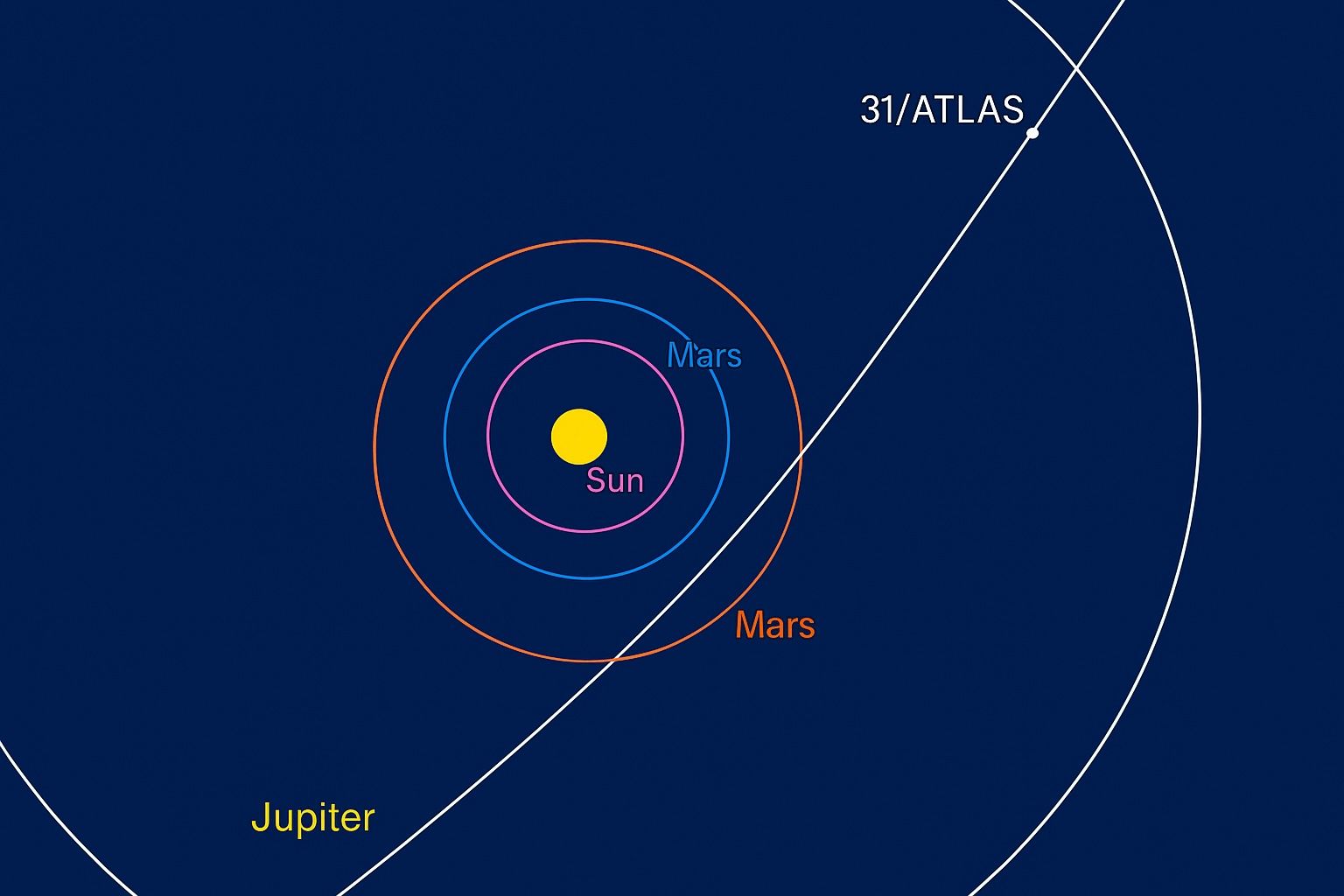
3I/ATLAS was first spotted on July 1, 2025 by the ATLAS telescope in Río Hurtado, Chile, and officially designated 3I/2025 A1 (ATLAS), the third confirmed interstellar object after 1I/‘Oumuamua (2017) and 2I/Borisov (2019). It is traveling through the inner solar system at about 60–61 kilometers per second relative to the Sun on a hyperbolic trajectory, with perihelion near the orbit of Mars in late October 2025 (about 1.4 AU). Its closest approach to Earth will be roughly 1.6–1.8 AU (240–270 million kilometers), and it will be behind the Sun from Earth’s perspective at that time, posing no threat. The Hubble
3I/ATLAS: The Fastest Interstellar Comet Ever—Here’s What Scientists Are Saying

Interstellar Comet 3I/ATLAS – Third Cosmic Visitor Unveiled, Fast and Enormous

3I/ATLAS is the third interstellar object ever recorded. It was first spotted on July 1, 2025 by the ATLAS survey telescope in Río Hurtado, Chile. The designation 3I/ATLAS marks it as the third interstellar object in our solar system. Its orbit is hyperbolic with an eccentricity of about 6.2, meaning it is unbound and will exit the solar system. A faint coma was observed around 3I/ATLAS within days of discovery, confirming it is a comet. The object was traveling over 60 km/s at discovery and about 68 km/s at perihelion. Perihelion was predicted for October 29–30, 2025 at roughly 1.4
2 August 2025
Astronomers Spot a 7-Billion-Year-Old Interstellar Comet – Could It Be the Oldest Ever Seen?

Astronomers Spot a 7-Billion-Year-Old Interstellar Comet – Could It Be the Oldest Ever Seen?

On July 1, 2025, the ATLAS telescope in Río Hurtado, Chile, detected 3I/ATLAS near Jupiter’s orbit with a hyperbolic, interstellar trajectory. 3I/ATLAS is the third interstellar object identified, following 1I/ʻOumuamua in 2017 and 2I/Borisov in 2019. Estimates place 3I/ATLAS at 7–10 billion years old if formed in the Milky Way’s thick disk, making it possibly the oldest comet we’ve seen. Backward-orbit modeling using Gaia data and the Ōtautahi–Oxford model suggests an origin in the Milky Way’s thick disk. The nucleus is estimated to be 6–15 miles (10–24 km) across, larger than 1I/ʻOumuamua (~0.25 mile) and 2I/Borisov (~0.67 mile). It travels
Interstellar Comet 3I/ATLAS: Origin, Trajectory and Scientific Stakes In 2025’s Third‑Ever Extrasolar Visitor

Interstellar Comet 3I/ATLAS: Origin, Trajectory and Scientific Stakes In 2025’s Third‑Ever Extrasolar Visitor

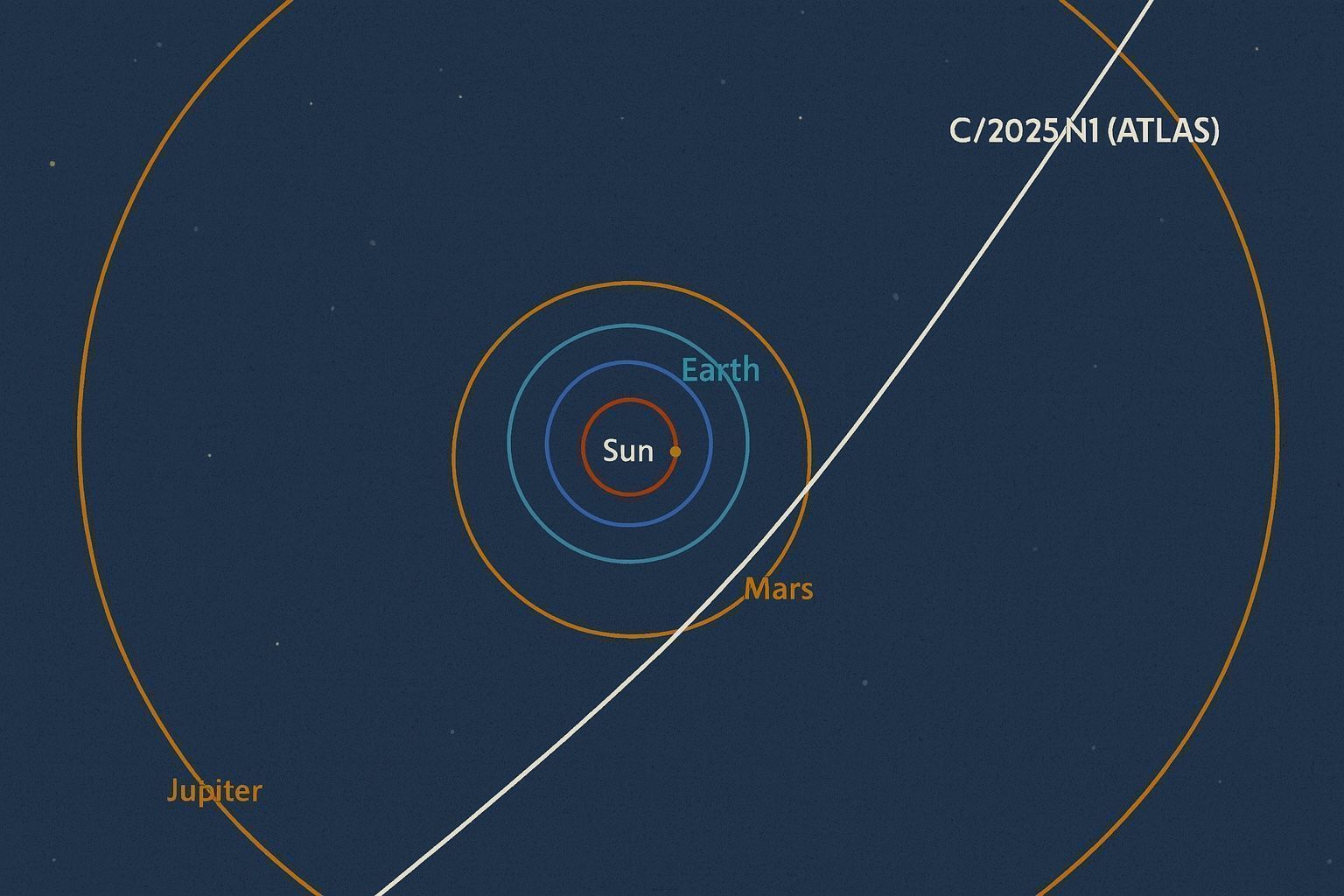
<li ATLAS imaged the interstellar candidate on 1 July 2025, with precovery back to 14 June 2025, and it was designated C/2025 N1 (ATLAS) and later 3I/ATLAS as the third confirmed interstellar object after Oumuamua and Borisov. <li A JPL orbital solution yields eccentricity e = 6.1 ± 0.1 and hyperbolic excess velocity V∞ ≈ 58 km/s, indicating an extrasolar origin from Galactic longitude about 5° toward the Galactic Center. <li The object’s nucleus is estimated at 9–20 km in diameter, with a developing coma and tail already visible, including a compact coma at about 4.5 AU from the Sun.
3I/ATLAS: The Fastest Interstellar Comet Ever—Here’s What Scientists Are Saying

3I/ATLAS: The Fastest Interstellar Comet Ever—Here’s What Scientists Are Saying

3I/ATLAS (C/2025 N1) is the third identified interstellar object, discovered on 1 July 2025 by the ATLAS telescope in Chile. It is on an extremely hyperbolic trajectory with a velocity of about 68 km/s and will reach perihelion on 29 October 2025 at 1.36 au, inside Mars’s orbit. It poses no threat to Earth. Early images show a faint coma and a short 3-arcsecond tail, confirming cometary activity. Detected at 4.5 au from the Sun months before perihelion, it offers an unprecedented window to study its composition, rotation, and size. The hyperbolic excess velocity v∞ is 57 km/s, making 3I/ATLAS
3 July 2025
1 7 8 9

Stock Market Today

Seagate (STX) stock jumps nearly 6% as Citi hikes target — what to watch next week

Seagate (STX) stock jumps nearly 6% as Citi hikes target — what to watch next week

7 February 2026
Seagate shares rose 5.9% to $429.32 Friday after Citigroup raised its price target to $480 and reiterated a buy rating. The gain ended a two-day slide but left the stock 6.6% below its Feb. 3 high. CEO Dave Mosley sold 20,000 shares on Feb. 2 under a pre-arranged plan, SEC filings show. U.S. jobs and inflation data next week are seen as key tests for tech stocks.
Cummins (CMI) stock price rebounds after earnings whipsaw as investors eye data-center power demand

Cummins (CMI) stock price rebounds after earnings whipsaw as investors eye data-center power demand

7 February 2026
Cummins shares jumped 6.8% to $577.73 Friday, recovering from a nearly 9% post-earnings drop the day before. The company reported Q4 revenue up 1% to $8.54 billion, took a $218 million charge tied to its hydrogen business, and guided for 2026 EBITDA of 17–18% of sales. Demand for data center generators offset weakness in North American truck markets. Analyst reaction was mixed; Truist raised its price target.
Corning stock hits first record close since 2000 as jobs, CPI data loom

Corning stock hits first record close since 2000 as jobs, CPI data loom

7 February 2026
Corning shares surged 8.3% to $122.16 Friday, their highest close since the dot-com era, after Meta agreed to buy up to $6 billion in fiber-optic cables. The stock is up 40% since late 2025, fueled by strong first-quarter guidance and AI data-center demand. Insiders sold shares following the rally, SEC filings show. Investors await next week’s U.S. jobs and inflation data for rate signals.
Go toTop