
Today: 1 July 2026
Browse Category

Digital Transformation 31 May 2025 - 16 June 2025

Inside Poland’s Internet Boom: From Urban Speeds to Satellite Signals

Inside Poland’s Internet Boom: From Urban Speeds to Satellite Signals

Poland is experiencing a rapid transformation in its internet landscape, marked by surging broadband speeds and expanding access even in remote villages. Once lagging behind its Western European peers in connectivity, the country is now closing the gap through aggressive fiber-optic rollout, near-ubiquitous mobile broadband, and even the adoption of cutting-edge satellite internet services. This report provides a comprehensive overview of Poland’s internet infrastructure – from the fiber lines beneath city streets to Starlink satellites overhead – along with key statistics on penetration, speed, affordability, regulatory developments, government initiatives, EU comparisons, and the major providers driving this internet boom. Fiber and DSL Broadband – The Urban-Rural Divide: Poland’s fixed broadband infrastructure has advanced significantly in recent years, but stark differences remain between urban and rural areas. In cities and large towns, high-speed internet options like fiber-optic and upgraded cable networks are widely available. In fact, by mid-2023 fiber-to-the-premises had become the most prevalent fixed broadband technology in Poland, passing 75.4% of all homes Point Topic. This represents a dramatic expansion – FTTP coverage jumped nearly 16 percentage points in one year, reflecting accelerated deployment in both new and existing neighborhoods Point Topic. Legacy DSL networks, while still present, continue to
Inside Saint Lucia’s Digital Revolution: The Untold Story of Internet and Satellite Access

Inside Saint Lucia’s Digital Revolution: The Untold Story of Internet and Satellite Access

Saint Lucia is experiencing a quiet digital revolution. Once limited by slow connections and spotty coverage, the island now boasts fiber-optic broadband, ubiquitous mobile internet, and even satellite links beaming connectivity from space. This report explores every facet of internet access in Saint Lucia – from the major service providers and infrastructure, to government initiatives and emerging technologies – painting a comprehensive picture of how this Caribbean nation is bridging the digital divide. Saint Lucia’s internet market is dominated by two main ISPs: Flow and Digicel+. These companies offer a range of home broadband plans, alongside island-wide mobile data services. In late 2024, a new player entered the scene in the form of Starlink satellite internet, expanding options for remote and rural users ts2.tech. Below is a comparison of the major providers, their technologies, and offerings:
The Digital Lifeline: Inside Ghana’s Internet Revolution from Fiber to Satellite

The Digital Lifeline: Inside Ghana’s Internet Revolution from Fiber to Satellite

Ghana has seen a rapid rise in internet usage over the past decade, evolving from single-digit penetration in 2010 to nearly 70% of the population online today. As of early 2025, approximately 24.3 million Ghanaians were internet users, representing an internet penetration rate of 69.9% datareportal.com. This is a dramatic increase from just 8% in 2010, thanks to expanding mobile networks and cheaper devices blogs.worldbank.org. The country had 38.3 million active mobile connections by 2025, indicating many people use multiple SIM cards datareportal.com. Most of these connections are now data-capable – over 93% of mobile connections are on 3G, 4G, or 5G networks datareportal.com – underscoring the dominance of mobile broadband in Ghana’s connectivity landscape. Internet Use by Demographics: Internet adoption is widespread across age groups and genders, but disparities exist. Young people are the most connected – about 80% of youth were internet users in 2021 blogs.worldbank.org – while usage among older adults was lower blogs.worldbank.org. Men are slightly more likely to be online than women blogs.worldbank.org, reflecting a persistent gender gap. Urban residents also have greater access: roughly 80% of urban Ghanaians used the internet in 2021, compared to 54% in rural areas blogs.worldbank.org. This urban–rural divide is
Inside Morocco’s Internet Revolution: From Fiber Optics to Satellite Access

Inside Morocco’s Internet Revolution: From Fiber Optics to Satellite Access

Morocco has experienced a dramatic expansion in internet connectivity over the past decade. As of early 2024, there were 34.47 million internet users in the country, representing an internet penetration rate of about 90.7% of the population datareportal.com datareportal.com. The vast majority of Moroccans online access the internet via mobile networks, reflecting the country’s strong mobile market. In fact, mobile phone subscriptions exceed the population size – with 51.36 million cellular connections as of 2024 datareportal.com. This high penetration is due to many users owning multiple SIMs and the ubiquity of mobile service. The mobile market is served by three major telecom operators: Maroc Telecom, Orange Maroc, and Inwi, which together dominate both mobile and fixed internet services trade.gov. Maroc Telecom is the former state incumbent and the largest provider, while Orange and Inwi are the other key players. According to recent figures, Maroc Telecom holds about 42.9% of the mobile market, Orange 33.2%, and Inwi 23.9% trade.gov. These three companies also offer fixed-line internet and effectively account for almost all internet subscriptions in Morocco trade.gov trade.gov. Infrastructure: Morocco’s internet infrastructure is a mix of robust backbone networks and last-mile connectivity that is still evolving. Fiber-optic cables form the core
Ukraine’s Telecom Revolution: 2025 Market Outlook and Strategic Insights

Ukraine’s Telecom Revolution: 2025 Market Outlook and Strategic Insights

Ukraine’s telecommunications sector has undergone a dramatic transformation from 2020 through 2024, marked by rapid digitalization, infrastructure upgrades, and unprecedented challenges from war. Despite setbacks, the industry has shown remarkable resilience and innovation. This report examines the key developments shaping Ukraine’s “telecom revolution” and provides a strategic outlook for 2025 and beyond, covering everything from 5G and fiber rollouts to market competition, regulation, investments, consumer trends, and geopolitical factors. 5G Rollout: Ukraine’s 5G journey has been slow but is now cautiously back on track. Pre-war plans to launch 5G by 2022 were derailed by the invasion and subsequent security concerns. For several years, the regulator and MNOs largely put 5G on hold, focusing instead on maximizing 4G coverage. However, the government sees 5G as crucial for Ukraine’s digital future and EU integration. In late 2023, Digital Transformation Minister Mykhailo Fedorov announced a two-year 5G pilot program to begin in 2024, covering three cities samenacouncil.org samenacouncil.org. The pilot, conducted with the cybersecurity authorities, is specifically designed to test 5G equipment’s compatibility with military systems and ensure that new networks won’t interfere with defense technologies samenacouncil.org samenacouncil.org. This reflects the wartime realities shaping Ukraine’s telecom choices. Fedorov noted that full nationwide 5G
Ground Control Goes Cloud: The Digital Overhaul of Satellite Operations (2025–2030)

Ground Control Goes Cloud: The Digital Overhaul of Satellite Operations (2025–2030)

The satellite industry is undergoing a profound digital transformation as ground control “goes cloud.” Between 2025 and 2030, satellite ground segment operations are shifting from hardware-centric architectures to flexible, software-defined, cloud-enabled infrastructure. This trend is driven by the explosive growth in satellite deployments and demand for real-time data services, which traditional ground systems struggle to support. Analysts project the global satellite ground station market will more than double from about $56 billion in 2022 to $125 billion by 2030, reflecting robust investment in new technologies. To remain competitive, satellite operators and service providers recognize that cloud computing and virtualization must underpin the next generation of ground networks. In short, ground control is being digitally overhauled – adopting cloud computing, virtualization of network functions, digital twin simulations, artificial intelligence integration, and software-defined networking – all to enable a more scalable, agile, and cost-efficient ground segment. This report provides a comprehensive overview of these global developments, the key technologies involved, their implications for stakeholders, and the outlook through 2030. The ground segment traditionally consists of earth stations, antenna farms, radio frequency equipment, baseband modems, and mission control centers – largely hardware-intensive and purpose-built. Today, this paradigm is rapidly shifting to a virtualized,
Inside Djibouti’s Digital Frontier: The Rise of Internet Access and Satellite Connectivity

Inside Djibouti’s Digital Frontier: The Rise of Internet Access and Satellite Connectivity

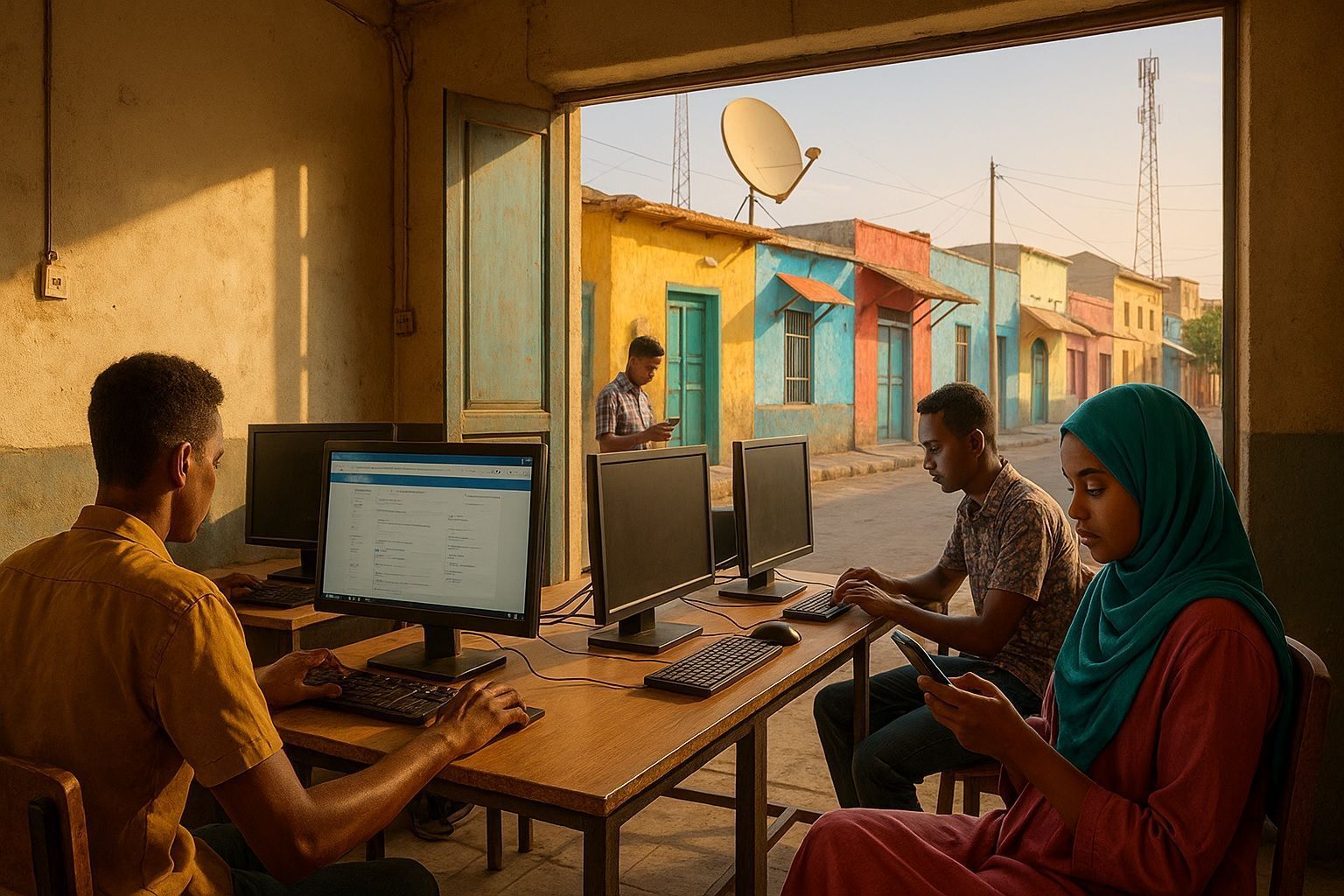
Djibouti has emerged as a critical connectivity hub at the crossroads of Africa, the Middle East and Asia. Its fiber-optic infrastructure is anchored by numerous submarine cables landing on its Red Sea coast – Djibouti hosts roughly 10–12 international undersea cables african.business techpoint.africa. These high-capacity links provide Djibouti with direct digital routes to Europe, Asia and East/Southern Africa. The state-owned Djibouti Telecom has invested heavily – over $200 million in the last decade african.business techpoint.africa – in landing stations and a protected submarine corridor, making Djibouti an essential gateway for regional internet traffic. On land, Djibouti is linked by terrestrial fiber to neighboring Ethiopia and Somalia, and increasingly by private fiber operators like AfriFiber african.business african.business. Djibouti also boasts growing data center capacity. The Djibouti Data Center is “the first and only carrier-neutral data center facility in East Africa”djiboutidatacenter.com, collocating all major cable landing points with Tier-3 colocation, peering and an Internet exchange. In 2024 there were four data centers and one active IXP in Djibouti pulse.internetsociety.org, all of which improve local routing and resilience. Emerging projects include Afridata-Park and planned extensions of fiber inside urban areas african.business.
Chad’s Digital Desert: The Shocking Truth Behind the Country’s Internet Revolution

Chad’s Digital Desert: The Shocking Truth Behind the Country’s Internet Revolution

Chad, a vast landlocked nation in Central Africa, has one of the world’s lowest rates of internet connectivity. As of early 2025, only about 13% of Chadians use the internet, compared to a global average around 60% capmad.com. This places Chad near the bottom globally in internet access. The digital infrastructure is underdeveloped, and most citizens remain offline due to a mix of limited networks, high costs, and challenging geography. Yet change is on the horizon – from ambitious government initiatives to new satellite services promising to close the connectivity gap. This report provides a comprehensive overview of internet access in Chad, examining current penetration, infrastructure, affordability, mobile and broadband services, the advent of satellite internet, government ICT policies, key challenges, and emerging opportunities. Key indicators of Chad’s internet landscape include: These headline numbers show the scale of Chad’s digital divide. In the sections below, we delve into why connectivity remains so scarce, how people who are online get access, what efforts are underway to improve the situation, and whether Chad may be on the cusp of an internet revolution.
The Digital Wave: Uncovering Internet Access and Satellite Connectivity in Barbados

The Digital Wave: Uncovering Internet Access and Satellite Connectivity in Barbados

Barbados is one of the Caribbean’s frontrunners in internet connectivity, with widespread access for consumers and businesses alike. As of the mid-2020s, roughly four out of five Barbadians use the internet, reflecting a high penetration rate of around 80–85% of the population Datareportal Datareportal. Both individual users and enterprises increasingly rely on fast, reliable broadband for everything from everyday communication to critical business operations. This report provides a comprehensive look at Barbados’ internet landscape – covering the available infrastructure, the major service providers and their offerings, pricing for home and business plans, the historical evolution of connectivity, government initiatives, and how Barbados compares with its Caribbean neighbors and global benchmarks. Finally, we examine emerging trends and upcoming projects that are shaping the future of digital connectivity on the island. Barbadian consumers enjoy broad internet availability, with services accessible in both urban and rural areas. Internet penetration stood at 85.8% of the population at the start of 2023 Datareportal, and by early 2025 it was estimated at 80% Datareportal – a slight adjustment reflecting updated data. This high usage places Barbados among the top in the region for connectivity Eclac. Households commonly subscribe to broadband packages for home use, and there

Stock Market Today

  • Bunzl PLC (LON:BNZL) Issues 20,187 Shares for Employee Schemes
    July 1, 2026, 6:26 AM EDT. Bunzl PLC issued and allotted 20,187 new ordinary shares of 32 1/7 pence each on the LSE Main Market, tied to employee share plans. The new shares are fungible with the company's existing stock. After this allotment, Bunzl has 324,289,178 shares in issue. The shares were admitted to trading via block admissions between June 1 and June 30, 2026. Bunzl said this is in line with The Public Offers and Admissions to Trading Regulations 2024 and keeps up its share issues for employee incentives.
Go toTop