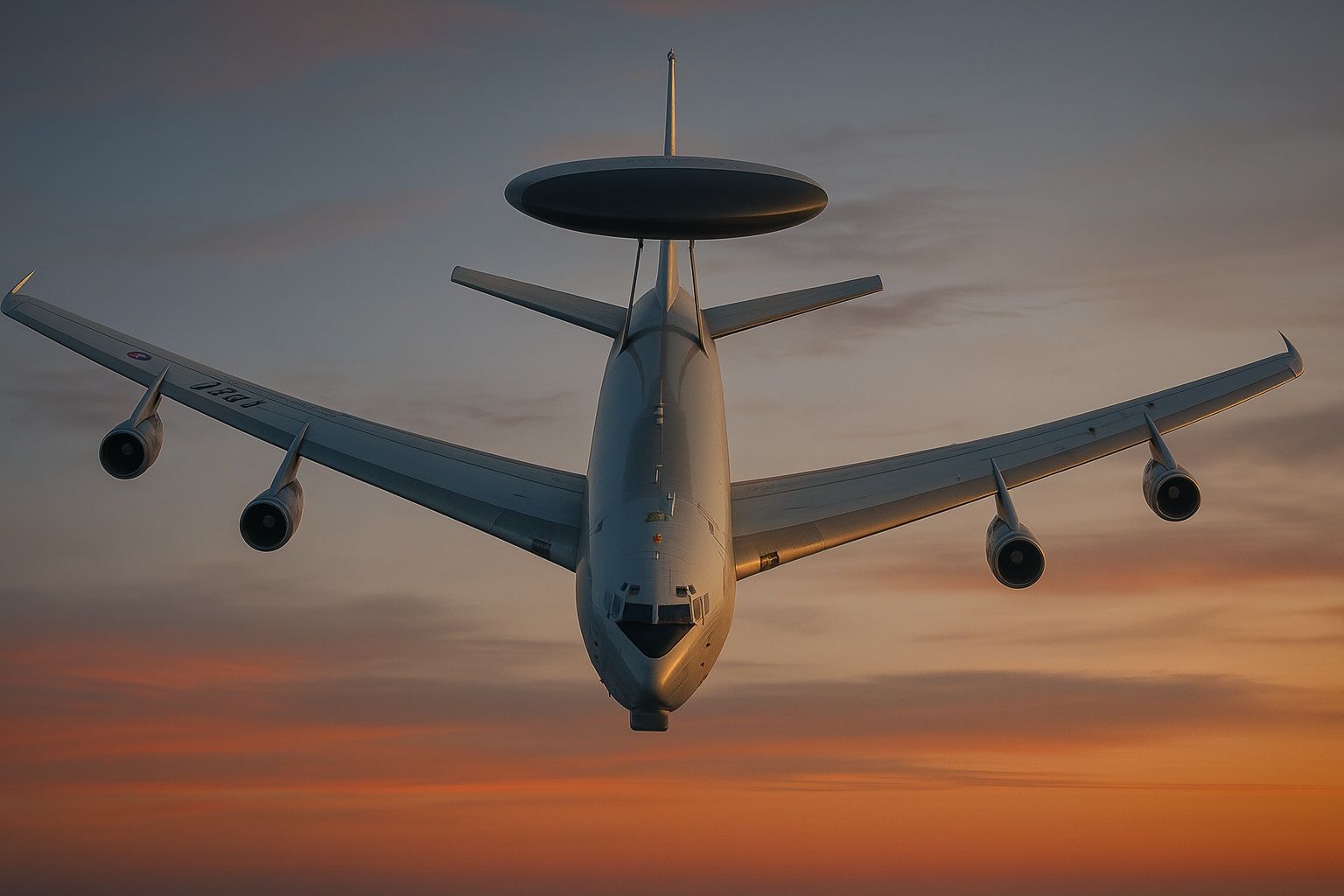

Modern AWACS aircraft are essentially flying sensor hubs and command centers. At their core is a powerful radar designed for all-around aerial surveillance. Classic AWACS like the E-3 Sentry use a spinning dish antenna on the fuselage, which mechanically rotates every 10–12 seconds to scan 360° euro-sd.com. In contrast, latest designs use Active Electronically Scanned Array radars that steer beams electronically. For example, the E-7 Wedgetail’s Northrop Grumman MESA radar is an L-band AESA using modern Gallium Nitride transmitter modules euro-sd.com. This AESA can vary scan rates and even focus on specific sectors with faster revisit times, unlike the fixed 10-second sweep of older dishes euro-sd.com. The result is quicker target tracking and the ability to handle multiple threats simultaneously. In practice, the Wedgetail’s radar provides full 360° coverage and long-range search/track capability, integrated with an Identification Friend-or-Foe system euro-sd.com. Similarly, Saab’s Erieye-ER radar is an AESA mounted in a “ski-box” on the aircraft’s spine – it has an instrumented range of over 650 km and boasts robust electronic counter-countermeasures against jamming euro-sd.com euro-sd.com. Chinese AWACS like the KJ-2000 and KJ-500 also use phased-array radars: the KJ-500’s system consists of three AESA panels in a triangular configuration within a round