
NEW YORK, July 29, 2026, 14:09 EDT — U.S. cash markets open.
- Shares dropped 6.4% to $787.19 as of 1:54 p.m. EDT following a rating and target reduction by Baird.
- The drop exceeded Tuesday’s projected 6.1% earnings move implied by options.
- The initial consensus expects earnings per share of $6.22 and revenue of $19.3 billion, representing a 17% increase.
Caterpillar shares dropped $53.66 after Baird lowered its rating on the machinery manufacturer to Neutral from Outperform. Analyst Mig Dobre reduced his price target to $900 from $1,200.
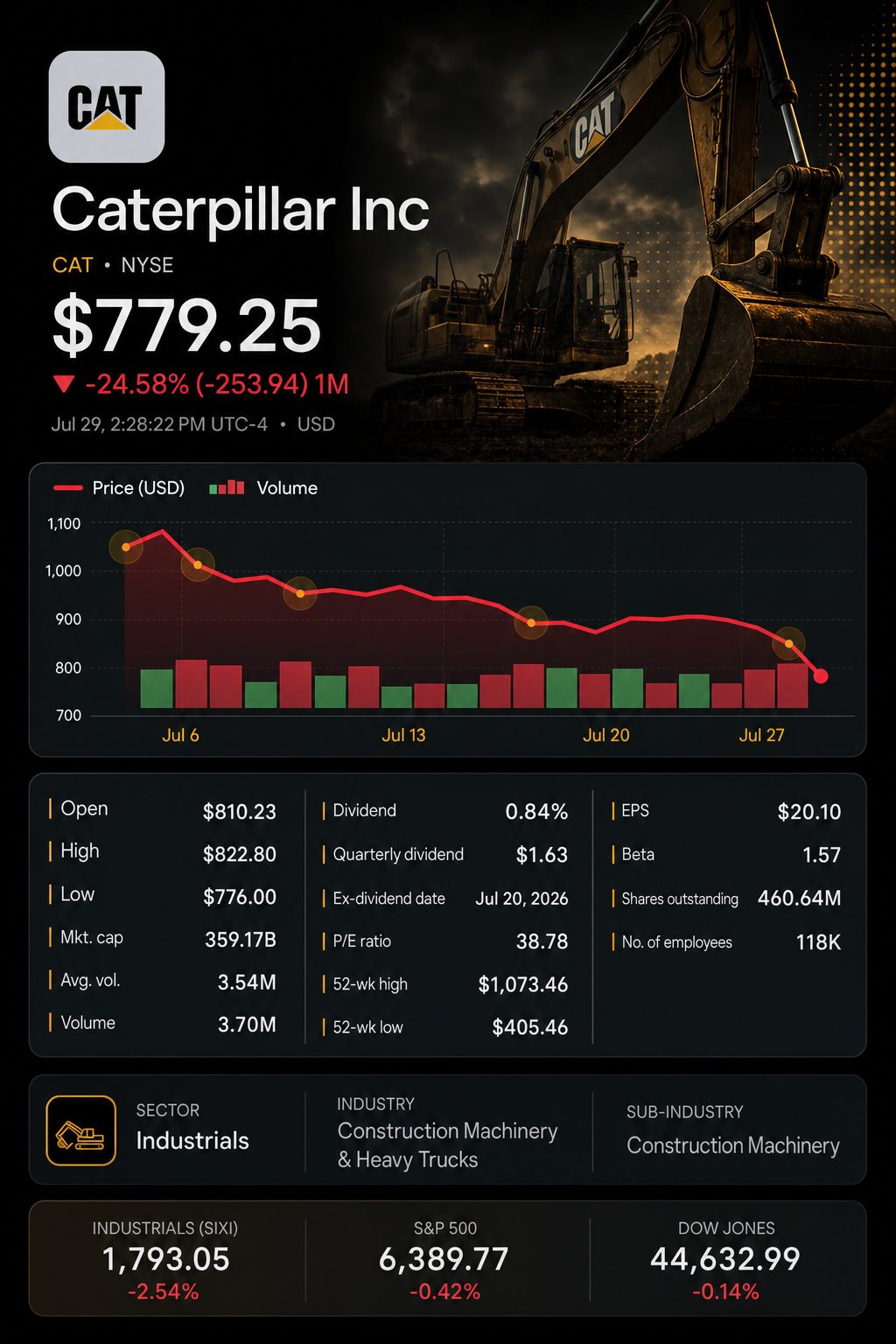
The magnitude of the decline is significant. It has already surpassed the 6.1% earnings swing projected by options data as of Tuesday. That previous forecast, based on Bloomberg’s data, was published earlier.
Baird’s revised target is still roughly 14% higher than the current intraday price. This suggests that the change reflects multiple compression instead of a sharp and sudden decline in earnings.
Dobre stated, “The ground is shifting in many ways.” He noted that the introduction of new rules might increase expenses, limit locations and slow investment. Barron’s
The figures indicate the current state of repricing.
| Comparison | Latest reading | Investor read-through |
|---|---|---|
| Wednesday drop compared to previous earnings forecast | 6.4% versus 6.1% | The policy shock already surpassed the initial move on results day. Investing.com UK |
| Baird’s price objective | $900, reduced from $1,200 | The reduction is 25%, while remaining 14% higher than the current share price. Barron’s |
| Future valuation | Roughly 30 times against a 15-times usual average | Caterpillar is still valued at about double its historical average. Barron’s |
| New York project limit versus major data center | 50 MW versus above 1,000 MW | The company’s highest-priority projects may surpass the limit by a factor of twenty. Governor Kathy Hochul |
Caterpillar started Wednesday having risen 47% so far this year and 96% over the past 12 months. The share price was $787.19, almost 27% under its June peak of $1,073.46.
The elevated share price increases its impact on the price-weighted Dow. The $53.66 decline on Wednesday accounted for nearly 319 points in downward pressure on the index.
On July 14, New York issued an order to temporarily halt state-level discretionary permits that have not been finalized for eligible data centers. The order does not affect local permitting. The rule applies to facilities with power demands of 50 megawatts or more.
The state reported close to 12 gigawatts of applications in New York’s interconnection queue, with over eight gigawatts submitted in 2025 alone.
The threshold applies to projects within Caterpillar’s target market. A presentation from March indicated that some large data centers surpass one gigawatt in size. Caterpillar provides main as well as backup power solutions to these facilities.
The exposure is significant. Power & Energy revenue for the first quarter increased 22% to $7.03 billion. Caterpillar posted a record backlog of $62.7 billion.
Management anticipates further expansion. By 2030, sales of power-generation are projected to be three times higher than in 2024. Caterpillar is set to double capacity for large engines and increase turbine capacity by 2.5 times.
Chief Executive Joe Creed stated: “Investment in critical infrastructure programs and data centers is contributing to overall construction spending levels.” Reuters
Caterpillar is scheduled to release results before markets open on August 4. Analysts’ preliminary consensus forecasts quarterly earnings per share at $6.22, with revenue projected at $19.3 billion, up 17%.
The call might distinguish timing risk from demand destruction. Investors are monitoring 2027 orders, any cancellations in backlog and delays in projects at the state level.
Risks go in both directions. Tighter permit limits might push back generator and turbine order timelines. Still, New York’s directive leaves out finalized applications and projects with local sign-off. This outstanding backlog could support short-term deliveries.
Currently, regulatory issues have overtaken earnings as the primary short-term risk. With shares trading at about 30 times projected earnings, there is limited tolerance for uncertainty around policy.
Related articles: NYSE:CAT