
Comet 3I/ATLAS news roundup — November 6, 2025
Today’s big development: China’s Tianwen‑1 Mars orbiter captured and released new images of the interstellar comet 3I/ATLAS (also cataloged as C/2025 N1), taken from roughly 30 million km away during the comet’s October 3 pass near Mars. China’s state outlets say the sequence shows clear cometary features and marks one of the closest probe‑based looks at the object to date. The observation doubles as a technology pathfinder for China’s upcoming Tianwen‑2 mission.
What the Tianwen‑1 images add
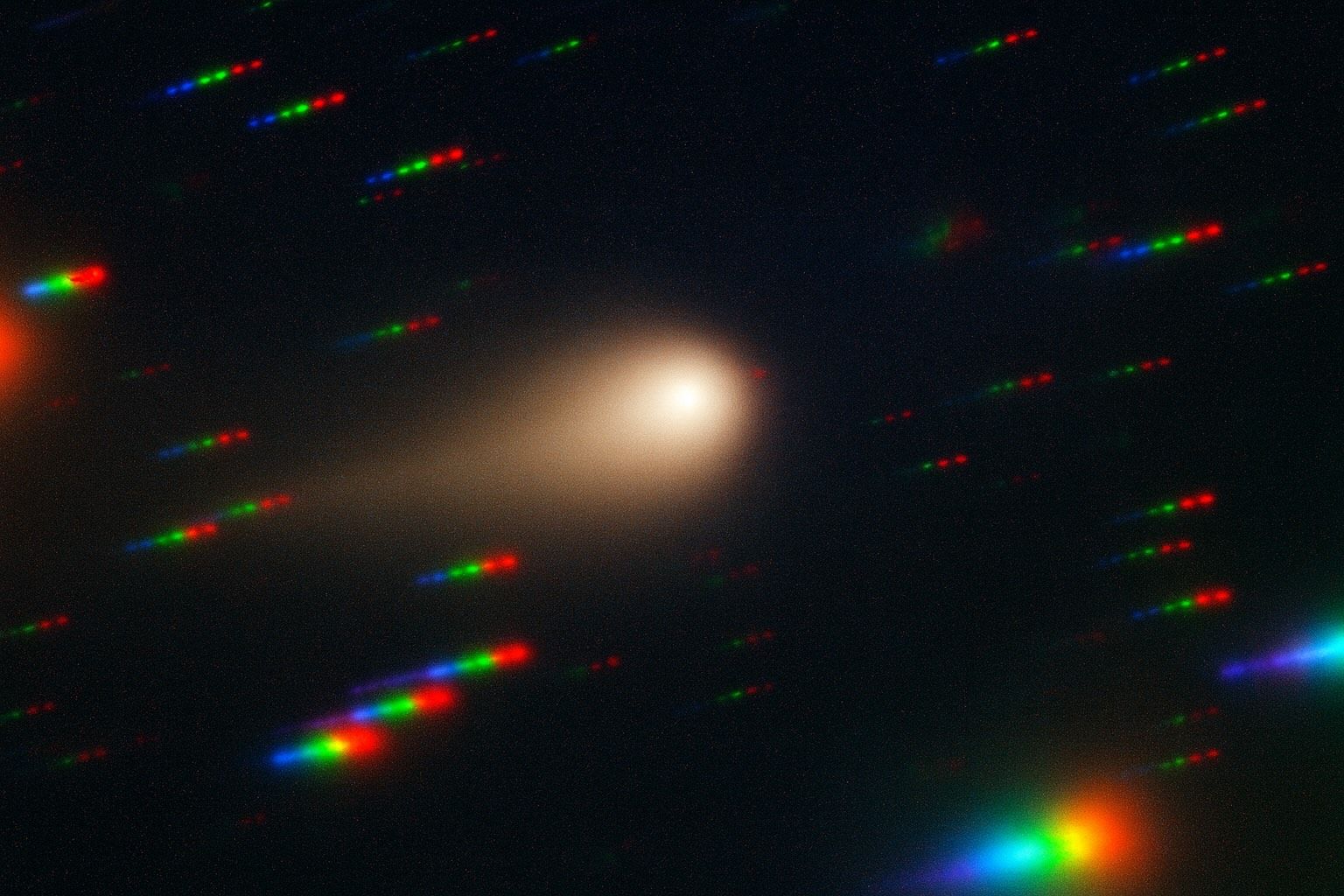
- Proximity & timing: Captured around the Mars flyby on Oct. 3, from ~30 million km — similar to ESA’s ExoMars Trace Gas Orbiter viewing distance — the images show the central coma as a fuzzy point moving across the field over ~30 seconds.
- Scientific value: Besides documenting activity near perihelion, the dataset provides a comparative checkpoint to ESA’s TGO sequence and future post‑perihelion observations. (ESA confirmed its own Oct. 1–7 campaign with TGO and Mars Express.
Context: ESA’s TGO produced the closest European look on Oct. 3; the team emphasized just how challenging it is to resolve such a faint, fast‑moving target from Mars orbit.
Quick refresher: where 3I/ATLAS is in its journey
- No threat to Earth: NASA reiterates 3I/ATLAS will not come closer than ~1.8 AU (~270 million km) to Earth. Perihelion occurred around Oct. 30 at ~1.4 AU (just inside Mars’ orbit).
- What “3I” means: It’s the third confirmed interstellar object after 1I/ʻOumuamua (2017) and 2I/Borisov (2019); the “ATLAS” name comes from the survey that first reported it. NASA Science
Science update: JWST and the “cosmic‑ray crust”
A late‑October analysis based on JWST spectra and modeling suggests billions of years of galactic cosmic‑ray exposure have chemically and physically altered the comet’s outer layers, creating a ~15–20 m deep irradiated crust enriched in CO₂ produced from irradiated CO. That means much of what we see off‑gassing may reflect the interstellar journey, not the pristine makeup of its birth system.
The perihelion surprise: a rapid brightening behind the Sun
While 3I/ATLAS was hidden in solar glare from Earth, spacecraft and solar monitors tracked it around perihelion. Analyses using imagery from NOAA’s GOES‑19, SOHO, and STEREO‑A reported an unexpectedly fast brightening, consistent with strong gas emissions. Researchers noted estimates reaching roughly magnitude 9 at peak — unusually brisk for expectations — though the underlying driver is still being investigated.
Back in view: first post‑perihelion images & what observers are seeing
- First optical look after conjunction: On Oct. 31, astronomer Qicheng Zhang recorded the first optical image of 3I/ATLAS as it reemerged, confirming it’s recoverable for ground‑based telescopes again.
- Fresh image last night: The Virtual Telescope Project published a new photo on Nov. 5, marking the start of the post‑perihelion observing window for many amateurs.
How to see 3I/ATLAS in November (for experienced observers)
- When: The comet is transitioning into the pre‑dawn sky. It’s a faint target (~mag 11–12), so plan on dark skies and a mid‑size telescope (small amateur rigs may struggle). Expect it to rise higher and fade gradually through December.
- Where: It reappears low in the eastern morning twilight as it pulls away from the Sun; precise coordinates change nightly — use tools like JPL Horizons or your preferred ephemeris. (General visibility guidance and timing align with NASA’s and independent skywatcher briefings.
Tip: Because the comet is gas‑rich and dust‑poor, imaging with longer integrations and careful background subtraction can help tease out the coma. (Recent reports of a bluish hue are consistent with gas‑dominated emission.
What to watch next
- Spacecraft fly‑throughs: Prior forecasts suggested ESA’s Hera and NASA’s Europa Clipper could sample the ion tail downwind — Hera’s window was Oct. 25–Nov. 1 and Europa Clipper’s extended through today, Nov. 6. If the solar wind and geometry cooperated, teams may report in‑situ plasma/field signatures in the weeks ahead.
- More post‑perihelion chemistry: With JWST and Hubble continuing targeted programs and ground‑based facilities regaining line of sight, expect improved constraints on nucleus size and volatile ratios — especially CO₂ vs. H₂O — now that the comet’s venting has evolved past perihelion.
Sorting signal from noise
Public interest has spiked as some commentators speculated about exotic origins. NASA scientists have repeatedly emphasized that 3I/ATLAS behaves like a natural comet and poses no danger to Earth. Today’s Tianwen‑1 images and ESA’s October sequences strengthen the mainstream view: we’re witnessing a gas‑rich, interstellar comet doing comet things — albeit with a few surprises that are scientifically valuable.
Sources & further reading (selected)
- Tianwen‑1 images released today (Nov. 6, 2025) — official reports and details via Xinhua/China Daily/CGTN and China’s government English portal.
- NASA overview & FAQs — distance, perihelion, safety, and naming.
- JWST “cosmic‑ray crust” analysis — Live Science summary of Oct. 31 preprint and implications for CO→CO₂ conversion and outer‑layer processing. Live Science
- Perihelion brightening tracked by spacecraft — synthesis of GOES‑19/SOHO/STEREO observations.
- Post‑perihelion recovery images — first optical recovery by Qicheng Zhang; Virtual Telescope’s Nov. 5 image.
- ESA Mars‑orbit observations (Oct. 3) — ExoMars TGO and Mars Express campaign recap.
FAQ
Is 3I/ATLAS dangerous?
No. Its closest approach to Earth stays around 1.8 AU, far beyond the Moon and even beyond the Sun–Earth distance.
Why is it called 3I/ATLAS and also C/2025 N1 (ATLAS)?
“3I” marks it as the third interstellar object; “C/2025 N1” is the comet’s standard non‑periodic designation. Both refer to the same object discovered by the ATLAS survey. NASA Science
Why did it brighten so much near the Sun?
Perihelion heating likely drove strong volatile outgassing, making the comet brighten faster than expected; analyses are ongoing.
Editor’s note for readers and publishers
This roundup focuses on developments as of Nov. 6, 2025, led by today’s Tianwen‑1 release. It contextualizes ongoing spacecraft and telescope results and links to primary space‑agency sources wherever possible for verification and follow‑up.