
Published: 12 November 2025
The interstellar comet 3I/ATLAS is putting on fresh science today. New images show its ion tail lengthening and sharpening as the object climbs back into our predawn sky after its late‑October swing around the Sun. Meanwhile, astronomers have confirmed the first radio detection from this visitor—evidence of ordinary comet chemistry rather than extraterrestrial tech. Here’s what’s new, why it matters, and how to spot it.
Today’s key updates
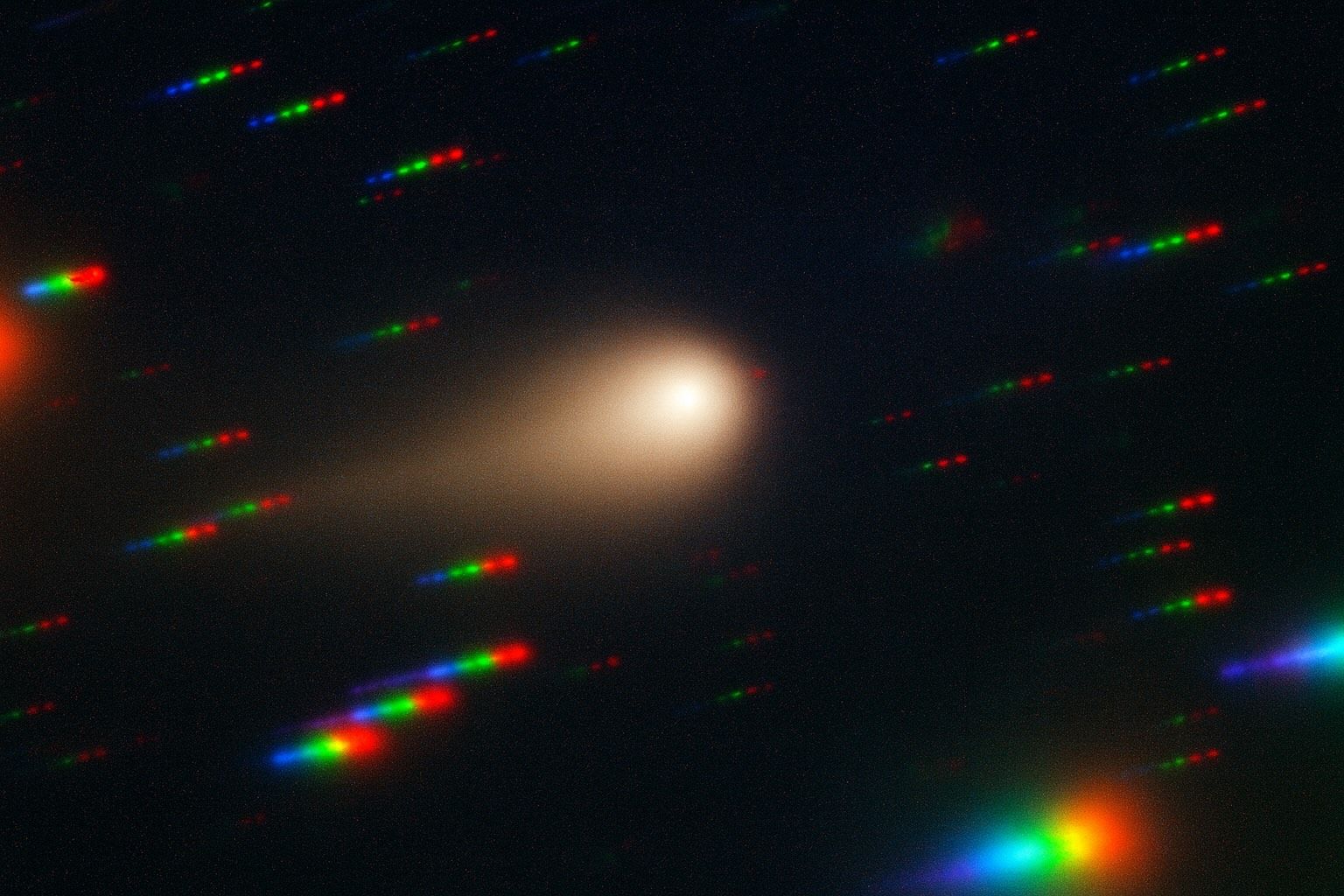
- Tail growth caught on camera: A series of images taken Nov. 10–11 by the Virtual Telescope Project reveal a longer, more structured ion tail as 3I/ATLAS emerges into the morning sky. Coverage today highlights the enhanced tail seen just before dawn on Nov. 11 (04:31 UTC). Ion tails are sculpted by the solar wind and point directly away from the Sun; the evolving shape is a sign of vigorous outgassing.
- First radio detection (context): Using South Africa’s MeerKAT array, astronomers reported hydroxyl (OH) absorption at 1,665 and 1,667 MHz on Oct. 24—classic evidence of water being broken apart by sunlight. The result, posted to The Astronomer’s Telegram and summarized by science outlets this week, supports a plain‑vanilla interpretation: 3I/ATLAS is a natural comet.
- Where to look tonight: 3I/ATLAS has reappeared in the predawn sky, low in the east, currently drifting through Virgo and rising higher through November. It’s faint (roughly magnitude 11–12), so you’ll need a small–to–medium telescope or a sensitive smart scope; binoculars won’t cut it.
- What’s next in space: ESA confirms its JUICE spacecraft is attempting coordinated observations throughout November, with data returns expected in early 2026 due to geometry and downlink constraints. ESA’s Mars missions (Mars Express and the ExoMars Trace Gas Orbiter) also observed the comet around its close Mars pass on Oct. 3.
What the new images show
Today’s coverage features a crisp sequence from Nov. 10–11: against moonlit, low‑altitude conditions, 3I/ATLAS displays a brighter nucleus and a longer, well‑defined ion tail. The tail’s increasing length and structure reflect more gas being ionized and swept back by the solar wind as the comet recedes from the Sun but remains active. The Virtual Telescope Project notes the geometry is improving as the comet moves into the morning sky, which helps the tail stand out.
Several experienced astrophotographers in Europe have also documented complex tail behavior (multiple plumes and antitail‑like features) in the days around Nov. 8–11, consistent with a lively, jetty coma rather than anything exotic.
The “first radio signal” is chemistry, not technology
The MeerKAT team observed 3I/ATLAS on Oct. 24 and detected OH absorption at 1665/1667 MHz—right where cometary hydroxyl lines live. Hydroxyl arises when sunlight breaks apart water molecules from the comet; detecting it in radio is a time‑honored way to confirm water activity. Earlier September attempts yielded no detection; the late‑October success lines up with increased activity near perihelion. Translation: the signal clinches cometary behavior and undercuts “alien probe” speculation. The Astronomer’s Telegram+1
How to see 3I/ATLAS (tonight through the weekend)
- When: Predawn hours. Start looking ~90 minutes before local sunrise.
- Where: Low in the eastern sky in Virgo, slowly climbing higher through November and then into Leo next month. A planetarium app will help with the hop.
- Brightness & gear: Around mag. 11–12 this week—below naked‑eye and binocular reach. Use a 6–10 inch (150–250 mm) telescope or a tracked camera/smart telescope for imaging. Expect a small, condensed “fuzzy star” with a faint tail that deep exposures can reveal. Sky at Night Magazine
- Dates to note: Closest to Earth on Dec. 19, 2025 at about 270 million km (1.8 AU)—still far, but higher in the sky and better placed for backyard observations.
Mission watch: what spacecraft are doing
ESA’s Mars Express and ExoMars TGO captured views around the Oct. 3 Mars flyby, while JUICE is attempting observations throughout November using imagers, spectrometers, and particle sensors. Because of spacecraft geometry and limited downlink while near the Sun, JUICE’s data may not hit public archives until early 2026. NASA’s science page also lists a long bench of assets—Hubble, Webb, SPHEREx, Swift, Parker Solar Probe and more—participating in a global campaign.
Quick facts (refresher)
- What it is: The third confirmed interstellar object to visit our solar system (after 1I/ʻOumuamua in 2017 and 2I/Borisov in 2019), and it behaves like a comet.
- Discovery: ATLAS survey in Chile on July 1, 2025; pre‑discovery images extend back to mid‑June.
- Perihelion:Oct. 29–30, 2025 at ~1.4 AU from the Sun.
- Size (current bounds): Nucleus likely 440 m to ~5.6 km across (upper limit from Hubble modeling).
- Composition highlights: Space‑telescope spectra show CO₂, water and other volatiles in the coma—textbook comet stuff, not alloys or engines.
Why this matters
Interstellar comets are time capsules from other planetary systems. With 3I/ATLAS, scientists can compare “recipes” for comets beyond our Sun: 1I/ʻOumuamua looked dry and odd, 2I/Borisov was gassy and familiar, and now 3I/ATLAS is delivering water‑chemistry signatures in radio plus a dynamic ion tail in optical images. Each adds a puzzle piece to how worlds form—and how common the ingredients for life might be—across the galaxy. Live Science+1
Rumor control
Recent headlines about color changes, disappearing tails, or “alien probes” can sound dramatic—but the best evidence today points to a natural comet. Tail visibility depends on the viewing geometry; near perihelion we were looking almost straight down the tail, which hid it in some angles, while the latest morning‑sky geometry makes it obvious. The new OH radio detection is precisely the kind of chemistry we expect from a sun‑warmed, water‑rich comet. Live Science+1
Bottom line: On Nov. 12, 2025, 3I/ATLAS is back in the morning sky with a lengthening ion tail, and radio astronomers have logged the object’s first signal—natural hydroxyl, not ET. If you’ve got a telescope and a clear eastern horizon before dawn, now’s a great time to chase this once‑in‑a‑decade visitor.
Sources & further reading
Space.com — new Nov. 12 images and tail growth; Virtual Telescope details. Space
BBC Sky at Night — today’s recap of the tail’s return and observing guidance. Sky at Night Magazine
The Astronomer’s Telegram — MeerKAT detection of OH at 1665/1667 MHz (technical summary). The Astronomer’s Telegram
Live Science — news explainer on the first radio detection and what it means. Live Science
ESA FAQ — timeline, mission plans (JUICE, Mars missions), closest‑approach dates. European Space Agency
NASA Science — discovery context, perihelion distance, and observing campaign.
Editor’s note: This article focuses on updates current to 12 November 2025 and will age into background context as new results arrive from ongoing spacecraft observations and amateur imaging campaigns.