
As of 22.12.2025, the interstellar comet 3I/ATLAS—only the third confirmed object from beyond our solar system—is already on its way out again. Its closest pass by Earth happened just days ago, and while the comet never came anywhere near “close” in a human sense, the flyby has triggered a wave of fresh data releases, rapid-response observations, and (inevitably) some internet-fueled mythology.
Here’s what’s new right now: what scientists have actually seen, what they haven’t seen, and what comes next as 3I/ATLAS heads toward the outer solar system.
The big headline today: 3I/ATLAS is leaving—but the best data is still arriving
3I/ATLAS made its closest approach to Earth on 19 December 2025, staying about 1.7–1.8 AU away (roughly 167–170 million miles / 269–270 million km). That’s nearly twice the Earth–Sun distance—so no danger, no near-miss, just a rare scientific opportunity.
Even though the comet is now receding, researchers are still in the “download, calibrate, analyze” phase. Several of the most exciting observations came from spacecraft and space telescopes that either observed it earlier or grabbed opportunistic looks while geometry was favorable. NASA Science+2European Space Agency+2
What makes Comet 3I/ATLAS different from “ordinary” comets?
3I/ATLAS is categorized as interstellar because its orbit is hyperbolic—it’s moving too fast to be gravitationally bound to the Sun, meaning it’s just passing through and will continue back into interstellar space.
NASA says the comet likely formed around another star, drifted through interstellar space for an extraordinarily long time, and approached our solar system from the general direction of Sagittarius (toward the Milky Way’s central region).
That origin story is the point: every spectrum and every faint glow is effectively a small, dirty postcard from a different planetary system.
Current news roundup for 22.12.2025: the most important new observations and releases
1) Radio telescopes checked for “technosignatures.” Result: no artificial signal detected.
A spike in headlines about a “radio signal” from 3I/ATLAS is largely a story of misunderstanding (and sometimes, sensational framing).
The reality: the Breakthrough Listen program and partners observed 3I/ATLAS with multiple facilities and report no evidence of artificial radio emissions associated with the object. Their write-up is unusually explicit: “No artificial radio emission localized to 3I/ATLAS was detected.” SETI Institute+1
Key details from the Breakthrough Listen update:
- Green Bank Telescope (GBT): Observed the comet on 18 December 2025, just before closest approach, using receivers spanning 1–12 GHz. They report sensitivity to extremely low transmitter power levels (expressed as EIRP) and still found no artificial emission.
- MeerKAT: Detected hydroxyl (OH) signatures—exactly what you’d expect when sunlight breaks down water-related molecules in cometary material. In parallel, their analysis found no artificial radio emission down to a reported limit across 900–1670 MHz.
- Allen Telescope Array (ATA) + other campaigns: Observations began within days of discovery and continued through the close-approach window, again with no technosignatures reported.
So if you’ve seen “radio signal” floating around today, the most defensible translation is: radio telescopes detected normal chemistry and did a sensitive search for artificial transmissions—then reported none. SETI Institute+1
2) A Jupiter-bound spacecraft (JUICE) spotted 3I/ATLAS acting like… a comet
ESA’s Jupiter Icy Moons Explorer (JUICE) made a very “space is weird and wonderful” cameo in this story.
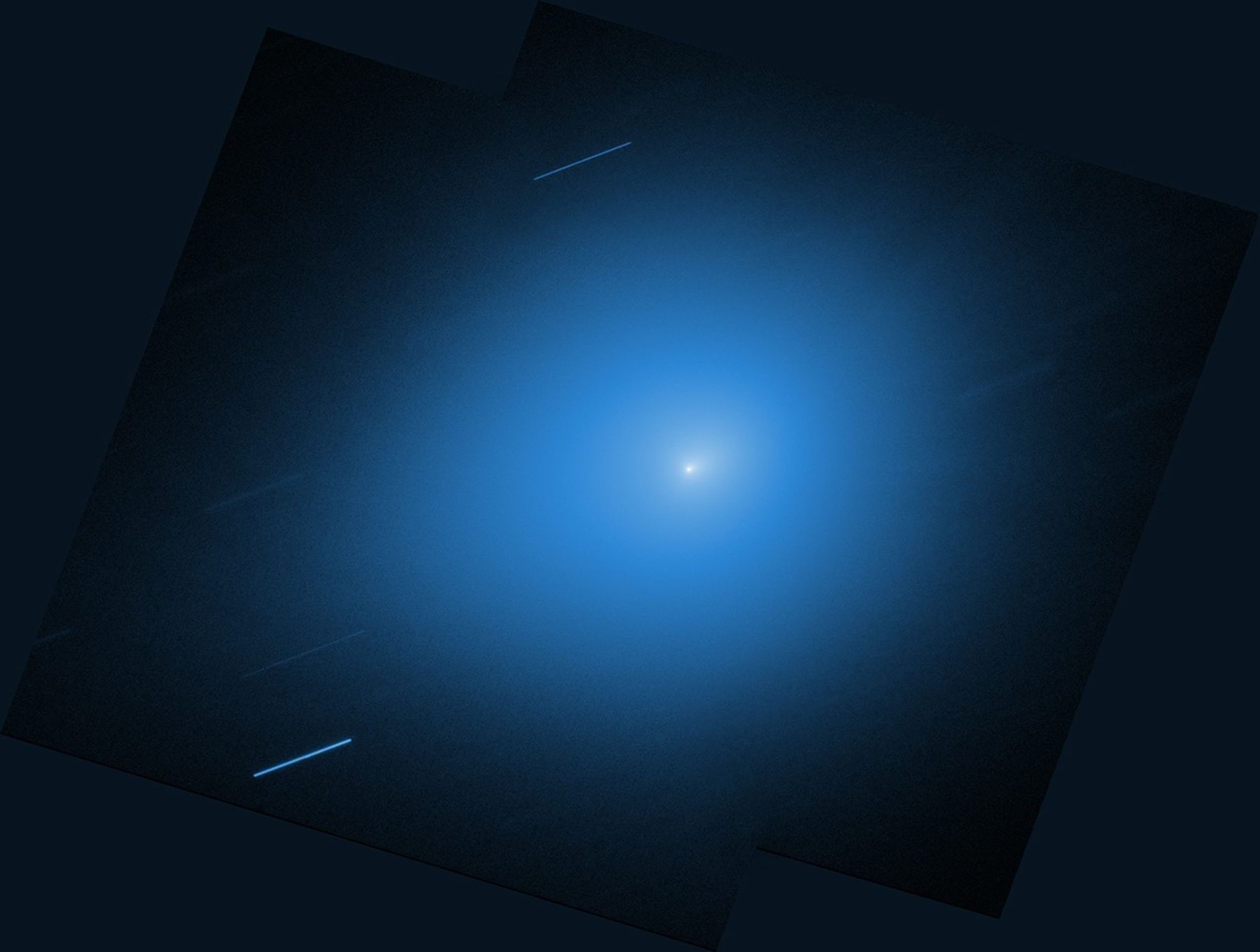
In November 2025, JUICE used five science instruments to observe 3I/ATLAS, and also grabbed a look with its Navigation Camera (NavCam). ESA says the team downloaded just a quarter of a single NavCam image early—and were surprised by how clearly the comet’s activity showed up.
What ESA reports seeing in that NavCam look:
- A coma (the halo of gas around the nucleus)
- A hint of two tails: a plasma tail (ionized gas) and a fainter dust tail European Space Agency
ESA also provides a concrete “what’s next” timeline: the full JUICE instrument data (including JANUS, MAJIS, UVS, SWI, and PEP) is expected to arrive on Earth on 18 and 20 February 2026, with the delay attributed to JUICE using its high-gain antenna as a heat shield, leaving a slower downlink via a smaller antenna. European Space Agency
3) X-rays from an interstellar comet: XRISM and XMM-Newton add a new layer of physics
Optical images show dust and sunlight. X-rays, on the other hand, are a tracer of violent micro-interactions—especially where solar wind slams into escaping comet gas.
ESA says 3I/ATLAS is the first interstellar comet imaged in X-ray light, using XRISM’s Xtend instrument, and compares it with ESA’s XMM-Newton, which also observed a diffuse X-ray glow.
What XRISM (JAXA) explains about its observation:
- XRISM performed a Target of Opportunity observation from 23:20 Nov. 26 to 20:38 Nov. 28, 2025, with an effective exposure of 17 hours.
- A preliminary analysis suggests a faint X-ray glow extending roughly 400,000 km around the nucleus—but XRISM stresses it could still be influenced by instrument effects or noise, so careful analysis is ongoing.
- The spectrum shows features consistent with charge exchange—a process where solar wind ions interact with comet gas, producing characteristic X-ray emission—hinting at contributions from elements like carbon, nitrogen, and oxygen.
This is one of the most scientifically valuable angles: it’s not just “a pretty picture,” it’s a diagnostic of how an interstellar comet’s material behaves when it’s chemically and electrically bullied by our Sun.
4) NASA spacecraft also joined the chase: Europa Clipper and Parker Solar Probe
Europa Clipper (on its way to Jupiter’s moon Europa) observed 3I/ATLAS on 6 November 2025 from roughly 102 million miles (164 million km) away. NASA says its Europa-UVS instrument collected data over seven hours, intended to help determine the composition and distribution of material in the coma.
Meanwhile, Parker Solar Probe—a mission built to study the Sun—also managed an interstellar comet cameo. NASA reports Parker observed 3I/ATLAS from Oct. 18 to Nov. 5, 2025 with its WISPR instrument, capturing about 10 images per day during a period when the spacecraft was moving away from the Sun after a close solar flyby.
These aren’t just bonus snapshots. They widen the viewing geometry—helping researchers disentangle what’s intrinsic to the comet from what’s an artifact of viewing angle, solar illumination, and instrument sensitivity.
Can you see Comet 3I/ATLAS tonight?
Not with your eyes alone. But you can still track and observe it if you know what you’re doing (or you’re willing to let software do the hard part).
NASA says that after passing behind the Sun in October, 3I/ATLAS is observable from Earth again and “can be observed, even with a small telescope, in the pre-dawn sky,” remaining observable until spring 2026. NASA Science
For tracking, NASA specifically points readers to its Eyes on the Solar System simulation for the comet’s current location and path.
What happens next: Jupiter flyby, delayed spacecraft data, and the long goodbye
Even though the Earth flyby is in the rearview mirror, two big milestones are still ahead:
- February 2026: ESA expects JUICE’s full science-instrument data return on 18 and 20 February 2026—a likely treasure chest for composition and activity analysis.
- March 2026: 3I/ATLAS is expected to pass much closer to Jupiter, with reporting placing the distance around 33 million miles (53 million km).
Past that, the comet continues outward. AP reports it’s expected to leave the solar system by the mid-2030s—and barring extremely futuristic propulsion, it won’t be back for an encore.
A quick “myth vs. measurement” check (because the internet is the internet)
Two claims tend to spike around interstellar objects:
“It’s sending a radio signal.”
The strongest current reporting from SETI-affiliated observers is the opposite: they looked, and they did not find artificial emission. What was detected (like hydroxyl signatures) fits normal comet chemistry.
“It’s behaving too strangely to be natural.”
NASA addresses this directly at the level of orbital physics: comets can experience small trajectory changes from outgassing, and NASA says observed perturbations for 3I/ATLAS are small and compatible with that process.
Scientific skepticism isn’t the enemy of wonder—it’s the method that keeps wonder attached to reality.
Why this matters beyond one comet
Interstellar objects are rare in confirmed form, and each one gives astronomers a chance to test how “planet-building leftovers” might differ across star systems—composition, volatile chemistry, dust production, interaction with stellar winds, and more. NASA explicitly frames 3I/ATLAS as scientifically important because differences from local comets could reveal something about the chemistry of other solar systems. NASA Science
And the broader lesson is practical: the scramble around 3I/ATLAS is a rehearsal for the next interstellar visitor—when better early warning and faster coordination could mean even richer data.
Sources used for this 22.12.2025 roundup include updates and releases from NASA, ESA, JAXA/XRISM, the SETI Institute/Breakthrough Listen, and Associated Press.