
December 18, 2025 — The interstellar comet 3I/ATLAS (sometimes written as 3I/Atlas) is back in the spotlight today as it heads into a key milestone: its closest approach to Earth early Friday, Dec. 19. It won’t be a dramatic “near miss” in everyday terms—NASA emphasizes the comet will remain about 1.8 astronomical units away (roughly 170 million miles / 270 million kilometers, nearly twice the Earth–Sun distance)—but in astronomy, that’s close enough to trigger an all-hands observation push across telescopes and spacecraft. NASA Science
Today’s coverage (Dec. 18) is dominated by two themes: how to watch the flyby in real time, and what scientists are learning from this rare visitor from another star system—only the third interstellar object ever confirmed passing through our solar system.
Quick facts: 3I/ATLAS at a glance (as of Dec. 18, 2025)
- Closest approach to Earth: about 1 a.m. EST (0600 GMT) on Dec. 19, at ~1.8 AU distance Space+1
- Threat level: None—NASA says there is no danger to Earth NASA Science
- Speed: about 137,000 mph (221,000 km/h) when discovered; peaked near 153,000 mph (246,000 km/h) near perihelion NASA Science
- Size (best current estimate): nucleus diameter not less than ~440 meters (1,400 feet) and not greater than ~5.6 km (3.5 miles), based on Hubble observations cited by NASA NASA Science
- Where to look (general): pre-dawn sky, in the east to northeast, near Regulus in the constellation Leo(telescope/binoculars required for most observers) Chron+1
What’s new in the news today (Dec. 18): livestreams, viewing guides, and “weird motion” explainers
If you search “3I/ATLAS today” on Dec. 18, the headlines tell a consistent story: the main event is tonight and early tomorrow, and if you don’t have a telescope (or clear skies), you can still watch online.
1) A free livestream is scheduled for tonight (Dec. 18)
Multiple outlets are pointing readers to the Virtual Telescope Project livestream, timed to the comet’s closest approach window. Space.com reports the stream will begin at 11 p.m. EST on Dec. 18 (0400 GMT on Dec. 19), weather permitting, using remote telescopes in Manciano, Italy.
The Virtual Telescope Project’s own event page lists a 04:00 UTC start for the Dec. 19 broadcast.
2) “Can I see it?” guides are everywhere—because it’s faint
Today’s viewing guides stress the same caveat: 3I/ATLAS is not a naked-eye comet. NASA says it can be observed from the ground again now that it has reemerged from the Sun’s glare, and that it’s observable in the pre-dawn sky (and remains a target into spring 2026).
Some local coverage is more specific about gear, suggesting larger backyard telescopes improve your odds. For example, the Houston Chronicle notes that a telescope around 30 cm aperture may be needed to reliably pick it up, with the comet appearing beneath Regulus ahead of sunrise.
Smithsonian Magazine’s Dec. 18 item similarly highlights binoculars or a backyard telescope and places the object under Regulus in the predawn sky.
3) Today’s explainer trend: “non‑gravitational acceleration” (and why it doesn’t mean aliens)
A recurring Dec. 18 narrative is that 3I/ATLAS has shown slight non‑gravitational acceleration—a phrase that can sound ominous until you remember comets are basically natural jet engines. As sunlight heats an icy nucleus, gases vent out, and the recoil can nudge the orbit.
NASA’s FAQ explicitly addresses this: outgassing near the Sun can cause small perturbations, and observations of 3I/ATLAS show these effects are small and compatible with that process.
Local reporting also frames the same conclusion: the observed acceleration is consistent with solar heating rather than any form of propulsion.
What is 3I/ATLAS—and why astronomers care so much
3I/ATLAS is named for what it is and who found it:
- “3I” = the third interstellar object confirmed passing through our solar system
- “ATLAS” = discovered by the NASA‑funded Asteroid Terrestrial-impact Last Alert System survey telescope (a planetary defense sky survey), reported July 1, 2025 NASA Science
NASA says the comet is approaching from the general direction of Sagittarius, toward the central region of the Milky Way—though pinning down a precise “home star” is extremely difficult for objects that have drifted for vast spans of time. NASA Science+1
Scientifically, 3I/ATLAS is valuable because it likely formed around another star and then was ejected into interstellar space. Its gases and dust—what it “sheds” as it warms—are potential clues to chemistry and building blocks beyond our solar system. Scientific American+1
How to watch the 3I/ATLAS comet tonight and tomorrow
Option A: Watch the livestream (recommended for most people)
- Virtual Telescope Project livestream: begins 11 p.m. EST Dec. 18 (0400 GMT / UTC Dec. 19), weather permitting Space+1
This is the easiest way to follow the event if your skies are cloudy, bright with city light, or you don’t have equipment capable of reaching faint objects.
Option B: Try to spot it yourself (telescope-first expectations)
Here’s the practical consensus from today’s guides and NASA’s own notes:
- When: pre-dawn hours leading into Friday, Dec. 19 (and continuing into the following mornings as it recedes) NASA Science+1
- Where: low east to northeast, in/near Leo, beneath Regulus Smithsonian Magazine+1
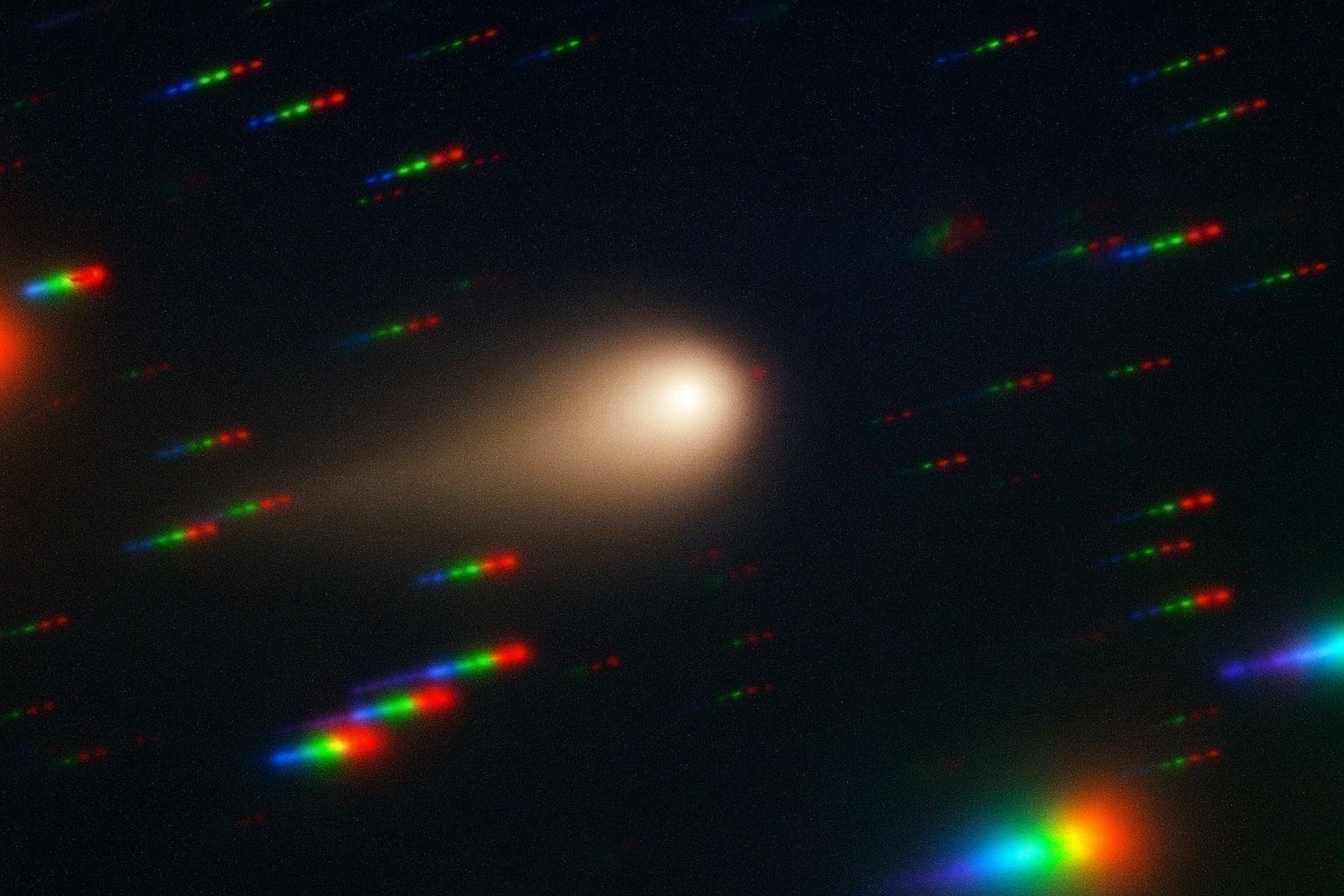
- What you’ll see: not a big sweeping tail; more like a faint smudge or star-like glow, depending on your optics and sky darkness Chron+1
Tips that actually help:
- Use a sky app (or NASA’s Eyes on the Solar System) to confirm position and timing NASA Science
- Prioritize dark skies, and give your eyes time to adapt
- If you’re doing imaging, longer exposures can bring out details that are hard to see visually
Beyond visible light: the comet has been spotted in X-rays—and it’s turned greener
Not all of the “today” conversation is about where to look; a big part is what instruments are revealing about the comet’s physics.
X-ray glow: ESA’s XMM-Newton catches 3I/ATLAS in a different kind of light
The European Space Agency reports that its XMM‑Newton X-ray observatory observed 3I/ATLAS on Dec. 3 for around 20 hours, detecting low-energy X-ray emission consistent with a known comet process: gas streaming from the comet collides with the solar wind, producing X-rays.
The green shift: evidence of comet chemistry “switching on”
Earlier December telescope imaging (still heavily referenced in confirming what observers should expect now) shows 3I/ATLAS becoming brighter and greener, a color often linked to molecules such as diatomic carbon (C₂) when sunlight energizes the gas in the coma.
The takeaway: the comet is behaving like a comet—venting gases, building a coma, reacting to solar heating—even if its origin story is wildly different from comets born in our own solar neighborhood.
What happens after the Dec. 19 flyby
After this week’s closest approach, the story doesn’t immediately end—but it does shift:
- The comet will continue outbound on a hyperbolic path, meaning it’s not bound to the Sun and will ultimately leave our solar system.
- NASA says ground-based viewing is possible again now and extends into spring 2026, but it will gradually fade with distance.
- Longer-term, the comet is expected to keep traveling outward and, according to AP reporting citing NASA’s NEO office, won’t reach interstellar space again until the mid‑2030s.
For most readers, though, the practical bottom line is simpler: tonight’s livestream and tomorrow morning’s predawn window are the headline moments—the best-timed chance to follow a rare interstellar visitor while it’s still within reach of amateur instruments and public telescope feeds.
Related articles: Space