
NEW YORK, August 10, 2026, 04:12 EDT — Nasdaq was shut for its regular hours but premarket trading had begun.
- SpaceX finished Friday at $133.11, marking a 15.83% increase. Last week, the stock rose by 22.8%.
- Roughly 497 million shares changed hands from Thursday to Friday, representing 54.6% of the newly tradable block. The trading volume, however, does not indicate who sold.
- Space and AI accounted for 92.6% of capital expenditures in the second quarter. Together, they reported an operating loss totaling $1.799 billion.
Space Exploration Technologies Corp. NASDAQ:SPCX started Monday trading $1.89 under its IPO price. The stock saw its largest single-day advance since debuting in June on Friday. Despite the rise, shares are still 41% lower than their peak of $225.64.
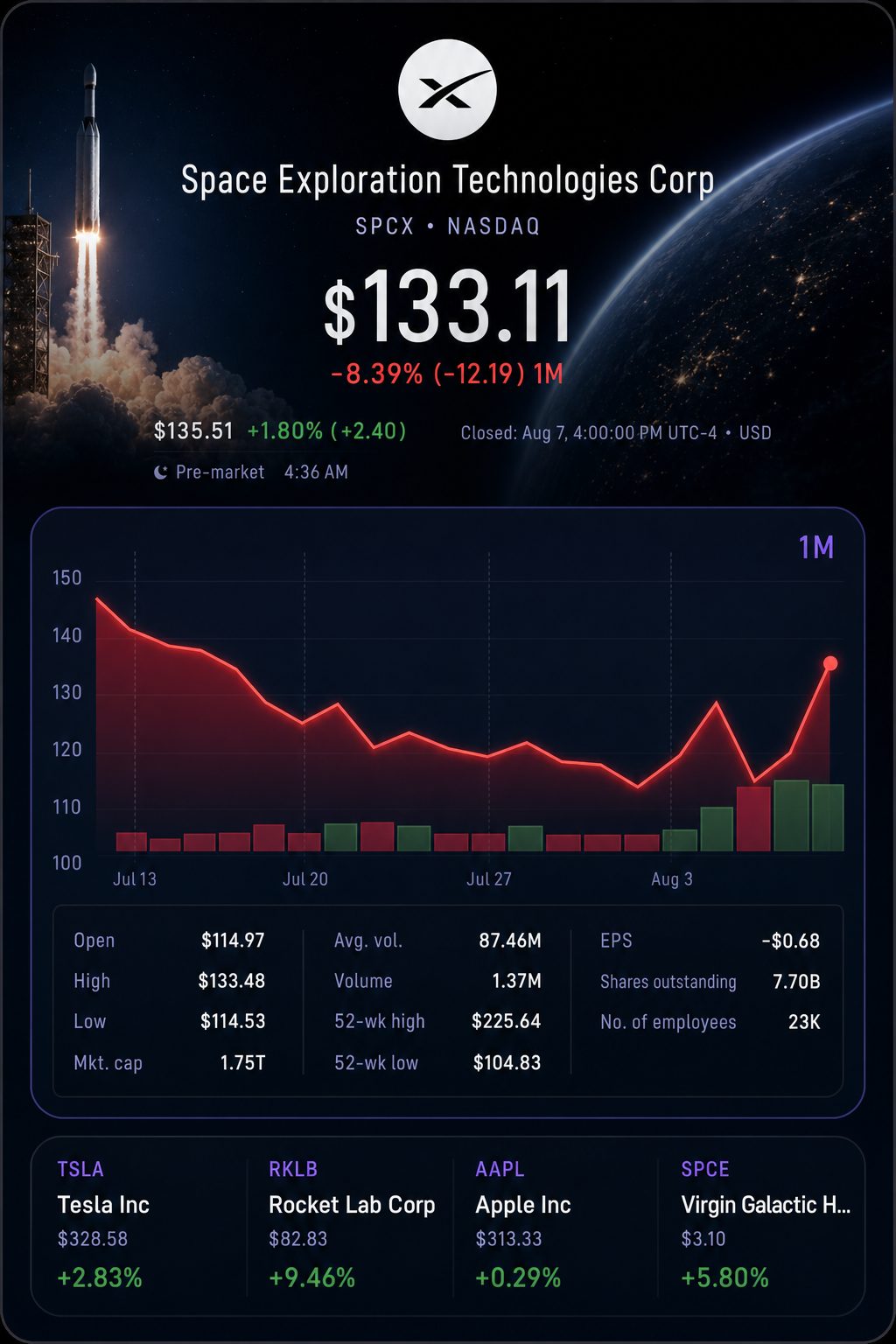
The rebound resolved an immediate issue, as buyers took on a significant boost in tradable supply. However, the broader valuation discussion remains unsettled.
Connectivity, primarily driven by Starlink, generated $1.656 billion in operating income. Combined losses from Space and AI reached $1.799 billion. The gains from the profitable unit nearly offset the total losses.
The lockup expired on Thursday, making 911.5 million shares available for sale and more than doubling the potential float. Around 497 million shares changed hands across Thursday and Friday, representing 54.6% of the unlocked shares, though this is not confirmed insider selling.
ActivTrades analyst Carolane de Palmas noted, “Even without heavy selling, the increase in available shares is likely to keep volatility elevated.” Reuters
Recent price levels and supply indicators reveal a significant adjustment. The analysis is based on closing prices, relevant filings, and Reuters’ unlock figures.
| Price and supply measure | Result | Comparison |
|---|---|---|
| Friday close | $133.11 | Up 15.83% |
| Weekly change | 22.8% higher | Up from $108.37 on July 31 |
| Distance from IPO price | 1.4% lower | IPO price: $135 |
| Distance from post-IPO peak | 41.0% below | Peak: $225.64 |
| Thursday-Friday turnover | Roughly 497 million shares | 54.6% of the unlocked block |
| Friday after-hours price | $134.11 | Up 0.75% |
The S&P 500 gained 0.62% on Friday, while SpaceX outperformed the index by 15.2 percentage points. This performance halted a run of four straight weekly losses.
Quarterly filings indicate the concentration of valuation pressure. Capital expenditure totaled $17.002 billion in the Space and AI segment. Connectivity recorded $1.367 billion in capex.
| Q2 2026 segment | Revenue | Operating result | Operating margin | Capex | Capex/revenue |
|---|---|---|---|---|---|
| Space | $0.962 billion | -$0.542 billion | -56.3% | $1.174 billion | 122.0% |
| Connectivity | $4.291 billion | +$1.656 billion | +38.6% | $1.367 billion | 31.9% |
| AI | $2.561 billion | -$1.257 billion | -49.1% | $15.828 billion | 617.9% |
| Consolidated | $7.814 billion | -$0.143 billion | -1.8% | $18.369 billion | 235.1% |
Starlink reached 12 million subscribers, a twofold increase. Average revenue per user each month dropped by 22% to $66. Despite the decline, connectivity revenue climbed 65.8% to $4.291 billion, driven by higher user numbers.
By the end of trading on Friday, the estimated equity value stood near $1.755 trillion, based on 13.182 billion economic shares. Net cash for June was approximately $60.6 billion, resulting in an estimated enterprise value of $1.694 trillion.
The annualised revenue for the second quarter suggests an enterprise value-to-sales ratio of 54.2 times. On an annualised adjusted EBITDA basis, the figure is 119.7 times. These early calculations are derived by multiplying one quarter’s results by four, and do not represent company guidance.
Management anticipates that growth will tighten those ratios. CFO Bret Johnsen stated that capital expenditures are likely to stay around their present levels for the next two quarters. SpaceX is aiming for a $100 billion revenue run-rate by December. Musk said, “We’re building AI compute capacity at scale faster than anyone else.” Reuters
Analysts’ post-earnings recommendations are still optimistic overall, yet the outlooks vary considerably. Argus Research increased its rating on Friday, introducing a short-term price target of $160. Potential gains are based on the stock’s closing value from Friday.
| Research firm | Recommendation | Target | Implied upside | Call date |
|---|---|---|---|---|
| Morgan Stanley NYSE:MS | Overweight | $300 | 125.4% | August 5 |
| Oppenheimer Holdings Inc. (NYSE:OPY) | Outperform | $250 | 87.8% | August 5 |
| Cantor Fitzgerald | Overweight | $246 | 84.8% | August 5 |
| Bank of America Corp. NYSE:BAC | Buy | $235 | 76.5% | August 5 |
| Argus Research | Buy | $160 | 20.2% | August 7 |
| Piper Sandler Cos. NYSE:PIPR | Neutral | $140 | 5.2% | August 5 |
The Associated Press reported that Morgan Stanley acted as an underwriter for the IPO. This connection remains pertinent when evaluating its $300 target.
Friday’s rally outpaced the advances among publicly traded space and satellite companies. These firms are smaller in scale and do not have SpaceX’s level of involvement with AI.
| Listed company | Friday close | Friday change | Market capitalisation |
|---|---|---|---|
| Space Exploration Technologies Corp. NASDAQ:SPCX | $133.11 | +15.83% | About $1.755 trillion |
| Rocket Lab USA Inc. NASDAQ:RKLB | $82.83 | +9.46% | $50.15 billion |
| AST SpaceMobile Inc. NASDAQ:ASTS | $71.94 | +6.86% | $20.91 billion |
| Iridium Communications Inc. NASDAQ:IRDM | $49.93 | +3.33% | $5.42 billion |
SpaceX’s equity is valued at roughly 23 times the combined market capitalisations. This disparity heightens the impact of launch delays, softer pricing or unmet AI objectives.
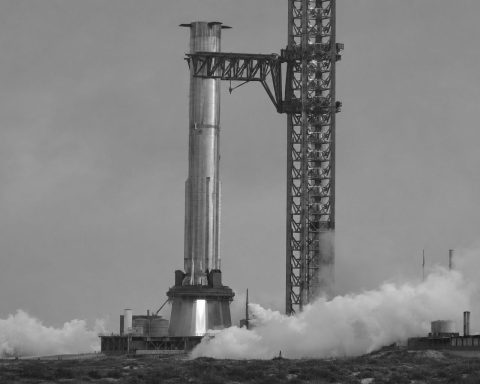
Operations remained active over the weekend. On Saturday, Falcon 9 deployed 24 Starlink satellites from Vandenberg. The next Starlink launch is slated for Tuesday. Globalstar Inc. NASDAQ:GSAT has a mission set for August 15. Investors are monitoring insider-sale disclosures as the potential float could approach 40% by December 8.
Risks: Additional unlock selling may boost supply pressure. Starlink’s reduced prices could dampen margin expansion. Capital expenditure could stay around $18.4 billion for two quarters. Delays in launches, regulation, or AI-contracts could challenge the valuation argument.
Related articles: NASDAQ:SPCX