
CrowdStrike Holdings, Inc. NASDAQ:CRWD heads into Monday’s session (Dec. 15, 2025) with investors weighing a powerful growth narrative—AI-driven cybersecurity consolidation—against a familiar set of concerns: premium valuation, sector volatility, and the lingering reputational and financial after-effects of the 2024 Windows outage.
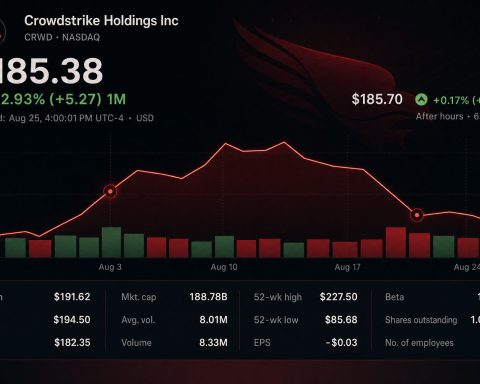
As of the last regular U.S. session (Friday, Dec. 12, 2025), CrowdStrike shares closed at $504.78, down 2.49% on the day. The stock is also roughly 11% below its 52-week high of $566.90 (set on Nov. 12, 2025), a reminder that expectations remain elevated even after a strong year.
Below is what matters most for CRWD stock heading into the open—latest headlines, key financial results, forward guidance, analyst forecasts, and the risks still in focus.
The biggest driver right now: Q3 results and a raised outlook
CrowdStrike’s most market-moving catalyst into mid-December is still its fiscal Q3 2026 earnings release (quarter ended Oct. 31, 2025) and the forward guidance that came with it.
What CrowdStrike reported for Q3 FY2026
From the company’s results announcement:
- Total revenue:$1.23 billion, up 22% year over year Business Wire
- Subscription revenue:$1.17 billion, up 21% year over year Business Wire
- ARR (annual recurring revenue):$4.92 billion, up 23% year over year Business Wire
- Net new ARR:$265.3 million for the quarter Business Wire
- Cash flow from operations:$398 million (record for Q3) Business Wire
- Free cash flow:$296 million (record for Q3) Business Wire
Investors.com also flagged the quarter as a modest beat versus expectations, pointing to adjusted EPS of $0.96 on 22% revenue growth to $1.23 billion, and highlighting the ARR and net new ARR upside.
Why the market still debates the “beat”
The headline numbers were strong—but in a high-multiple cybersecurity leader, the question often becomes: Was it strong enough to justify the price investors are already paying?
Reuters captured this tension after the earnings release, noting that CrowdStrike’s AI-integrated tools have been driving adoption and helping lift the outlook, but also emphasizing how closely investors are watching follow-through after last year’s outage-driven reputational hit.
Guidance: the forward numbers traders will anchor on Monday
The next key input for CRWD’s near-term direction is guidance for:
- Fiscal Q4 2026 (ending Jan. 31, 2026)
- Full-year fiscal 2026 (ending Jan. 31, 2026) Business Wire
From CrowdStrike’s issued outlook:
Q4 FY2026 guidance (ending Jan. 31, 2026)
- Revenue:$1.29B to $1.30B Business Wire
- Non-GAAP operating income:$315.4M to $319.4M Business Wire
- Non-GAAP net income:$282.1M to $286.6M Business Wire
- Non-GAAP EPS (diluted):$1.09 to $1.11 Business Wire
Full-year FY2026 guidance (ending Jan. 31, 2026)
- Revenue:$4.7966B to $4.8066B Business Wire
- Non-GAAP operating income:$1.0361B to $1.0401B Business Wire
- Non-GAAP net income:$949.6M to $954.0M Business Wire
- Non-GAAP EPS (diluted):$3.70 to $3.72 Business Wire
Reuters separately emphasized the same Q4 revenue range and framed the raise as evidence that AI adoption inside CrowdStrike’s Falcon platform is showing up in demand.
The narrative bulls are leaning into: platform consolidation + Falcon Flex
CrowdStrike is positioning itself as a “consolidation” winner—customers replacing point solutions with a broader platform. In its Q3 commentary, management explicitly tied strong results to the “single platform strategy” and its Falcon Flex subscription model, while also pointing to an “AI-driven demand environment.” Business Wire
One specific datapoint the company highlighted: it exceeded $1.35 billion in ending ARR from accounts using Falcon Flex, growing more than 200% year over year.
For Monday’s trade, this matters because “platform” stories can extend premium valuation—if investors believe consolidation can keep driving net retention, upsell, and multi-year expansion.
AI is not just marketing: two recent developments investors are watching
1) Charlotte AI gets FedRAMP High authorization (public sector angle)
On Nov. 25, 2025, CrowdStrike announced that Charlotte AI achieved FedRAMP High Authorization, making it available to federal, state, and local agencies through the Falcon platform in GovCloud.
CrowdStrike positioned this as enabling an “agentic SOC” (security operations center), including capabilities like a Detection Triage Agent and automation inside its SOAR workflows. CrowdStrike
Why it matters for the stock: FedRAMP High is a meaningful gate for U.S. government adoption, and public sector deals tend to be sticky and long-duration once deployed—potentially supporting durable ARR.
2) The Pangea deal: securing the AI “prompt layer”
CrowdStrike’s AI strategy is also being built via acquisition. On Sept. 16, 2025, it announced a definitive agreement to acquire Pangea, positioning the move as enabling what it calls AI Detection and Response (AIDR)—extending security across the AI lifecycle (data, models, agents, identities, infrastructure, and interactions).
In its Form 10‑Q for the quarter ended Oct. 31, 2025, CrowdStrike disclosed equity issuance related to acquisitions, including Pangea (Sept. 26, 2025) and Onum (Sept. 12, 2025).
Why it matters for Monday: investors increasingly treat “AI security” as a new budget line item. CrowdStrike is trying to own that category early—potentially expanding TAM beyond traditional endpoint.
The overhang investors still won’t ignore: the July 19 Incident
CrowdStrike continues to disclose that the July 19, 2024 content configuration update for its Falcon sensor caused Windows system crashes (the “July 19 Incident”). SEC
In the latest quarterly filing (ended Oct. 31, 2025), CrowdStrike reiterates that the incident has had, and is expected to continue to have, an adverse effect on business, customer/partner relations, reputation, and financial results—and that it has incurred and expects to continue incurring significant costs related to remediation and response.
That matters for CRWD stock in two practical ways:
- Headline risk: any fresh outage, customer dispute, or litigation update can move the stock quickly.
- Accounting/earnings quality scrutiny: investors watch the level of incident-related costs excluded from non-GAAP measures, and how those costs trend.
Reuters earlier reported that customer incentives introduced after the outage were expected to create a $10M to $15M revenue impact per quarter for the remainder of the fiscal year (at that time), reflecting how remediation can show up in reported numbers through timing and concessions.
Wall Street forecasts: what analysts expect (and what that implies)
Forecasts and price targets vary widely for CRWD—as you’d expect for a premium growth name—yet the direction of recent updates has generally been constructive after the Q3 print.
Consensus price targets
Two widely followed aggregators show similar consensus targets:
- MarketBeat: average $554.65 price target (about 9.9% above $504.78), with a “Moderate Buy” consensus based on 52 analyst ratings. MarketBeat
- Benzinga: consensus price target $554.18, with a recent-high target of $640 (BTIG, Dec. 3, 2025) and a low of $343 (Bernstein, Aug. 28, 2025).
Recent notable analyst changes (early December)
Benzinga’s compilation of recent moves shows several updates clustered immediately after earnings, including:
- Freedom Capital Markets (Dec. 11, 2025): upgrade to Buy, target $550 Benzinga
- Citigroup (Dec. 4, 2025): target raised to $595 (rating maintained as Buy) Benzinga
- Goldman Sachs (Dec. 4, 2025): target raised to $564 (Buy) Benzinga
Investing.com also reported Goldman’s target raise to $564 from $535 following the Q3 report, while underscoring the theme that “muted” market reactions can happen when expectations are already high. Investing
One underappreciated angle for Monday: seasonality going into Q4
CrowdStrike’s fiscal calendar ends Jan. 31, and the company explicitly notes that net new ARR generation is typically greater in the second half of the year—particularly in the fourth quarter—driven in part by customer budget cycles.
That disclosure matters because the market is now looking at Q4 as a “proof quarter”:
- Can the raised Q4 outlook translate into an additional upside surprise?
- Can CrowdStrike show the outage recovery story is fully behind it while still scaling new AI-led offerings?
What to watch before the bell on Dec. 15, 2025
Because Monday is the first session after the weekend, the most relevant “pre-market” checklist for CRWD is about news flow and cross-currents:
- Any weekend cybersecurity headlines (breaches, threat reports, critical vulnerabilities) that lift or hit the sector.
- Fresh analyst notes (upgrades/downgrades or target changes) following the early-December earnings cycle—especially from top-tier banks that can move institutional positioning.
- Risk appetite in high-multiple software/cybersecurity—CrowdStrike has been strong, but it can still trade with broader Nasdaq momentum.
- Follow-through on the raised outlook: investors often fade or chase premium names based on whether guidance looks “beat-able” beyond the headline raise. Business Wire
- Any update tied to the July 19 Incident (legal proceedings, customer commitments, or remediation costs).
Bottom line for CRWD stock into Monday
Heading into the Dec. 15 open, the bull case remains straightforward: CrowdStrike is posting strong revenue and ARR growth, lifting guidance, and tying product momentum to AI-driven consolidation—while adding new AI security capabilities through major launches and acquisitions.
The bear case is equally clear: after a big run, the market’s bar stays high, and CrowdStrike still carries a real “trust and execution” scar from the Windows outage—one the company itself says continues to affect the business and could generate ongoing costs and distractions. SEC
Related articles: NASDAQ:CRWD