
SEOUL, July 20, 2026, 17:15 KST
Shares in Samsung Electronics KRX:005930 and SK hynix KRX:000660 ended Monday trading down over 4%. New CXL updates sparked renewed speculation over a secondary boost for AI-related memory. Commercial rollout, however, remains behind.
Compute Express Link, known as CXL, enables memory pooling beyond traditional CPU slots. This technology may increase DRAM capacity per server as inference demands grow.
Goldman Sachs NYSE:GS projects monthly AI token usage will hit 120 quadrillion by 2030, a figure 24 times higher than in 2026.
Jim Schneider, the bank’s lead semiconductor analyst, noted that investors are concerned about “the sustainability of capex.” He added that improved margins for hyperscalers could provide greater flexibility for increased spending. Goldman Sachs
According to local media, Samsung moved CMM-D 3.0 from CXL 3.1 to 3.2. Mass production is scheduled for year-end, though the timeline is still subject to change.
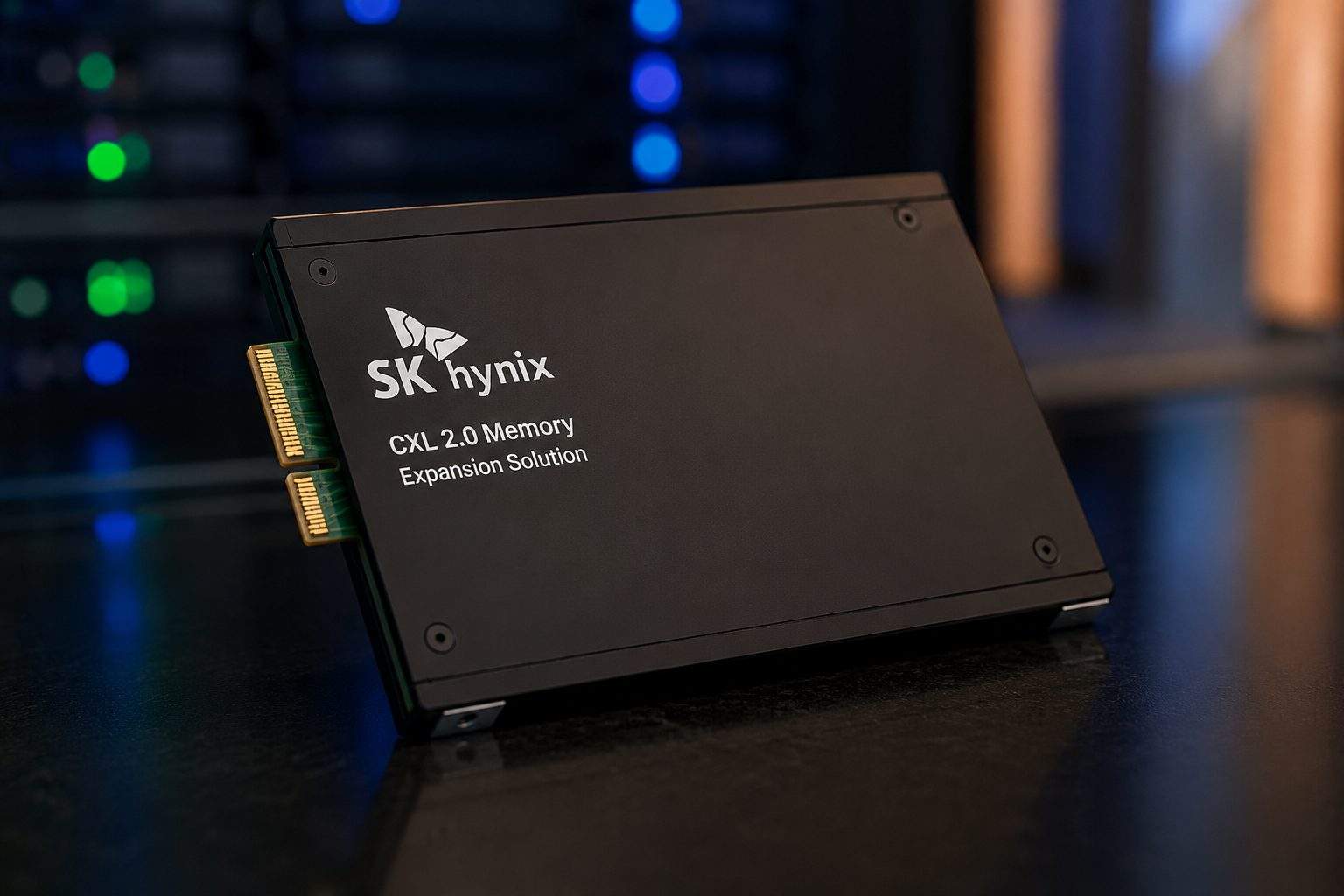
SK hynix provided more concrete proof of its hardware, showcasing a 256GB CXL 3.2 module in June. The module was also demonstrated operating within a pooled-memory server.
Samsung’s official CMM-D page continues to reference CXL 2.0. It notes that more recent standards have not yet reached full commercialisation. The broader ecosystem, including CPUs, switches, and software, is described as still developing.
Available public evidence remains inconsistent.
| Investor test | Samsung Electronics | SK hynix |
|---|---|---|
| Public version | This page references CXL 2.0; timing for CXL 3.2 remains tentative. Samsung Semiconductor Global | Presented a 256GB CXL 3.2 memory module. SK hynix Newsroom – |
| Measured result | Tests showed a 1TB memory pool delivering up to 92% of DRAM speeds when using eight GPUs. Samsung Semiconductor Global | The ITME demonstration boosted throughput by as much as 35.7%. arXiv |
| Readiness signal | According to Samsung, ecosystem maturity is still limited. Samsung Semiconductor Global | Showed successful interoperability within a pooled-memory server. SK hynix Newsroom – |
The benchmarks cannot be directly compared, as they rely on varying workloads, baselines, and system architectures.
Based on publicly available information, SK hynix’s hardware validation for CXL 3.2 appears more transparent. This does not demonstrate a lead in shipment numbers or earnings.
Samsung’s test highlights a wider bottleneck. It needed a tailored kernel, adjustments to LMCache and pinned memory. Software maturity could determine when revenue begins.
The CXL 3.2 specification focuses on monitoring, security, and support by operating systems. The hot-page unit enhances memory tiering. Investors are advised to distinguish between specification versions and bandwidth claims at the module level.
The KOSPI ended down 4.46% at 6,516.27. Samsung ended the session at 244,000 won, while SK hynix closed at 1,764,000 won.
The KRX cash market closed at 17:15 KST, with Nextrade’s after-market set to continue operating until 20:00.
Between the close on July 10 and July 16, Samsung declined by 10.5%. SK hynix slipped 15.5%, and the KOSPI lost 8.8%. Trading was halted on Friday for Constitution Day.
Alphabet NASDAQ:GOOGL is set to report results on Wednesday, with Intel NASDAQ:INTC following on Thursday. Expectations for AI investments and chip platform outlook are likely to put the wider case for CXL demand under scrutiny.
Kevin Mahn at Hennion & Walsh cautioned that any reduction in spending by Alphabet could cause “ripple effects across the entire AI ecosystem.” Reuters
Risks: CXL sales could decline if host CPUs, switches, or software fall behind. All performance data is based on company or prototype testing. Neither demonstrates actual customer revenue.
To investors, CXL represents a medium-term option for capacity rather than an immediate replacement for HBM. Any re-rating will depend on customer qualification, volume outlook, and reported sales figures.
Related articles: NYSE:GS