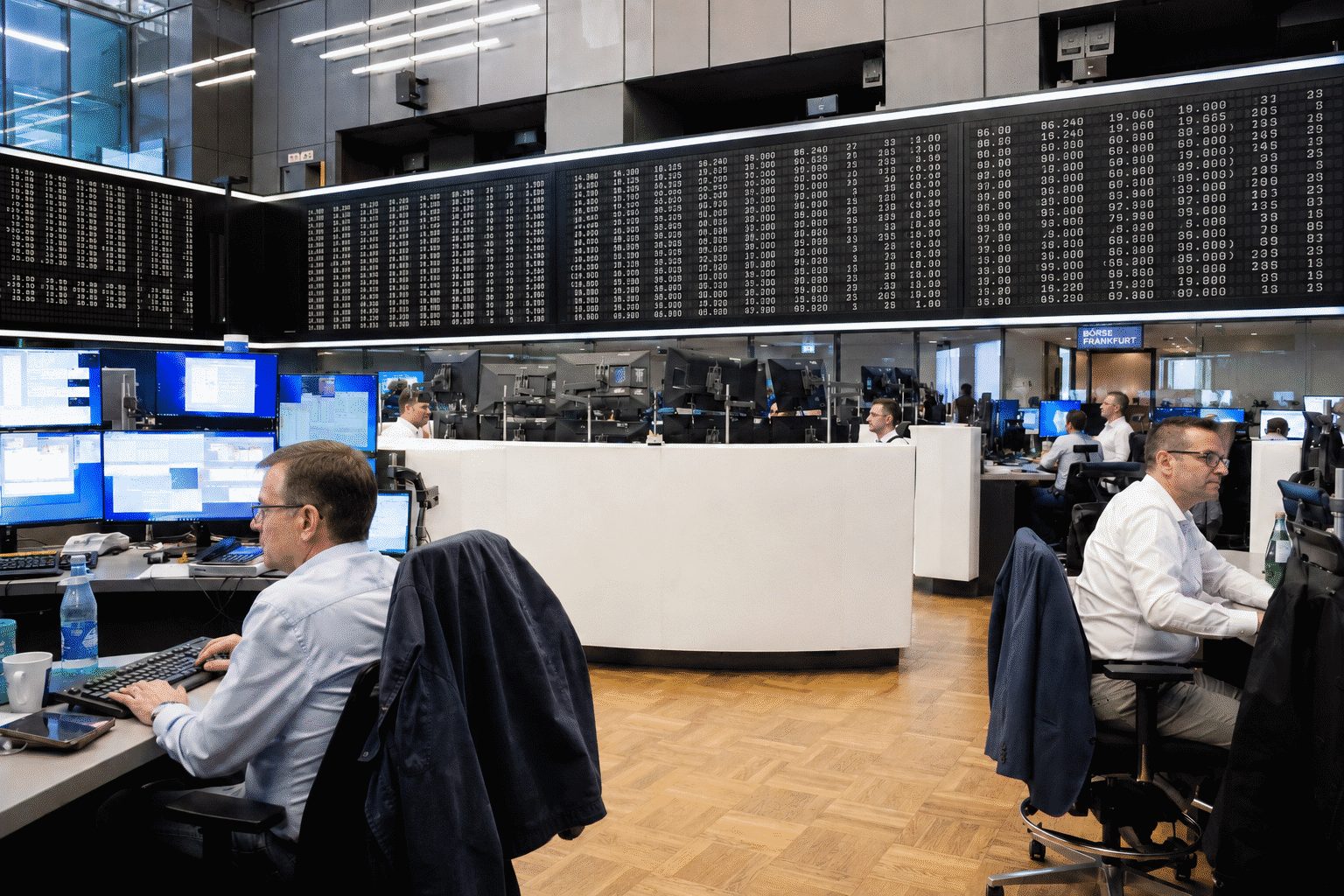

WARSAW, August 17, 2026, 11:00 CEST — Asian cash markets have largely finished the session, European markets are active, and U.S. stocks are still in premarket trade.
- European and Asian stocks advanced as the likelihood of a Federal Reserve rate hike in September declined to 30%.
- China’s production, retail sales and investment each fell short of expectations.
- Gold advanced as both the dollar and Treasury yields declined.
World stocks rose on Monday despite China reporting three new economic disappointments. Market participants turned their attention to weaker U.S. data, reducing the market-implied likelihood of a Federal Reserve rate hike in September to 30%, down from nearly 50% one week ago.
The separation holds significance. Rising valuations, driven by lower discount-rate risk, are outpacing the drag on earnings forecasts caused by softer Chinese demand. This situation is currently backing equities. However, it also heightens the market’s vulnerability to potential fresh inflation shocks.
| Equity market | Latest move | Session status | Main signal |
|---|---|---|---|
| STOXX Europe 600 | +0.2% | Trading | Resources and tech outperforming |
| MSCI Asia-Pacific ex-Japan | +0.5% | Mostly closed | Reduced Fed hike concerns |
| Hang Seng | +1.6% | Closed | Optimism over China stimulus |
| CSI 300 | +0.8% | Closed | Markets shrug off weak data |
| Nikkei 225 | +0.3% | Closed | GDP data mixed, dollar weaker |
| S&P 500 futures | +0.2% | Premarket | U.S. session supports sentiment |
| Nasdaq futures | +0.5% | Premarket | Growth shares favored |
China’s industrial output increased by 4.5% in July compared to the previous year. Analysts had anticipated a 4.8% gain. Retail sales advanced just 0.6%, falling short of the 1.5% expected, while fixed-asset investment fell 6.7% over the first seven months.
| China indicator | Actual | Forecast | Prior | Surprise |
|---|---|---|---|---|
| Industrial output, year-on-year | +4.5% | +4.8% | +5.3% | -0.3 percentage point |
| Retail sales, year-on-year | +0.6% | +1.5% | +1.0% | -0.9 percentage point |
| Fixed-asset investment, year-to-date | -6.7% | -6.0% | -5.7% | -0.7 percentage point |
Such misses typically weigh on miners and Asian cyclicals, but European basic resources advanced 1.4%, helped by gains in gold and a softer dollar. Technology added 1.1%. Shares of food and beverage companies slipped 0.7%.
Gains in Europe were modest. The STOXX 600 was at 659.30. Germany’s DAX hovered near unchanged, Britain’s FTSE 100 climbed 0.2%, while France’s CAC 40 edged down 0.1%. Sector differences outweighed headline index changes.
| Cross-asset market | Latest level or move | Investor message |
|---|---|---|
| U.S. two-year Treasury yield | 4.154%; -2 basis points | Expectations for limited Fed action soon |
| U.S. 10-year Treasury yield | 4.680%; -2 basis points | Persistent selling pressure at long-end |
| Dollar index | 99.501; -0.1% | Trading close to lowest in a month |
| Euro | $1.1588 | Reached highest in two months |
| Gold | $4,397; +0.5% | Helped by weaker dollar and rates |
| Bitcoin | $63,512.66; +0.8% | Shows moderate risk-seeking |
| Brent crude | About $88.5; nearly flat | Hormuz-related risk still factored in |
The market reaction supported the prevailing policy narrative. The euro climbed to its highest level in two months, and the yen appreciated to 159.075 per dollar. Fed fund futures showed a 69.9% probability the central bank would keep rates steady in September. Bitcoin and ether made small gains.
Japan issued a separate caution. The country’s economy grew at an annualised rate of 1.1% in the second quarter, and the yield on the 10-year Japanese government bond climbed to its highest level in thirty years. Despite this, the yen strengthened, indicating that the repricing of U.S. rates is overshadowing news about relative growth.
| Analyst recommendations and market calls | Verified view | Investor implication |
|---|---|---|
| BNY NYSE:BK analysts | Markets expect fewer than one full Fed rate hike by December; longer-term yields stay comparatively high | Prefer targeted duration positions over substantial long exposure in bonds |
| Capital Economics | Japan’s GDP figures present a mixed picture; government spending is providing some lift | Don’t interpret weak headline data as confirmation the Bank of Japan will pause |
| Shane Oliver, AMP ASX:AMP | The main scenario puts oil between $70 and $100 | Maintain energy hedges while oil shipments via Hormuz face disruption |
| Xu Tianchen, Economist Intelligence Unit | China is encouraged to use established fiscal measures more assertively | Chinese cyclical stocks require actual policy follow-through rather than just stimulus hopes |
Oil continues to hold back the rate-relief rally. Brent traded close to flat near $88.5, having risen 6% during the past week. AMP chief economist Shane Oliver sees a $70-to-$100 trading range and cautioned that flows from the Middle East are still running 10% to 15% under typical levels.
This morning supports assets with two characteristics: lower sensitivity to U.S. interest rates and minimal reliance on demand within China. European technology aligns with these traits. More convincing signs are needed for consumer and China-exposed cyclical stocks.
Risks: An upbeat U.S. Empire State report may boost expectations of a rate increase as Wall Street prepares to open. New disruptions in the Hormuz Strait could push both oil prices and long-term yields higher. Headlines about China stimulus could swiftly shift the current sector leadership.