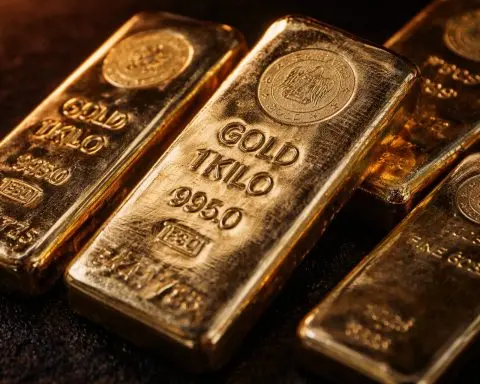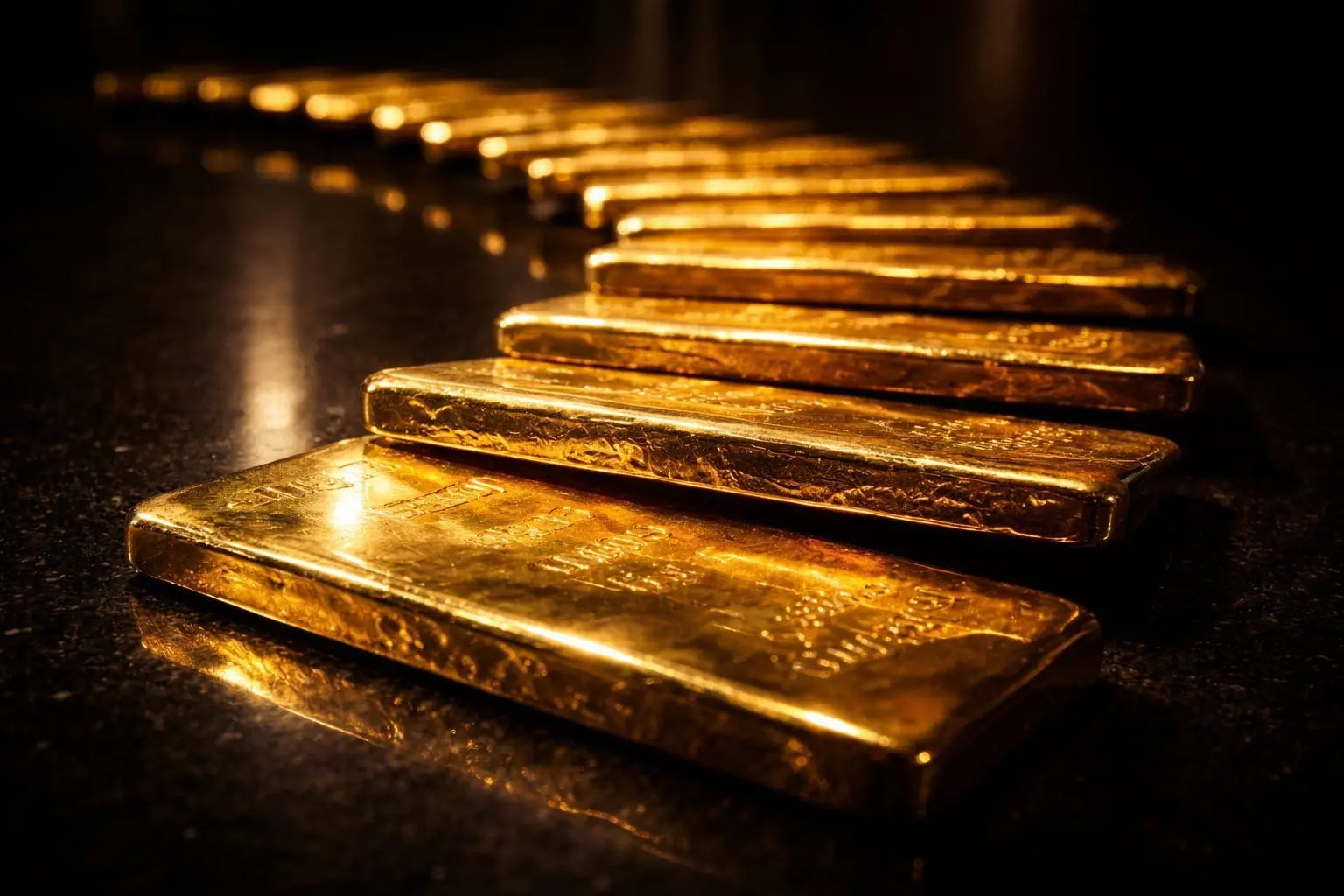
Gold is trading with a familiar late‑year mix of momentum and nerves: strong bids from macro and structural demand, but constant sensitivity to any shift in rates, the US dollar, and geopolitics.
At around 12:10 today, spot gold (XAU/USD) hovered near $4,333 per ounce, up roughly 0.7% on the session and holding firmly above the $4,300 handle as investors weighed the latest US labor-market signals and the next wave of inflation data. Investing.com
That “sticky bid” is not just a day‑trade story. A growing chorus of banks and consultancies is now openly discussing $5,000 gold in 2026, even as they warn that next year’s gains may be less explosive than 2025’s historic surge. Reuters+1
Gold price today: where bullion stood around 12:10
Spot pricing around midday showed gold steady-to-higher, after choppy moves earlier in the week. Real-time market data indicated:
- Spot gold (XAU/USD): ~ $4,332.84 around 12:07–12:10, +0.71% on the day Investing.com
- Intraday range: roughly $4,302–$4,349 Investing.com
- 52‑week range: roughly $2,580–$4,381 (underscoring how steep 2025’s climb has been) Investing.com
By early US hours, Reuters reported spot gold up about 0.8% to $4,335.64, while US gold futures traded higher as well—support coming from renewed expectations of rate cuts and an additional safe-haven layer tied to geopolitical headlines. Reuters
Why gold is moving right now: the three dominant drivers
1) The interest-rate narrative is back in control
Gold’s rally has been tightly linked to expectations that the Federal Reserve is not done easing. A softer unemployment picture—combined with ongoing debate inside the Fed about how much further rates should fall—has kept the market leaning bullish on non‑yielding assets like gold. Reuters+1
Market focus is now shifting to US CPI (Thursday) and PCE (Friday), both of which can quickly reprice rate expectations—and, by extension, gold. Reuters+1
2) The US dollar’s direction remains critical
A weaker dollar tends to make dollar‑priced bullion more attractive globally, and the dollar has repeatedly softened around key data points. Reuters noted the dollar index slipping to a two‑month low during Tuesday’s session after the jobs report, a classic tailwind for gold. Reuters
The World Gold Council’s Weekly Markets Monitor also flagged the DXY under pressure and pointed to a technical setup that could keep the dollar vulnerable—another supportive input for gold. World Gold Council
3) Geopolitics is adding a “safety premium”
This week delivered a clear example of how fast headline risk can move flows.
- Supportive today: Reuters cited rising safe‑haven demand as US–Venezuela tensions escalated, helping underpin gold alongside rate‑cut hopes. Reuters+1
- Less supportive on Monday: gold pared earlier gains as optimism grew around progress in US–Ukraine peace talks, which temporarily reduced the urgency of safe‑haven positioning. Reuters
This push‑pull is likely to persist into year‑end: any sign of de‑escalation can cool gold, while any flare‑up can quickly reignite demand.
What happened since 15.12.2025: the key gold headlines and market reactions
Dec. 15: Peace-talk optimism caps gold’s early pop
Gold started the week with upward momentum but trimmed gains as markets reacted to progress in talks involving US officials and Ukraine’s president—reducing immediate safe‑haven demand. Spot gold was cited around $4,309.82, after being more than 1% higher earlier in the session, with attention turning to upcoming US jobs and retail data. Reuters
Dec. 16: Jobs data, a softer dollar, and the first big “2026 forecast” wave
Tuesday brought a pivotal macro catalyst: a US jobs report that showed hiring improved but unemployment rose to 4.6%, reinforcing the idea that the Fed may keep cutting. Reuters reported spot gold up to about $4,310 as the dollar slid and yields eased. Reuters
Also on Dec. 16, Morgan Stanley published a widely cited outlook calling for slower gains in 2026, but still projecting gold at $4,800/oz by Q4 2026, with support from rate cuts and a weaker dollar—even as it expects purchases by central banks and ETFs to cool from today’s pace. Reuters
Dec. 17: Gold steadies above $4,300 as silver’s surge pulls the complex higher
By Wednesday, gold remained firm while silver stole the spotlight—briefly pushing above $66/oz and dragging attention (and in some cases capital) across the precious-metals space. Reuters quoted analysts noting that silver’s move has been “pulling gold up with it,” as investors rotate between metals. Reuters
At the same time, markets increasingly framed the recent jobs data as consistent with two rate cuts in 2026, keeping gold supported into the CPI/PCE releases. Reuters+1
A key “real economy” development: Zimbabwe backs off a planned gold royalty hike
Not all gold news is macro. A notable mining and supply-side headline also landed on Dec. 17: Zimbabwe reversed plans to double its gold royalty rate to 10%, keeping a 5% rate for prices up to $5,000/oz and only applying 10% above that level. The change followed industry pushback and comes as Zimbabwe reported record production in 2025. Reuters
Gold forecasts and analyst calls: why $5,000 is no longer a fringe target
The most consequential shift in the gold narrative this week is that $5,000 has moved from “bull case” chatter into mainstream bank forecasts.
A Reuters analysis published Dec. 17 laid out the core thesis:
- Gold has posted its biggest annual jump since the 1979 oil crisis, with prices doubling over two years and reaching a record $4,381/oz in October. Reuters+1
- Analysts at J.P. Morgan, Bank of America, and Metals Focus now see a path to $5,000/oz in 2026, supported by a larger investor base and persistent structural demand. Reuters
- Central banks are viewed as the cycle’s anchor for a fifth straight year, as reserve diversification away from dollar‑denominated assets continues to underpin dips. Reuters
What the major forecasts imply in practice
Here’s how the current consensus is taking shape (all figures as reported by Reuters and other primary-source analysis):
- J.P. Morgan: expects average prices above $4,600 in Q2 2026 and above $5,000 in Q4 2026, while also estimating the market may need about 585 tonnes per quarter of combined central bank + investment demand to sustain elevated levels. Reuters
- Bank of America: sees diversification and macro policy dynamics as ongoing drivers behind additional upside. Reuters
- Metals Focus: forecasts $5,000 by end‑2026. Reuters
- Morgan Stanley: forecasts $4,800 by Q4 2026 (bullish, but more conservative than the $5,000 camp). Reuters
- Macquarie: sees 2026 average around $4,225, arguing the world stabilizes somewhat and real rates remain relatively high. Reuters
- MKS PAMP: expects $4,500 average in 2026 and frames gold as becoming a “multi‑year secular” portfolio asset rather than just a cyclical hedge. Reuters
- Allegiance Gold (via Reuters): suggested that if gold finishes 2025 above $4,400, 2026 could target roughly $4,859–$5,590. Reuters
What’s changed: from “crisis hedge” to “portfolio asset”
One of the most important ideas in the Reuters analysis is that gold’s buyer base is expanding beyond traditional channels.
Reuters highlighted new participation ranging from corporate treasurers to stablecoin issuer Tether, noting Tether disclosed purchases of about 26 tonnes of gold in Q3. It also pointed to policy shifts that could broaden Asian participation, including India allowing some pension funds to buy precious‑metals ETFs and China opening the door for some insurance funds to buy gold. Reuters
Separately, Morgan Stanley’s research also emphasized a structural story: gold’s larger role in central bank reserves, strong ETF demand, and regulatory/permitting constraints that can limit how quickly supply responds to higher prices. Morgan Stanley
Technical and positioning view: levels traders are watching into year-end
While fundamentals are doing the heavy lifting, traders are also paying close attention to key chart levels.
- FXStreet noted gold pushing toward seven‑week highs above $4,350 in early European trading, with a potential retest of $4,381 (the October record) if momentum continues. FXStreet+1
- The World Gold Council described gold as confirming a triangle continuation pattern—typically a bullish technical signal in trend markets. World Gold Council+1
From a “map” perspective, the near-term battleground is clear:
- Resistance zone: the $4,350 area first, then the record region near $4,381 FXStreet+1
- Support area: the $4,300 handle has been acting as a psychological floor; Reuters and other market commentary repeatedly reference gold holding above it after the latest data. Reuters+1
The risks: what could derail gold’s run (even if the 2026 story stays bullish)
Even in a structurally bullish cycle, gold is not immune to drawdowns—especially after a year of outsized gains.
Reuters flagged several key vulnerabilities:
- Equity market corrections can force liquidation: if stocks drop sharply, investors sometimes sell even safe havens to raise cash, which can pressure gold temporarily. Reuters
- Slowing ETF/central bank flows: some forecasts explicitly assume these flows cool in 2026, which could cap the pace of gains. Reuters+1
- Real-rate or dollar rebounds: any upside surprise in inflation or hawkish pivot in policy expectations could lift yields and the dollar, both traditionally headwinds for gold. Reuters+1
The takeaway: the “$5,000 gold” narrative can still coexist with periods of sharp volatility.
What to watch next: CPI, PCE, and central banks
Gold’s next directional push may come less from geopolitics and more from scheduled macro catalysts.
US inflation: CPI Thursday, PCE Friday
Markets are bracing for inflation prints that can shift the 2026 rate path.
Investopedia reported expectations that CPI would show inflation running around 3.1% year-over-year in November, with tariffs cited as a factor keeping inflation elevated—complicating the Fed’s tradeoff between inflation control and a softening job market. Investopedia
Central banks: BoE, ECB, BoJ in focus
Global policy divergence matters for gold because it influences currencies and global real yields.
Reuters’ broader markets coverage pointed to expectations around the Bank of England and ECB, while also noting Japan policy expectations are in play. Reuters
IG’s weekly market navigator similarly framed the week ahead as central‑bank heavy, following a Fed cut with dissent and ahead of major decisions in Europe and Japan. IG
Bottom line: gold’s 2025 surge is turning into a 2026 debate
Gold’s midday hold near $4,333 isn’t just another tick in a busy tape—it reflects a market that has largely embraced a new regime:
- Rate cuts (or the expectation of them) remain central. Reuters+1
- Central bank diversification continues to provide an underlying bid. Reuters+1
- The range of credible 2026 forecasts has widened, from $4,225 average at the cautious end to $5,000+ at the bullish end. Reuters+1
If CPI and PCE confirm a path that keeps the Fed easing, gold’s bulls will argue the market is still in “trend continuation” territory. If inflation surprises higher—or if the dollar reverses—gold could see sharp pullbacks even within a longer-term uptrend.
Either way, after Dec. 15–17’s rapid-fire headlines, one point is clear: gold is no longer trading like a quiet commodity—it’s trading like a macro barometer. Reuters+1